Die
Here, 'Die' means “the” in 'Die Wettervorhersage' and introduces the noun being discussed. It is the article placed before a noun in this phrase. In this lesson, it also appears in 'die Veranstaltung' when referring to the event.
Wettervorhersage
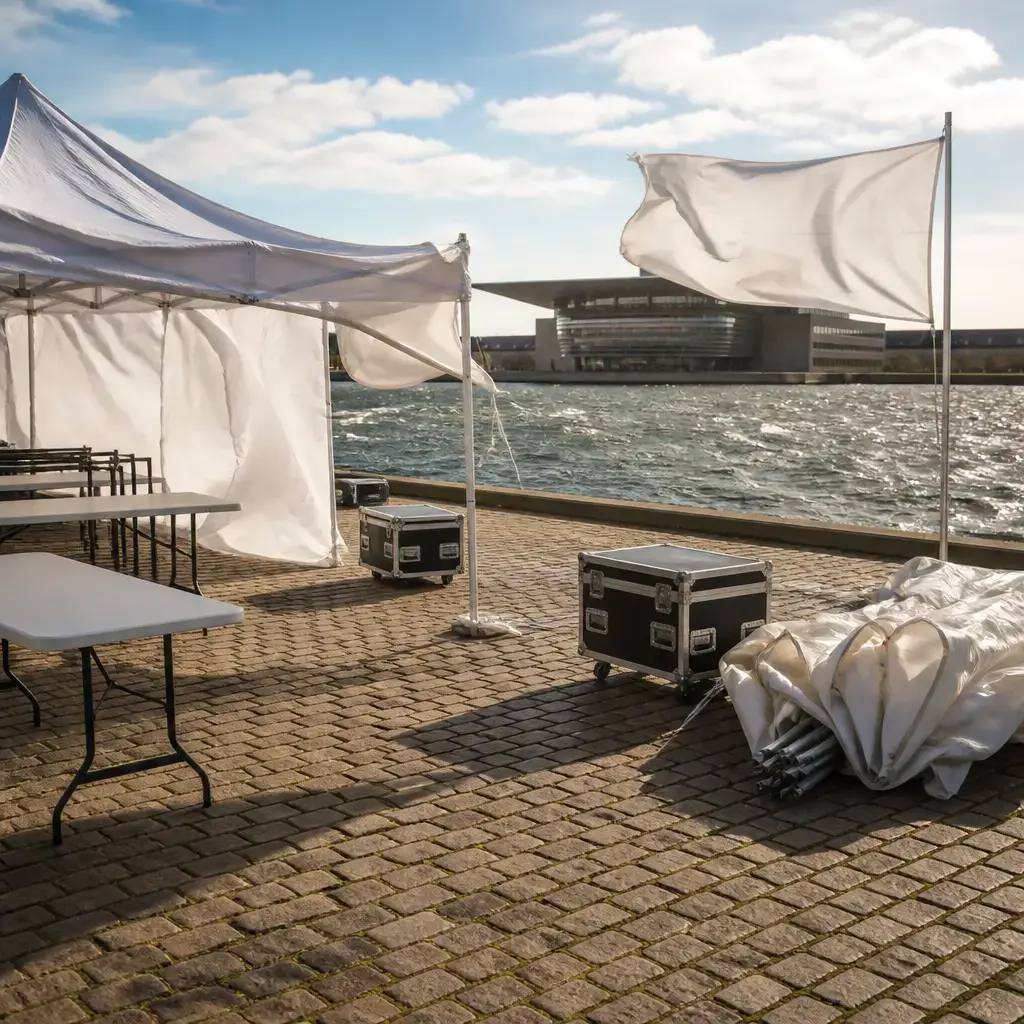
'Wettervorhersage' means “weather forecast,” the prediction that gives information about the coming weather. In 'Die Wettervorhersage sagt', it is the source of the information. This word is useful when discussing expected weather before an activity.
sagt
'sagt' means “says” in 'Die Wettervorhersage sagt'. It reports information from the forecast and is followed here by 'dass' to introduce what the forecast says. The pattern 'sagt, dass' is useful when reporting information.
dass
'dass' means “that” and introduces the content of what the forecast says. In 'sagt, dass während der Veranstaltung draußen weiterhin starker Wind wehen wird', it begins a subordinate clause whose verb phrase comes at the end. Use it after expressions that report or state information.
während
'während' means “during” and places the continuing wind within the time of 'der Veranstaltung'. It introduces the period in which something happens. Use it before an event or activity when describing what happens during that time.
der
In 'während der Veranstaltung', 'der' is the article used before 'Veranstaltung' after 'während'. Together, these words mean “during the event.” This article form belongs to the reusable time expression 'während der Veranstaltung'.
Veranstaltung
'Veranstaltung' means “event” in the context of the planned outdoor activity. In 'während der Veranstaltung', it names the period during which the wind will continue. The word is also used in 'die Veranstaltung' when referring to the event as something that can be moved.
draußen
'draußen' means “outside” and specifies that the wind will continue outdoors. It gives the location of the weather described in the forecast. In this lesson, it contrasts with moving the event 'nach drinnen'.
weiterhin
'weiterhin' means “still” or “continuing” and shows that the strong wind is expected to persist. In 'weiterhin starker Wind wehen wird', it modifies the continuing situation rather than introducing a new event. Use it when an existing condition remains in place.
starker
'starker' means “strong” and describes the intensity of 'Wind'. It appears before the noun in 'starker Wind'. This adjective-before-noun pattern is useful when describing the strength of weather conditions.
Wind
'Wind' means “wind” and is the weather condition expected to continue. In 'starker Wind wehen wird', it is the thing that blows. The word is useful in weather reports and safety discussions about outdoor plans.
wehen
'wehen' means “to blow” when used with 'Wind'. In 'starker Wind wehen wird', it describes the wind’s movement and appears with 'wird' in the forecast. The combination 'Wind wehen' is a useful pattern for describing wind.
wird
'wird' helps express the future in 'starker Wind wehen wird'. Together with the infinitive 'wehen', it says that the wind will blow during the event. In this subordinate clause, the verb phrase appears at the end, as in '... wehen wird'.
Das
Here, 'Das' means “that” or “it” and refers to the wind-related situation just mentioned. In 'Das könnte mit den Zelten und der Tontechnik ein Problem sein', it is the subject of a cautious assessment. This form is useful for referring to a situation without repeating it.
könnte
'könnte' means “could” or “might” and presents the problem as possible rather than certain. In 'Das könnte ... ein Problem sein', it expresses a cautious assessment. Use this pattern when discussing a possible consequence or risk.
mit
'mit' means “with” in 'mit den Zelten und der Tontechnik'. Here it connects the possible problem to the tents and sound equipment involved. The pattern 'ein Problem mit ...' is useful when identifying what may cause or experience a problem.
den
In 'mit den Zelten', 'den' is the article used before 'Zelten' after 'mit'. It forms the phrase meaning “with the tents.” This exact article-and-noun combination is useful when naming equipment affected by a situation.
Zelten
'Zelten' means “tents” in 'mit den Zelten'. It identifies the outdoor structures that may be affected by the wind. The word is used here after 'mit' in the phrase for discussing a problem involving the tents.
und
'und' means “and” and joins 'den Zelten' with 'der Tontechnik'. It shows that both the tents and the sound equipment are part of the possible problem. Use it to connect items in the same list.
Tontechnik
'Tontechnik' means “sound equipment” in the context of the event. In 'mit den Zelten und der Tontechnik', it names the audio equipment that could be affected by the wind. This word is useful when discussing technical equipment for an event.
ein
'ein' means “a” in 'ein Problem sein'. It introduces one possible, unspecified problem. The phrase 'ein Problem sein' is useful when evaluating whether a situation may cause difficulty.
Problem
'Problem' means “problem” in 'ein Problem sein'. It names the difficulty that the wind could create for the tents and sound equipment. Use it with 'mit' to specify what the problem concerns, as in 'ein Problem mit ...'.
sein
'sein' means “be” and completes the possibility expressed by 'könnte' in 'könnte ... ein Problem sein'. It links the situation to the description 'ein Problem'. This infinitive is useful after 'könnte' when describing a possible state or result.
Wir
'Wir' means “we” and refers to the people jointly handling the event. In 'Wir können die Tische sichern', it is the subject of a proposed action. The pattern 'Wir können ...' is useful when offering or describing a group’s ability to act.
können
'können' means “can” and expresses ability or possibility in 'Wir können die Tische sichern'. It is followed by the infinitive 'sichern'. Use 'können' with an infinitive when saying what someone is able or prepared to do.
Tische
'Tische' means “tables” and is the object of 'sichern'. The dialogue refers to tables that can be made stable despite the wind. Use it with an action verb when discussing event furniture.
sichern
'sichern' means “to secure” or make safe and stable. In 'die Tische sichern', it describes protecting the tables from the windy conditions. The pattern object + 'sichern' is useful when discussing safety measures for equipment or furniture.
aber
'aber' means “but” and introduces a contrast between securing the tables and the danger of hanging the banner. It connects two parts of the same decision. Use it to contrast a possible action with a limitation or risk.
es
Here, 'es' fills the subject position in the impersonal assessment 'es könnte gefährlich sein, das Banner aufzuhängen'. It does not refer directly to the banner; the following infinitive phrase explains what may be dangerous. This pattern is useful for giving a general safety assessment.
gefährlich
'gefährlich' means “dangerous” in 'es könnte gefährlich sein'. It describes the planned action of hanging up the banner as unsafe. The pattern 'könnte gefährlich sein' is useful when warning about a possible risk.
Banner
'Banner' means “banner” and is the object of 'aufzuhängen'. It names the event sign that someone is considering putting up. In 'das Banner aufzuhängen', it appears as the object of the action.
aufzuhängen
'aufzuhängen' means “to put up” or “to hang up” the banner. In 'es könnte gefährlich sein, das Banner aufzuhängen', it names the action being judged as dangerous. This infinitive construction is useful when explaining why a planned action may be unsafe.
Sicherheit
'Sicherheit' means “safety” and is the subject of 'Sicherheit ist wichtiger'. It represents the priority that should guide the decision about the event. The phrase 'Sicherheit ist wichtiger' is useful when prioritizing safety over another concern.
ist
'ist' means “is” and links 'Sicherheit' with the comparison 'wichtiger'. It states the importance of safety in the sentence. The pattern 'X ist ...' is useful for describing or evaluating a subject.
wichtiger
'wichtiger' means “more important” and compares safety with keeping the original setup. In 'Sicherheit ist wichtiger, als ...', it shows which priority comes first. Use this comparative form when ranking one concern above another.
als
'als' means “than” and introduces the second part of the comparison after 'wichtiger'. In 'wichtiger, als den ursprünglichen Aufbau beizubehalten', it contrasts safety with keeping the setup. This word is used with a comparative to state what has lower priority.
ursprünglichen
'ursprünglichen' means “original” and describes 'Aufbau', the setup that was planned first. In 'den ursprünglichen Aufbau', it distinguishes the existing arrangement from a changed one. The adjective appears directly before the noun it describes.
Aufbau
'Aufbau' means “setup” or arrangement in the event context. It refers to the original way the event was arranged. In 'den ursprünglichen Aufbau beizubehalten', it is the thing that could be kept unchanged.
beizubehalten
'beizubehalten' means “to keep” or “to maintain” the original setup. In 'den ursprünglichen Aufbau beizubehalten', it names the alternative that is less important than safety. This infinitive appears after the comparison introduced by 'als'.
Sollen
'Sollen' means “should” in the question 'Sollen wir absagen oder alles ins Gemeindezentrum verlegen?'. It asks for a decision about what the group ought to do. The pattern 'Sollen wir ...?' is useful when proposing alternatives for joint consideration.
absagen
'absagen' means “to cancel” the event. In 'Sollen wir absagen', it is the first option being considered in the decision. This infinitive follows 'Sollen wir' when asking whether an event should be called off.
oder
'oder' means “or” and separates the two alternatives: canceling or moving everything to the community hall. It marks a choice between actions. Use it to connect options in a question or decision.
alles
'alles' means “everything” and refers to all the event-related items that may need to be moved. In 'alles ins Gemeindezentrum verlegen', it is the object of 'verlegen'. This word is useful when referring to the complete set of things involved.
ins
'ins' is the contraction of 'in das' and means “into the” in 'ins Gemeindezentrum'. It marks movement toward the community center. Use this contraction before a destination expressed with 'das'.
Gemeindezentrum
'Gemeindezentrum' means “community center” or “community hall” and is the destination for the event items. In 'alles ins Gemeindezentrum verlegen', it identifies the place to which everything may be moved. It is useful when discussing a public venue in the community.
verlegen
'verlegen' means “to move” or “relocate” something to another place. In 'alles ins Gemeindezentrum verlegen', it describes moving the event materials indoors. The pattern 'etwas ins ... verlegen' is useful when changing the location of an event or activity.
Wenn
'Wenn' means “if” here and introduces the condition that the hall must be available. In 'Wenn der Saal verfügbar ist', it begins a subordinate clause with the verb at the end. Use it to state a condition for a decision or recommendation.
Saal
'Saal' means “hall” and is the place whose availability is being checked. In 'Wenn der Saal verfügbar ist', it is the subject of the condition. The word is useful when referring to a large indoor room for an event.
verfügbar
'verfügbar' means “available” in 'der Saal verfügbar ist'. It says that the hall can be used for the event. The pattern 'wenn ... verfügbar ist' is useful when making a plan dependent on a place or resource being free.
besser
'besser' means “better” and expresses the recommendation that moving the event indoors is preferable. In 'ist es besser, die Veranstaltung nach drinnen zu verlegen', it evaluates the proposed action. Use it when recommending one option over another.
nach
'nach' marks direction in 'nach drinnen'. It shows movement toward an indoor location rather than simply being indoors. This exact phrase is useful when describing moving an activity inside.
drinnen
'drinnen' means “indoors” and identifies the destination of the moved event. In 'nach drinnen zu verlegen', it completes the direction phrase for moving the event inside. It is useful when contrasting an indoor location with 'draußen'.
zu
'zu' marks the infinitive phrase 'zu verlegen' after 'besser'. It connects the recommendation with the action being recommended. The pattern 'es ist besser, ... zu verlegen' is useful for giving advice about moving something.
Ich
'Ich' means “I” and identifies the speaker as the person offering to make the call. In 'Ich kann den Organisator anrufen', it is the subject of the offer. The pattern 'Ich kann ...' is useful when volunteering for an action.
kann
'kann' means “can” and expresses the speaker’s ability or willingness to call the organizer. In 'Ich kann den Organisator anrufen', it is followed by the infinitive 'anrufen'. Use it to offer a practical action you are able to take.
Organisator
'Organisator' means “organizer,” the person responsible for the event. In 'den Organisator anrufen', this person is the one the speaker plans to contact. The phrase is useful when identifying whom to call about an event decision.
anrufen
'anrufen' means “to call” by telephone in 'den Organisator anrufen'. It is the action the speaker offers to perform. The pattern 'den Organisator anrufen' is useful when contacting the person responsible for an event.
Möglichkeit
'Möglichkeit' means “possibility” or “option” in 'nach der Möglichkeit drinnen fragen'. It refers to the option of holding the event indoors. The pattern 'nach der Möglichkeit fragen' is useful when asking whether an option exists.
fragen
'fragen' means “to ask” in 'nach der Möglichkeit drinnen fragen'. With 'nach', it introduces the option or information being requested. This pattern is useful when asking about an arrangement or possibility.
Sag
'Sag' means “tell” or “say” and is an instruction to one person in 'Sag den Teilnehmenden auch Bescheid'. It asks the listener to pass on information. The pattern 'Sag ... Bescheid' is useful when instructing someone to let others know.
Teilnehmenden
'Teilnehmenden' refers to the participants in the event. In 'Sag den Teilnehmenden auch Bescheid', they are the people who should receive the information. This word is useful when addressing or informing people taking part in an event.
auch
'auch' means “also” or “too” and adds informing the participants to the other actions being planned. In 'auch Bescheid', it emphasizes that this communication should happen as well. Use it when adding another responsibility or instruction.
Bescheid
In 'Sag den Teilnehmenden auch Bescheid', 'Bescheid' is part of the expression meaning “let the participants know.” Its meaning here comes from the whole expression 'Bescheid sagen', not from the word alone. This expression is useful when passing on an update or decision.
bevor
'bevor' means “before” and places the communication earlier than the participants’ departure. In 'bevor sie sich auf den Weg machen', it introduces the action that must happen first. Use it to set a deadline relative to another action.
sie
'sie' means “they” here and refers to the participants. In 'bevor sie sich auf den Weg machen', it is the subject of the subordinate clause. The context makes clear that the participants should be informed before they leave.
sich auf den Weg machen
The expression 'sich auf den Weg machen' means “to set off” or “to start traveling.” In it, 'sich' shows that the participants set themselves in motion, 'auf den Weg' gives the idea of beginning a journey, and 'machen' completes the expression. Use the whole pattern when someone begins traveling to a destination.
Späte
'Späte' means “late” and describes 'Änderungen' that happen close to the event. In 'Späte Änderungen', it appears before the noun at the beginning of the sentence. This phrase is useful when discussing last-minute adjustments.
Änderungen
'Änderungen' means “changes” and refers to adjustments made to the event plan. In 'Späte Änderungen sind frustrierend', these changes are evaluated as frustrating. The word is useful when describing modifications to an existing arrangement.
sind
'sind' means “are” and links 'Späte Änderungen' with the description 'frustrierend'. It is used with the plural subject 'Änderungen'. The pattern 'Änderungen sind ...' is useful for evaluating changes.
frustrierend
'frustrierend' means “frustrating” and describes the reaction to late changes. In 'Späte Änderungen sind frustrierend', it is a predicate description after 'sind'. Use it when explaining that an unexpected adjustment causes annoyance or difficulty.
gefährliche
'gefährliche' means “dangerous” and describes 'Bedingungen'. In 'gefährliche Bedingungen sind schlimmer', it identifies the safety risk as more serious than the frustration of late changes. This adjective-before-noun pattern is useful when describing unsafe conditions.
Bedingungen
'Bedingungen' means “conditions” and refers here to the dangerous weather situation. In 'gefährliche Bedingungen sind schlimmer', it is the subject of the comparison. The word is useful when discussing circumstances that affect safety or plans.
schlimmer
'schlimmer' means “worse” and presents the dangerous conditions as more serious than the late changes. It is the comparative evaluation in 'gefährliche Bedingungen sind schlimmer'. Use it when saying that one negative situation has more serious consequences than another.
Klare
'Klare' means “clear” and describes 'Kommunikation'. In 'Klare Kommunikation', it refers to messages that are understandable and not ambiguous. This phrase is useful when emphasizing the quality needed for event updates.
Kommunikation
'Kommunikation' means “communication” and is the subject of the statement about what matters when the weather changes the plan. In 'Klare Kommunikation ist wichtig', it refers to sharing the decision and relevant information. The phrase is useful when discussing updates between organizers and participants.
wichtig
'wichtig' means “important” in 'Klare Kommunikation ist wichtig'. It states that clear communication is necessary when the plan changes. Use the pattern 'X ist wichtig' to emphasize the value or necessity of something.
Wetter
'Wetter' means “weather” and is the subject of the subordinate clause 'wenn das Wetter den Plan ändert'. It represents the changing conditions that affect the event decision. This word is useful when explaining why an outdoor plan must be revised.
Plan
'Plan' means “plan” and is the object changed by the weather in 'das Wetter den Plan ändert'. It refers to the intended arrangement for the event. The pattern 'den Plan ändern' is useful when describing a change to an existing plan.
ändert
'ändert' means “changes” or “alters” in 'wenn das Wetter den Plan ändert'. It describes the weather causing the event plan to be different. The pattern 'das Wetter ändert den Plan' is useful when explaining how weather affects arrangements.