Könnte
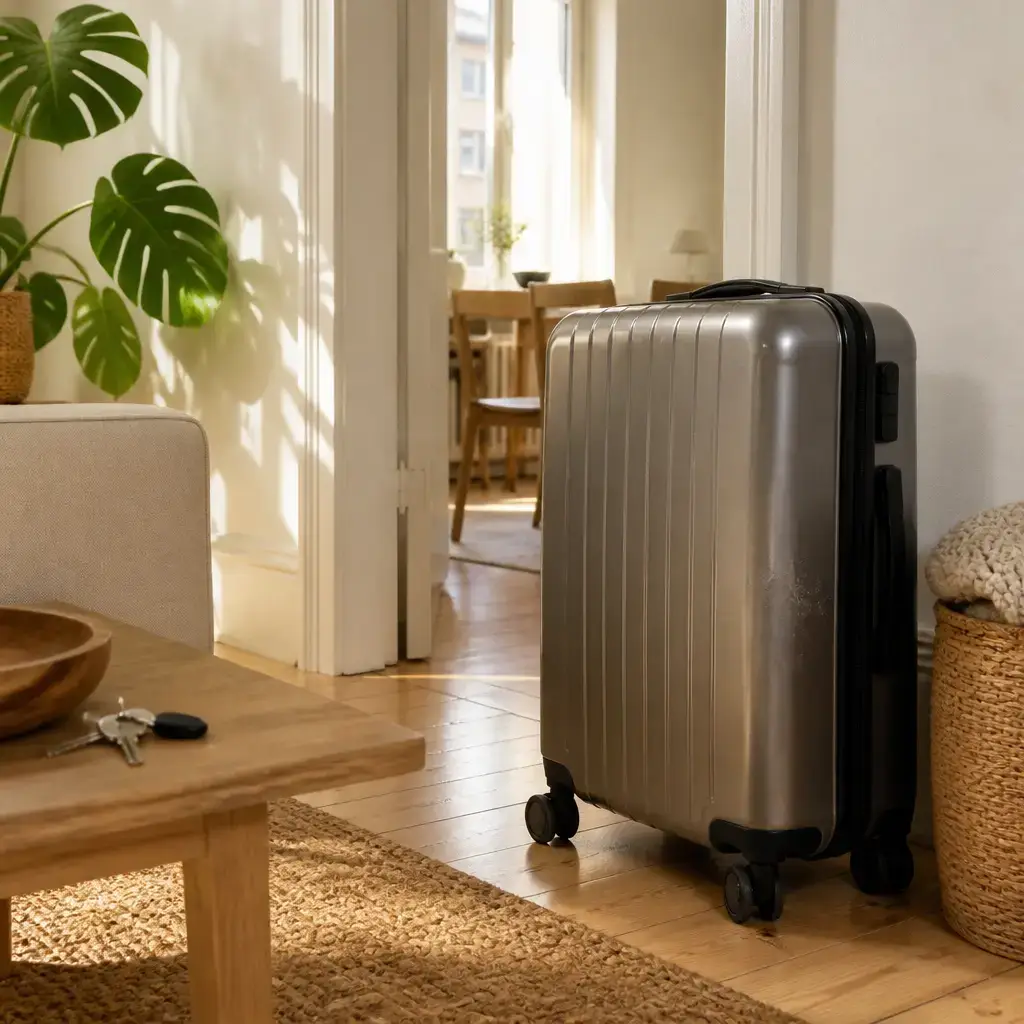
In „Könnte ich deinen mittelgroßen Koffer ... ausleihen?“ makes the request polite: could I borrow it? Use „Könnte ich ...?“ when asking permission in a considerate way.
ich
„ich“ refers to the person speaking, who wants to borrow the suitcase. It commonly appears as the subject in questions and statements, as in „Könnte ich ...?“.
deinen
„deinen“ means your and identifies the suitcase as belonging to the person being addressed. It appears before the noun in „deinen mittelgroßen Koffer“.
mittelgroßen
„mittelgroßen“ describes the Koffer as medium-sized. It is used before a noun to specify its size, as in „mittelgroßen Koffer“.
Koffer
„Koffer“ means suitcase in „deinen mittelgroßen Koffer“. Use it when talking about the case used to carry clothes or other belongings.
für
„für“ means for in „für meine Reise“ and introduces the purpose or occasion. A common pattern is „für“ followed by a person, thing, or activity.
meine
„meine“ means my and identifies „Reise“ as belonging to the speaker. It is used before a noun to show possession, as in „meine Reise“.
Reise
„Reise“ means trip or journey in „meine Reise“. It names the planned occasion for which the suitcase is needed.
nächste
„nächste“ means next in the time expression „nächste Woche“. It is used before a time word to refer to the following period.
Woche
„Woche“ means week in „nächste Woche“. Together with a time word, it helps specify when something will happen.
ausleihen
„ausleihen“ means borrow in the polite request „Könnte ich ... ausleihen?“. A reusable pattern is „etwas ausleihen“, with the borrowed object in the object position.
Das
In „Das kannst du“, „Das“ refers back to the requested act of borrowing the suitcase. It can point to an action or situation already mentioned.
kannst
In „Das kannst du“, „kannst“ says that the other person may or is allowed to do the action. Use it with „du“ to give permission in an informal conversation.
du
„du“ refers to the person being addressed. Here it is the person who may borrow the suitcase and who should handle it carefully.
aber
„aber“ means but and contrasts permission with the following warning: the suitcase may be borrowed, but the handle needs care. Use it to connect two opposing or limiting statements.
sei
„sei“ gives the direct instruction to be careful in „sei vorsichtig mit dem Griff“. It is useful when telling someone how to behave in a specific situation.
vorsichtig
„vorsichtig“ means careful in „sei vorsichtig mit dem Griff“. The pattern „vorsichtig mit“ is used when warning someone to handle a person or thing gently.
mit
„mit“ means with in „mit dem Griff“ and identifies the thing that requires careful handling. It commonly follows expressions such as „vorsichtig mit“.
dem
„dem“ means the in „mit dem Griff“ and belongs to the noun „Griff“. It forms the definite noun phrase naming the specific handle.
Griff
„Griff“ means handle in „mit dem Griff“. Here it names the part of the suitcase that may be damaged by rough handling.
weil
„weil“ means because and introduces the reason for the warning about the handle. In „weil er etwas empfindlich ist“, the explanation follows the main statement.
er
„er“ refers to the handle, not the suitcase, in „weil er etwas empfindlich ist“. It avoids repeating „der Griff“ in the reason clause.
etwas
„etwas“ means a little or somewhat before „empfindlich“ in „etwas empfindlich“. It softens the description instead of presenting the handle as completely fragile.
empfindlich
„empfindlich“ describes the handle as delicate or needing gentle treatment. In „etwas empfindlich“, the phrase explains why careful handling is requested.
ist
„ist“ means is and links the handle with the description „etwas empfindlich“. In „weil er etwas empfindlich ist“, it appears at the end of the reason clause.
werde
„werde“ expresses a future intention in „Ich werde das im Hinterkopf behalten und ihn nicht zu voll packen“. It is used with infinitives to state what the speaker plans to do.
im Hinterkopf behalten
The expression „im Hinterkopf behalten“ means keep something in mind. „im“ places the idea figuratively in the „Hinterkopf“, while „behalten“ contributes the idea of retaining it; together they express remembering a point for later consideration.
und
„und“ means and and joins the two intentions in „im Hinterkopf behalten und ihn nicht zu voll packen“. Use it to connect actions that belong to the same statement.
ihn
„ihn“ means it here and refers to the suitcase. It is the object of „packen“, so the speaker promises not to pack the suitcase too full.
nicht
„nicht“ negates the action in „ihn nicht zu voll packen“. It is placed before the part of the statement that should not happen.
zu
In „zu voll packen“, „zu“ means too and marks an excessive degree. The pattern „zu“ plus an adjective describes something as more than is suitable.
voll
„voll“ means full in „ihn nicht zu voll packen“. With „zu“, it describes the suitcase as filled beyond the desired level.
packen
„packen“ means pack in „ihn nicht zu voll packen“. It is used with the object being filled, here „ihn“, referring to the suitcase.
Außerdem
„Außerdem“ means additionally and adds another piece of information about the suitcase: it has a scratch. It is especially useful at the beginning of a sentence when adding a further point.
an
„an“ means at or on in „an der Seite“ and locates the scratch on the suitcase. The phrase identifies the place where something is attached or visible.
der
„der“ means the in „an der Seite“ and belongs to the noun „Seite“. It identifies the specific side being discussed.
Seite
„Seite“ means side in „an der Seite“. Here it names the part of the suitcase where the scratch is located.
ein
„ein“ introduces one unspecified item in „ein Kratzer“ and „Ein Foto“. It is used before a singular noun when the item is not yet identified as a particular one.
Kratzer
„Kratzer“ means scratch in „ein Kratzer“. It describes visible damage on the side of the suitcase.
Möchtest
„Möchtest“ asks would you like in „Möchtest du, dass ich vor der Benutzung ein Foto mache?“. Use it for a polite question about another person’s preference or request.
dass
„dass“ means that and introduces the action the speaker is asking about in „dass ich vor der Benutzung ein Foto mache“. It connects the question to a full clause.
vor
„vor“ means before in „vor der Benutzung“. It places one action earlier than another event or activity.
Benutzung
„Benutzung“ means use in „vor der Benutzung“. It refers to the act of using the suitcase, and the phrase specifies that the photo should be taken beforehand.
Foto
„Foto“ means photo in „ein Foto mache“. The common expression „ein Foto machen“ means to take a photo.
mache
In „ein Foto mache“, „mache“ contributes the action of taking or making the photo. The expression „ein Foto machen“ is used when creating a photograph.
würde
„würde“ means would in „Ein Foto würde den Zustand ... deutlich machen“. It presents the photo as something that would have a particular useful result.
den
„den“ means the in „den Zustand“. It introduces the specific condition of the suitcase that the photo would show clearly.
Zustand
„Zustand“ means condition or state in „den Zustand ... deutlich machen“. Here it refers to the suitcase’s condition before it is used.
uns
„uns“ means us in „für uns beide“. It identifies the two speakers as the people who benefit from having the condition documented.
beide
„beide“ means both in „für uns beide“. It emphasizes that the statement applies to the two speakers together.
deutlich
„deutlich“ means clear in „den Zustand ... deutlich machen“. With „machen“, it describes the result of making the condition easy for both people to see or understand.
machen
In „den Zustand ... deutlich machen“, „machen“ supplies the action of making something become clear. The reusable pattern is „etwas deutlich machen“, with the thing being clarified in the object position.
bringe
In „Ich bringe ihn ... zurück“, „bringe“ describes the speaker’s action of returning the suitcase. The time expression makes this a future arrangement, and a reusable pattern is „Ich bringe etwas zurück“.
am
„am“ means on the in „am Tag nach meiner Rückkehr“. It is used in this time expression to specify the day when the return will happen.
Tag
„Tag“ means day in „am Tag nach meiner Rückkehr“. It helps specify a particular day in relation to another event.
nach
„nach“ means after in „nach meiner Rückkehr“. It places the return of the suitcase later than the speaker’s return from the trip.
meiner
„meiner“ means my in „meiner Rückkehr“. It identifies the return as belonging to the speaker.
Rückkehr
„Rückkehr“ means return in „meiner Rückkehr“. Here it names the event of the speaker coming back from the trip.
zurück
„zurück“ means back in the return action „bringe ihn ... zurück“. It marks movement back to the owner or the original place.
Bitte
„Bitte“ means please and makes „Bitte wisch die Rollen ab“ a polite request. It is commonly placed at the beginning of a request.
wisch
„wisch“ gives the direct instruction to wipe in „wisch die Rollen ab“. It is used when telling someone informally to clean a surface.
die
„die“ means the in „die Rollen“. It introduces the specific wheels of the suitcase.
Rollen
„Rollen“ means wheels or rollers in „die Rollen ab“. Here it refers to the small wheels on the suitcase that may need cleaning before it is brought inside.
ab
In „wisch die Rollen ab“, „ab“ adds the idea of wiping something off or removing dirt from it. It completes the wiping action with the wheels as its object.
bevor
„bevor“ means before and introduces the action that must happen earlier in „bevor du ihn ins Haus bringst“. It is useful for ordering two actions in time.
ins
„ins“ marks movement into a definite place in „ins Haus“. It shows that the suitcase is being brought from outside to inside the house.
Haus
„Haus“ means house in „ins Haus“. It is the destination into which the suitcase should be brought.
bringst
„bringst“ means bring in „bevor du ihn ins Haus bringst“. It describes the person addressed moving the suitcase to the house, and it appears in the clause introduced by „bevor“.
draußen
„draußen“ means outside in „Das mache ich draußen“. It specifies where the wiping will happen before the suitcase is brought back inside.
zurückbringe
In „bevor ich ihn zurückbringe“, „zurückbringe“ means bring back or return. It expresses the return action in the clause about bringing the suitcase back.
Sag
„Sag“ means tell or let someone know in „Sag mir Bescheid“. It is a direct informal instruction used when asking someone to report information.
mir
„mir“ means me in „Sag mir Bescheid“. It identifies the person who should receive the information.
Bescheid
In „Sag mir Bescheid“, „Bescheid“ is part of the expression meaning let me know. The whole expression is used when asking someone to inform you about a situation or change.
wenn
„wenn“ means if or when in „wenn der Griff dir während der Reise Probleme macht“. It introduces the condition or situation that should trigger the notification.
dir
„dir“ refers to you as the person experiencing the trouble in „dir ... Probleme macht“. It identifies who is affected by the problems.
während
„während“ means during in „während der Reise“. It specifies the period in which the handle might cause trouble.
Probleme
„Probleme“ means problems or trouble in „dir ... Probleme macht“. The reusable pattern „jemandem Probleme machen“ describes something causing difficulties for someone.
macht
In „der Griff dir Probleme macht“, „macht“ means causes or makes: the handle causes problems for you. A reusable pattern is „etwas macht jemandem Probleme“.