Wir
‘Wir’ means ‘we’ and refers to the people making the dinner plan. It is the subject in ‘Wir müssen’ and can be reused before a verb when speaking for yourself and others.
müssen
‘müssen’ means ‘need to’ or ‘must’ here, expressing that choosing a restaurant is necessary. With ‘Wir müssen’, the following action is expressed by the infinitive ‘auswählen’ at the end.
für
‘für’ means ‘for’ here and introduces the group the restaurant is intended for. It is used in the pattern ‘für unsere Gruppe’ when naming the intended people or purpose.
unsere
‘unsere’ means ‘our’ and describes the group belonging to the speakers. In ‘für unsere Gruppe’, it appears directly before the noun it describes.
Gruppe
‘Gruppe’ means ‘group’, here the people who will eat together. It is used in ‘unsere Gruppe’ to identify the group being planned for.
am
‘am’ means ‘on’ in the time expression ‘am Samstag’, meaning on Saturday. It is the common form used before a day of the week in this type of time expression.
Samstag
‘Samstag’ means ‘Saturday’, the planned day for the group dinner. It follows ‘am’ in the time expression ‘am Samstag’.
ein
‘ein’ means ‘a’ or ‘an’ and introduces one unspecified restaurant in ‘ein Restaurant’. It is placed before the noun when mentioning a non-specific choice.
Restaurant
‘Restaurant’ means ‘restaurant’, the place the group needs to choose. It is the object of ‘auswählen’ in ‘ein Restaurant auswählen’.
auswählen
‘auswählen’ means ‘choose’ or ‘select’, here referring to selecting a restaurant. After the modal verb in ‘Wir müssen ... auswählen’, the infinitive comes at the end.
Dann
‘Dann’ means ‘then’ and moves the conversation to the next planning step. It commonly appears at the beginning of a sentence to connect one action with what follows.
sollten
‘sollten’ means ‘should’ here and gives a recommendation about checking the group’s preferences. In ‘wir sollten ... prüfen’, the suggested action is expressed by the infinitive ‘prüfen’.
vor
‘vor’ means ‘before’ here and places one action earlier than the reservation. In ‘vor der Reservierung’, it introduces the event that should come later.
der
‘der’ means ‘the’ in ‘vor der Reservierung’ and belongs to the noun ‘Reservierung’. Together with ‘vor’, it forms the time expression for before the reservation.
Reservierung
‘Reservierung’ means ‘reservation’, referring to booking the restaurant. It is used after ‘vor’ in ‘vor der Reservierung’ to name the action that has not happened yet.
die
‘die’ means ‘the’ in ‘die Essensvorlieben aller’ and introduces the plural noun phrase about food preferences. It directly precedes ‘Essensvorlieben’.
Essensvorlieben
‘Essensvorlieben’ means ‘food preferences’, specifically the kinds of food people prefer. It is used in ‘die Essensvorlieben aller prüfen’ as the information that should be checked.
aller
‘aller’ means ‘of everyone’ or ‘everyone’s’ here, showing that the food preferences belong to all the people in the group. It follows ‘Essensvorlieben’ in ‘die Essensvorlieben aller’.
prüfen
‘prüfen’ means ‘check’ or ‘review’, here referring to checking everyone’s food preferences. It follows ‘sollten’ in ‘wir sollten ... prüfen’ as the action being recommended.
Manche
‘Manche’ means ‘some people’ and introduces one part of the group. It contrasts with ‘andere’ in the sentence ‘Manche wollen Sushi, aber andere bevorzugen ein warmes Essen’.
wollen
‘wollen’ means ‘want’ here and expresses what some people want to eat. It is followed by ‘Sushi’ in ‘Manche wollen Sushi’.
Sushi
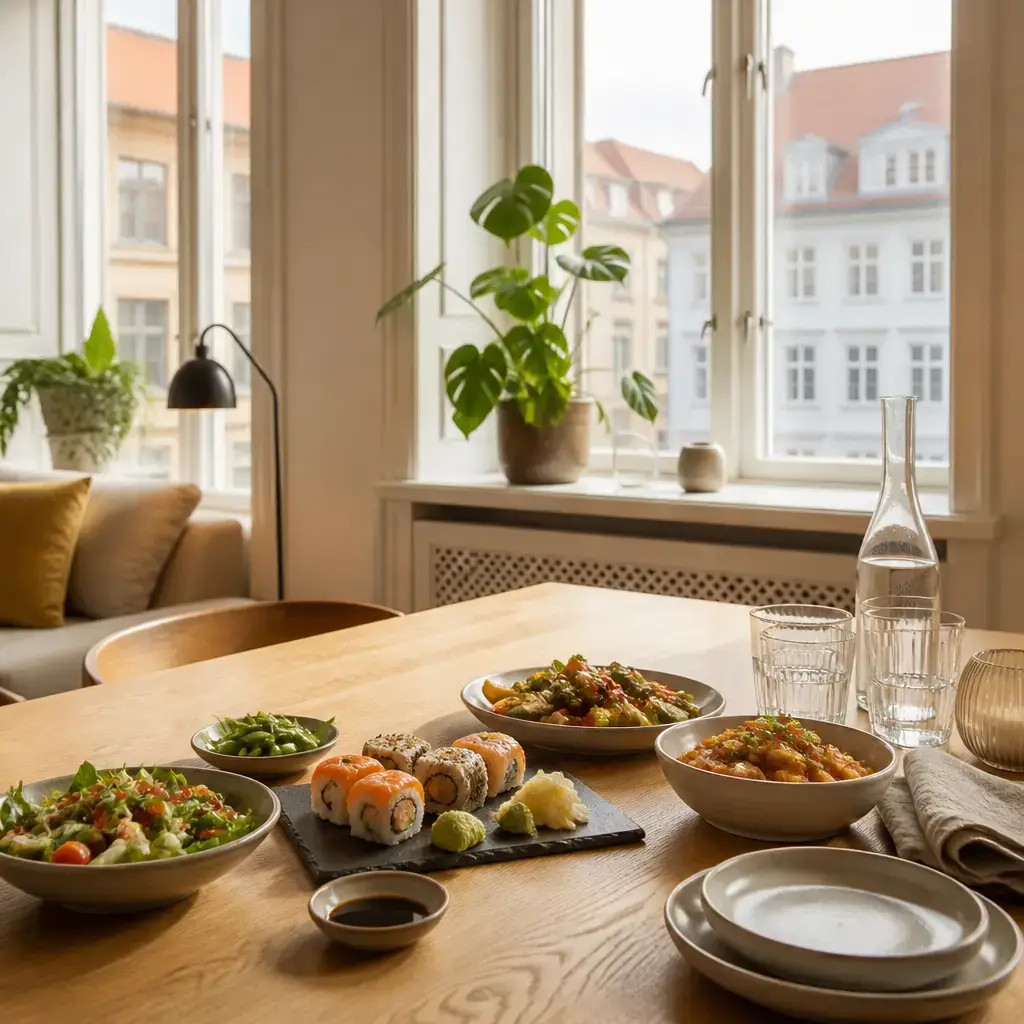
‘Sushi’ refers to sushi, one of the food choices mentioned by the group. It is the thing wanted in ‘wollen Sushi’.
aber
‘aber’ means ‘but’ and marks a contrast between the people who want sushi and those who prefer a warm meal. It connects the two contrasting parts of the sentence.
andere
‘andere’ means ‘others’ here and refers to people different from those introduced by ‘Manche’. It introduces the contrasting group in ‘aber andere bevorzugen ein warmes Essen’.
bevorzugen
‘bevorzugen’ means ‘prefer’, here describing the choice of a warm meal. The preferred item follows it in ‘andere bevorzugen ein warmes Essen’.
warmes
‘warmes’ means ‘warm’ or ‘hot’ here and describes the meal in ‘ein warmes Essen’. It appears directly before the noun it describes.
Essen
‘Essen’ means ‘meal’ here, referring to a warm dish or meal rather than to the general activity of eating. It is the preferred item in ‘ein warmes Essen’.
mit
‘mit’ means ‘with’ and introduces features included in the restaurant description. In ‘mit einer abwechslungsreichen Speisekarte’, it connects the restaurant with its varied menu.
einer
‘einer’ means ‘a’ or ‘an’ in ‘mit einer abwechslungsreichen Speisekarte’. It introduces one unspecified menu and appears directly before the noun phrase it belongs to.
abwechslungsreichen
‘abwechslungsreichen’ means ‘varied’ or ‘offering variety’ and describes the menu in ‘eine abwechslungsreiche Speisekarte’ within the sentence. It appears before ‘Speisekarte’ and characterizes the range of food available.
Speisekarte
‘Speisekarte’ means ‘menu’, the list of food available at the restaurant. It is used in ‘mit einer abwechslungsreichen Speisekarte’ to describe a restaurant with many different choices.
wäre
‘wäre’ means ‘would be’ here and presents the restaurant as a possible, hypothetical choice. In ‘wäre flexibler’, it links the restaurant description with the suggested quality.
flexibler
‘flexibler’ means ‘more flexible’, comparing this restaurant with other possible choices. It follows ‘wäre’ in ‘wäre flexibler’ to describe why the varied menu could suit the group better.
Ich
‘Ich’ means ‘I’ and identifies the speaker as the person who found the restaurant. It is the subject of ‘Ich habe ... gefunden’.
habe
‘habe’ means ‘have’ here and helps form the completed statement ‘Ich habe ... gefunden’. It is used with ‘gefunden’ to say that the speaker has found something.
ungezwungenes
‘ungezwungenes’ means ‘casual’ or ‘relaxed’ and describes the restaurant in ‘ein ungezwungenes Restaurant’. It appears before the noun and presents the atmosphere as informal.
vegetarischen
‘vegetarischen’ means ‘vegetarian’ and describes the options in ‘mit vegetarischen Optionen’. It appears before ‘Optionen’ to specify what kind of choices the restaurant offers.
Optionen
‘Optionen’ means ‘options’, here referring to vegetarian choices on the menu. It is used in ‘mit vegetarischen Optionen’ to describe what the restaurant provides.
und
‘und’ means ‘and’ and joins the vegetarian options with the big tables in the restaurant description. It connects two features in ‘vegetarischen Optionen und großen Tischen’.
großen
‘großen’ means ‘big’ or ‘large’ and describes the tables in ‘großen Tischen’. It appears before the noun it characterizes.
Tischen
‘Tischen’ means ‘tables’, referring to the large tables available at the restaurant. It is used after ‘mit’ in ‘mit ... großen Tischen’.
gefunden
‘gefunden’ means ‘found’ and says that the speaker located the restaurant. It appears with ‘habe’ in ‘Ich habe ... gefunden’ to describe a completed discovery.
Das
‘Das’ means ‘that’ here and points back to the restaurant just described. In ‘Das klingt nach ...’, it is the thing being evaluated.
klingt
‘klingt’ literally means ‘sounds’, but in ‘Das klingt nach ...’ it expresses how the suggestion seems based on the information given. The construction ‘klingt nach’ is used to give an impression or assessment.
nach
‘nach’ contributes to the expression ‘klingt nach’, meaning ‘sounds like’ or ‘seems like’ in this sentence. It introduces the choice being evaluated: ‘nach einer sichereren Wahl’.
sichereren
‘sichereren’ means ‘safer’ here and describes the choice as less risky for a group with different preferences. It appears before ‘Wahl’ in ‘einer sichereren Wahl’.
Wahl
‘Wahl’ means ‘choice’, here the restaurant choice that seems suitable for the group. It is used in the expression ‘eine sicherere Wahl’ to evaluate an option.
eine
‘eine’ means ‘a’ or ‘an’ and introduces the choice in ‘eine gemischte Gruppe’. It appears before the noun phrase describing the group.
gemischte
‘gemischte’ means ‘mixed’, here describing a group whose members have different food preferences. It appears before ‘Gruppe’ in ‘für eine gemischte Gruppe’.
Soll
‘Soll’ means ‘should’ or ‘shall’ here and asks whether the speaker ought to ask the group first. At the beginning of ‘Soll ich ...?’, it forms a question about what action to take.
Buchung
‘Buchung’ means ‘booking’, referring to booking the restaurant. It appears in ‘vor der Buchung’ to mark the action that should happen before booking.
fragen
‘fragen’ means ‘ask’, here referring to asking the group for their preference. It is used in ‘die Gruppe fragen’ and follows the modal verb in ‘Soll ich ... fragen?’.
oder
‘oder’ means ‘or’ and presents the alternative between asking the group and choosing the restaurant immediately. It connects the two options in the question.
es
‘es’ means ‘it’ here and refers back to the restaurant being considered. In ‘es jetzt auswählen’, it stands for the restaurant that could be chosen now.
jetzt
‘jetzt’ means ‘now’ and indicates that the restaurant could be selected immediately. It appears before ‘auswählen’ in ‘es jetzt auswählen’.
Gib
‘Gib’ means ‘give’ here and is an informal singular command to provide the group with two choices. In ‘Gib ihnen zwei Möglichkeiten’, it is followed by the recipient and the things being given.
ihnen
‘ihnen’ means ‘to them’ or ‘them’ here, referring to the people in the group who will receive the options. It is used after ‘Gib’ in ‘Gib ihnen zwei Möglichkeiten’.
zwei
‘zwei’ means ‘two’ and specifies the number of choices to offer. It directly describes ‘Möglichkeiten’ in ‘zwei Möglichkeiten’.
Möglichkeiten
‘Möglichkeiten’ means ‘options’ or ‘possibilities’, referring to the choices presented to the group. It is used in ‘zwei Möglichkeiten’ to name the alternatives.
bitte
‘bitte’ means ‘ask for’ in the expression ‘bitte um eine schnelle Antwort’. Here it is part of a request for a response, not merely a standalone polite word.
um
‘um’ introduces the thing requested in ‘bitte um eine schnelle Antwort’. Together with ‘bitte’, it forms the pattern used when asking for something.
schnelle
‘schnelle’ means ‘quick’ or ‘fast’ and describes the requested response in ‘eine schnelle Antwort’. It appears directly before ‘Antwort’.
Antwort
‘Antwort’ means ‘answer’ or ‘response’, referring to what the group should send back after seeing the options. It is the thing requested in ‘bitte um eine schnelle Antwort’.
schicke
‘schicke’ means ‘send’ here and describes the speaker’s planned action of sending a poll. In ‘Ich schicke eine kurze Umfrage’, it is followed by the thing being sent.
kurze
‘kurze’ means ‘short’ or ‘brief’ and describes the poll in ‘eine kurze Umfrage’. It appears before ‘Umfrage’ to indicate that the poll will be concise.
Umfrage
‘Umfrage’ means ‘poll’ or ‘survey’, here a short poll for collecting the group’s choice. It is the thing being sent in ‘Ich schicke eine kurze Umfrage’.
damit
‘damit’ means ‘so that’ and introduces the purpose of sending the poll. In ‘damit wir heute Abend entscheiden können’, it connects the poll with the intended result.
heute
‘heute’ means ‘today’, and in ‘heute Abend’ the phrase means ‘this evening’ or ‘tonight’. It identifies when the group should make the decision.
Abend
‘Abend’ means ‘evening’ and combines with ‘heute’ in ‘heute Abend’ to mean ‘tonight’ or ‘this evening’. It is used to specify the time of the decision.
entscheiden
‘entscheiden’ means ‘decide’, here referring to deciding which restaurant to choose. It appears with ‘können’ in ‘entscheiden können’.
können
‘können’ means ‘can’ or ‘be able to’, expressing that the group will be able to decide tonight. With ‘damit’, it appears after the infinitive in ‘entscheiden können’.
den
‘den’ means ‘the’ in ‘den Plan’ and introduces the plan that should be advanced. It appears directly before the masculine noun ‘Plan’.
Plan
‘Plan’ means ‘plan’, here the developing plan for the group dinner. It is the object in ‘den Plan voranbringen’.
voranbringen
‘voranbringen’ means ‘move forward’ or ‘advance’, here referring to making progress with the dinner plan. In ‘den Plan voranbringen’, it is used with a plan as the object.
ohne
‘ohne’ means ‘without’ and introduces something that should not be necessary: asking too many people for their opinions. It is followed here by the infinitive construction ‘zu viele Leute nach ihrer Meinung zu fragen’.
zu
‘zu’ marks the infinitive in ‘zu fragen’ after ‘ohne’. The construction ‘ohne ... zu fragen’ means ‘without asking’ and describes an action that is avoided.
viele
‘viele’ means ‘many’, and with ‘zu’ in ‘zu viele Leute’ the phrase means ‘too many people’. It directly describes the people who might otherwise be asked.
Leute
‘Leute’ means ‘people’, referring to members of the group. In ‘zu viele Leute nach ihrer Meinung fragen’, it identifies the people whose opinions might be requested.
ihrer
‘ihrer’ means ‘their’ here and describes the opinions belonging to the people being asked. It appears in ‘nach ihrer Meinung’ before ‘Meinung’.
Meinung
‘Meinung’ means ‘opinion’, referring to what the people in the group think about the restaurant choices. It is used in the expression ‘nach ihrer Meinung fragen’.