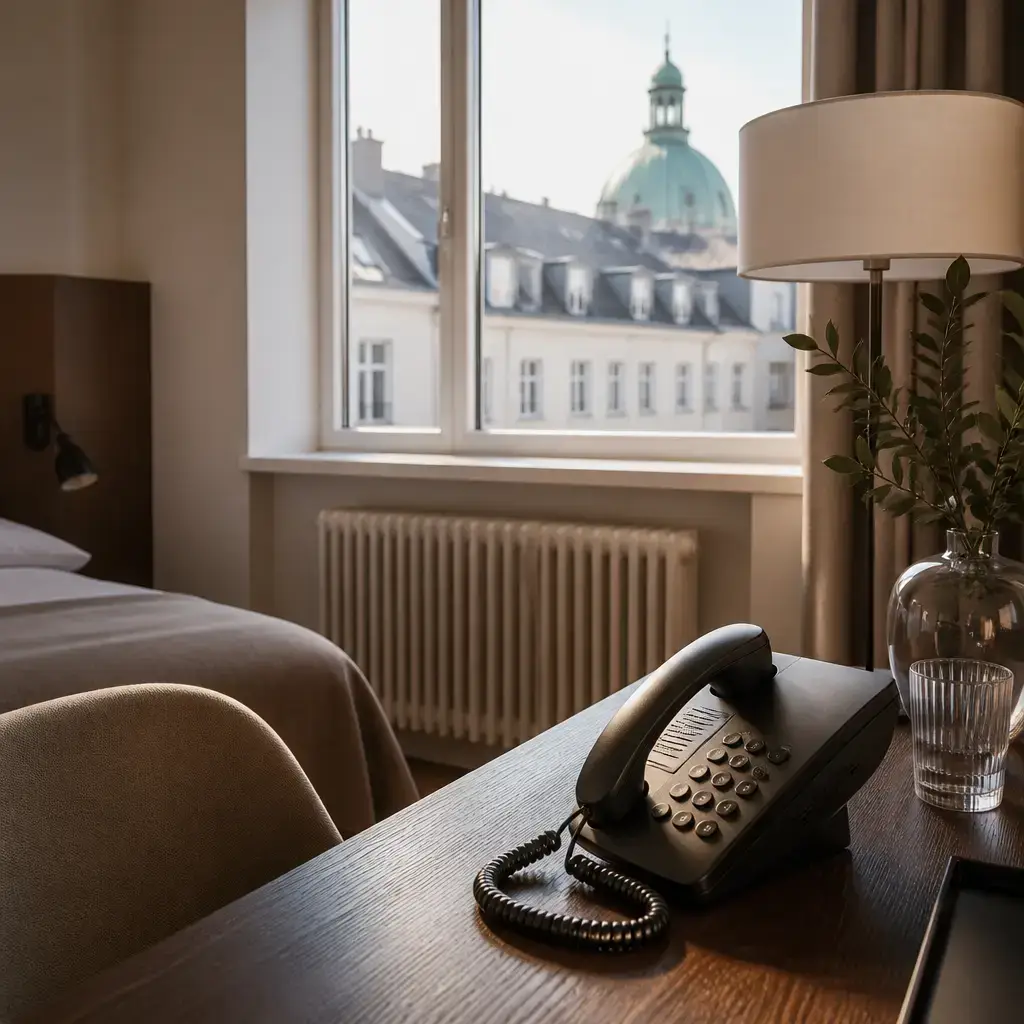
Ich
“Ich” means “I” and is the speaker of the call in “Ich rufe aus meinem Zimmer an”. German uses “Ich” as the subject in a pattern such as Ich + verb when stating what you are doing.
rufe
“rufe” means “call” here. It is the first-person form of the separable verb anrufen, and the separate word “an” completes the phone-call meaning; “jemanden anrufen” is a reusable pattern for calling someone.
aus
“aus” means “from” in “aus meinem Zimmer”, showing the place from which the guest is calling. A useful pattern is aus + place for a starting location.
meinem
“meinem” means “my” in “aus meinem Zimmer”, so the room belongs to the speaker or is assigned to the speaker. It is the form of possessive mein used in this phrase.
Zimmer
“Zimmer” means “room”, specifically the guest’s hotel room in “aus meinem Zimmer”. It is useful with place expressions such as aus meinem Zimmer and zu meinem Zimmer.
an
“an” is the separable part that completes the verb anrufen in this sentence, giving the meaning “call by phone”. It appears at the end of the main clause after the location and subject information.
weil
“weil” means “because” and introduces the reason for the call. In a weil-clause, the conjugated verb comes at the end, as in “weil die Heizung nicht funktioniert”.
die
“die” means “the” before “Heizung” in “die Heizung”. It identifies the specific heating system being reported, and die + noun is a common way to refer to a known thing.
Heizung
“Heizung” means “heating” or “heater” here, the system that is not working in the hotel room. The phrase “die Heizung funktioniert” is useful when reporting whether the heating works.
nicht
“nicht” means “not” and negates “funktioniert” in “nicht funktioniert”. It is useful for stating that a service or device does not work.
funktioniert
“funktioniert” means “works” or “functions” here, referring to the heating. It is the third-person form of funktionieren, and “etwas funktioniert” is a common pattern for saying that something works.
Das
“Das” means “that” in “Das tut mir leid” and refers to the heating problem or situation just described. It points back to something already mentioned before the apology.
tut mir leid
The exact expression “tut mir leid” means “am sorry” and is used here as a polite apology. “tut” supplies the verb, “mir” marks the person affected, and “leid” completes this fixed expression; “Das tut mir leid” is reusable when responding sympathetically to a problem.
Ist
“Ist” means “is” in the question “Ist das Zimmer kalt”. It is the question form of sein used to ask about the room’s current condition.
kalt
“kalt” means “cold” and describes the room’s condition. The pattern “Das Zimmer ist kalt” can be used to report that a room feels cold.
seit
“seit” means “since” and introduces the point from which the room has been cold. It can be followed by a time or by a clause, as in “seit Sie angekommen sind”.
Sie
“Sie” means formal “you” when the guest addresses the hotel employee politely. It is used with the formal register in a service conversation.
angekommen
“angekommen” means “arrived” in “seit Sie angekommen sind”. It is the participle of ankommen and combines with sind here to describe the guest’s arrival.
sind
“sind” means “are” in the question and functions with angekommen to express “have arrived” in “seit Sie angekommen sind”. It is a form of sein and is used in this clause with the formal subject Sie.
Es
“Es” means “it” in “Es ist kalt”, referring to the cold condition being discussed. This pattern is useful when describing the weather or a general physical condition.
heute
“heute” means “today” and places the afternoon and check-in on the current day. It combines directly with a time expression such as “heute Nachmittag”.
Nachmittag
“Nachmittag” means “afternoon” in “heute Nachmittag”. Together, these words specify when the guest checked in.
eingecheckt
“eingecheckt” means “checked in” in the hotel context. It is the participle of einchecken and appears with habe in “seit ich heute Nachmittag eingecheckt habe”.
habe
“habe” means “have” and works with “eingecheckt” to describe the speaker’s check-in. It is the first-person form of haben in the clause “seit ich heute Nachmittag eingecheckt habe”.
kann
“kann” means “can” and expresses the staff member’s ability or possibility to send someone. It is a form of können and is followed here by the infinitive schicken.
sofort
“sofort” means “right away” and emphasizes that the staff member can act without delay. It is useful for promising immediate action, as in “sofort jemanden schicken”.
jemanden
“jemanden” means “someone” and refers to an unspecified person whom the staff member can send. It is used as the person affected by schicken in “jemanden von der Haustechnik schicken”.
von
“von” means “from” or “of” in “von der Haustechnik”, identifying the department the person comes from. The pattern von + department or organization is useful when describing someone’s affiliation.
der
“der” means “the” in “von der Haustechnik”. It is the article used with the department name after von in this phrase.
Haustechnik
“Haustechnik” refers to the building-maintenance staff or department responsible for technical problems. In this dialogue, someone from the Haustechnik is sent to inspect the heating.
schicken
“schicken” means “send” and describes sending a maintenance person to the room. It follows kann as the infinitive in “jemanden von der Haustechnik schicken”.
um
“um” means “in order to” in “um es zu überprüfen” and introduces the purpose of sending someone. The reusable construction um + zu-infinitive expresses what an action is intended to achieve.
zu
“zu” is the infinitive marker in “zu überprüfen” after um. Together with um, it forms the purpose construction um es zu überprüfen.
überprüfen
“überprüfen” means “inspect” or “check” and describes examining the heating problem. The pattern etwas überprüfen is useful when checking a device, room, or situation.
Wenn
“Wenn” means “if” and introduces the condition that the problem cannot be repaired tonight. A wenn-clause states what must happen before the main question or result applies.
Abend
“Abend” means “evening” in “heute Abend”, specifying when the repair might not be completed. The expression heute Abend is a common way to refer to this evening.
repariert
“repariert” means “repaired” or “fixed” in “nicht repariert werden kann”. It is the participle of reparieren and describes the heating as the thing that may be fixed.
werden
“werden” helps form the meaning “be repaired” in “repariert werden kann”. Together with repariert and kann, it presents the repair as something that can be done to the problem.
ein
“ein” means “a” or “one” in “ein anderes Zimmer”. It introduces the possible replacement room, and ein + noun is a common way to mention one non-specific item.
anderes
“anderes” means “another” or “different” and describes a possible replacement room. In “ein anderes Zimmer”, it makes clear that the guest is asking for a room different from the current one.
verfügbar
“verfügbar” means “available” and asks whether another room can be offered. The pattern etwas ist verfügbar is useful when checking whether a service, item, or room can be used.
prüfe
“prüfe” means “check” in “Ich prüfe die Verfügbarkeit”. It is the first-person form of prüfen, used when the staff member says they will check something.
Verfügbarkeit
“Verfügbarkeit” means “availability”, here referring to whether another room can be offered. It commonly appears with prüfen when someone checks what is available.
und
“und” means “and” and links the staff member’s two actions: checking availability and holding a room ready. It is used to join coordinated actions or statements.
halte
“halte” means “hold” or “keep” in “halte ein ähnliches Zimmer bereit”, meaning the staff member will keep a room available for the guest. It is the first-person form of halten and is used with bereit here.
ähnliches
“ähnliches” means “similar” and describes the possible replacement room in “ein ähnliches Zimmer”. It signals that the alternative should be comparable to the current room.
bereit
“bereit” means “ready” or “held ready” in “ein ähnliches Zimmer bereit”. The pattern etwas bereit halten is useful for keeping something available for a possible need.
falls
“falls” means “if” or “in case” and introduces a possible condition: the hotel will hold the room if it has one. It is useful for planning around a possibility that may or may not occur.
wir
“wir” means “we” and refers to the hotel staff or hotel as the acting group. It is the subject of actions such as prüfe, halten, or haben when speaking on behalf of the hotel.
eines
“eines” means “one” and stands for one room in “falls wir eines haben”, avoiding repetition of Zimmer. This kind of pronoun can refer back to an item already mentioned.
haben
“haben” means “have” in “falls wir eines haben”, asking whether the hotel has a suitable room available. It is the infinitive form used with the subject wir in this subordinate clause.
brauche
“brauche” means “need” in “Ich brauche kein Upgrade”. It is the first-person form of brauchen and is followed by the thing that is or is not needed.
kein
“kein” means “no” or “not any” and negates the noun Upgrade in “kein Upgrade”. It is useful for saying that a particular thing is not required.
Upgrade
“Upgrade” means an upgrade to a better or higher-level room or service. Here, the guest says that an upgrade is not needed and asks only for a warm room.
sondern
“sondern” means “but rather” and corrects the negated preference after “kein Upgrade”. The pattern kein A, sondern B contrasts what is not wanted with what is wanted instead.
nur
“nur” means “only” or “just” and limits the request to a warm room for sleeping. It helps make clear that the guest is asking for a basic solution rather than an extra benefit.
warmes
“warmes” means “warm” and describes the room the guest needs. In “ein warmes Zimmer”, it specifies the practical condition the replacement room should meet.
zum
“zum” means “for” or “to the” in “zum Schlafen”. It is the contraction of zu dem and introduces the purpose of the room.
Schlafen
“Schlafen” means “sleeping” in “zum Schlafen”, describing what the room is needed for. The pattern zum + activity is useful for expressing purpose.
versuchen
“versuchen” means “try” in “Wir versuchen zuerst, es zu reparieren”. It introduces an action the staff will attempt before using the alternative room.
zuerst
“zuerst” means “first” and sets the repair as the first step in the plan. It is useful for ordering actions when one solution should be attempted before another.
reparieren
“reparieren” means “repair” or “fix” and is the action the staff will try first. It appears in the construction versuchen, etwas zu reparieren, which means trying to fix something.
halten
“halten” means “keep” or “hold” in “halten ein anderes Zimmer bereit”. It is the infinitive after versuchen? Here it is coordinated with versuchen and describes keeping an alternative room ready.
nötig
“nötig” means “necessary” in the shortened expression “falls nötig”, meaning “if necessary”. This expression is useful when an action depends on whether it is needed.
Bitte
“Bitte” means “please” and makes the request polite in “Bitte rufen Sie mich an”. It is commonly placed at the beginning of a polite request.
mich
“mich” means “me” and identifies the person who should receive the call in “rufen Sie mich an”. It is used as the object of the phone-call verb anrufen.
bevor
“bevor” means “before” and introduces the event that must not happen until the guest has been called. It is useful for setting a time condition, as in “bevor die Haustechnik kommt”.
kommt
“kommt” means “comes” and refers to the maintenance staff coming to the guest’s room. It is the third-person form of kommen in the subordinate clause introduced by bevor.
noch
“noch” means “again” in the expression “noch einmal”. It adds the idea that the call will happen one more time, not just once.
einmal
“einmal” means “once” or “one time” in “noch einmal”, which together means “again”. The expression noch einmal is useful when requesting or promising a repeated action.
Neuigkeiten
“Neuigkeiten” means “news” or “updates” in “wenn ich Neuigkeiten habe”. It refers to new information about the repair or room, and the pattern Neuigkeiten haben is useful when promising to share an update.