Ich
„Ich“ means “I” and identifies the person speaking. The lowercase form „ich“ also appears in „bevor ich die Bestellung bearbeite“; German capitalizes it here only when it begins a sentence. Use it before a verb when stating what you do or can do.
mag
„mag“ expresses liking in „Ich mag diesen Schreibtisch“. It is the form of mögen used with „Ich“. A reusable pattern is „Ich mag ...“ when saying that you like a person or thing.
diesen
„diesen“ means “this” and points to the specific desk in „diesen Schreibtisch“. It is used directly before the masculine noun „Schreibtisch“ here. Use „diesen“ before a specific masculine item when referring to it as the object of an action.
Schreibtisch
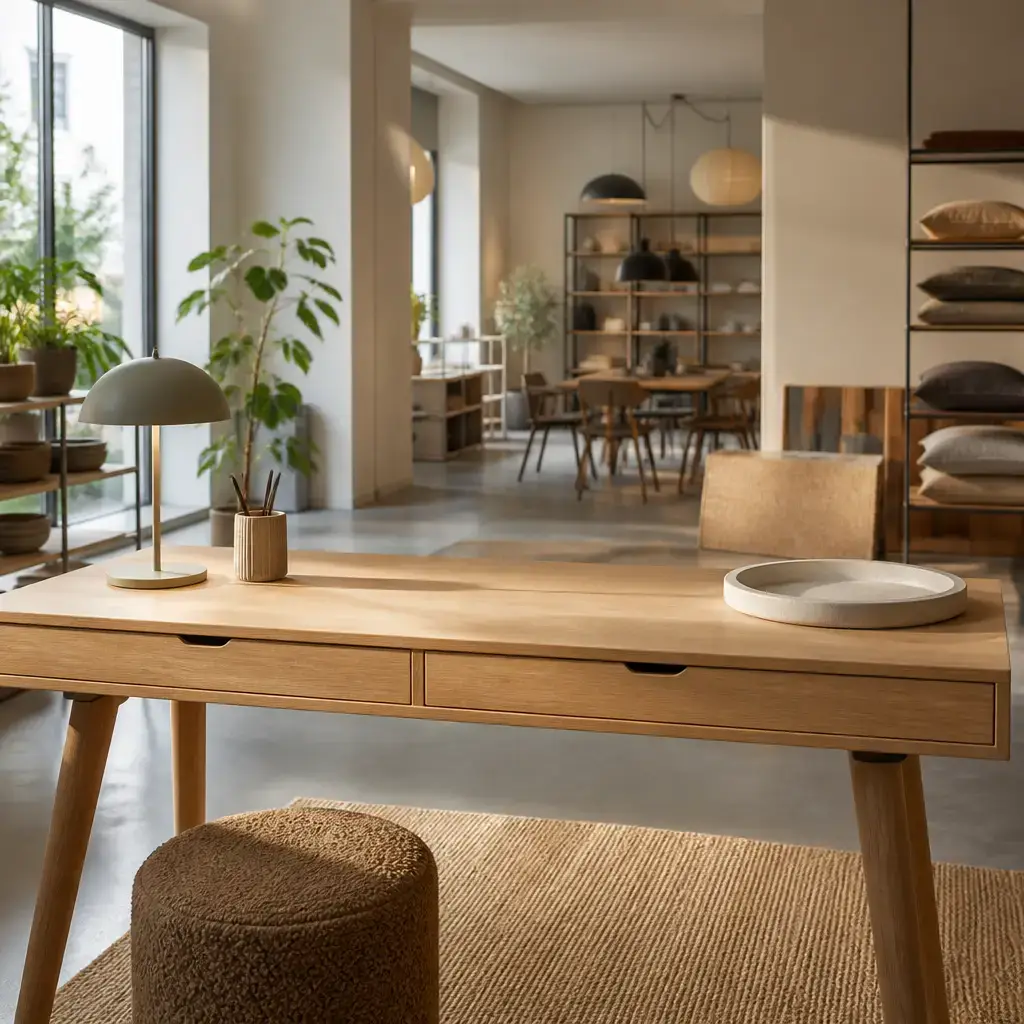
„Schreibtisch“ means “desk” in this shop conversation. It is the item the customer likes, wants delivered, and plans to assemble. A useful object phrase from the dialogue is „diesen Schreibtisch“.
aber
„aber“ means “but” and introduces a contrast between liking the desk and being unable to carry it alone. It connects two contrasting parts of a sentence. Use „aber“ when the second statement limits or contrasts with the first.
kann
„kann“ expresses ability in „Ich kann ihn nicht allein nach Hause tragen“. It is used with the infinitive „tragen“ at the end of the sentence. A reusable pattern is „Ich kann ...“ followed by an action.
ihn
„ihn“ means “it” here and refers back to the masculine noun „Schreibtisch“. It is the thing that the customer cannot carry and later can assemble. Use „ihn“ to refer back to a masculine item when it is the object of an action.
nicht
„nicht“ negates the ability to carry the desk alone in „kann ihn nicht allein ... tragen“. It appears before „allein“ to deny that condition. Use „nicht“ before the part of a sentence that is being negated.
allein
„allein“ means “alone” or “by oneself” in „nicht allein“. It describes carrying the desk without another person’s help. A reusable pattern is „etwas allein machen“ for doing something by oneself.
nach
„nach“ contributes the direction “to” in the fixed expression „nach Hause“. Here it indicates movement toward home. Use „nach Hause“ when saying that someone or something is going home.
Hause
„Hause“ means “home” in the fixed expression „nach Hause“. This form is used in that expression rather than as an ordinary reference to a building. Use „nach Hause“ for movement home, as in „etwas nach Hause tragen“.
tragen
„tragen“ means “carry” in „nach Hause tragen“. It is the action placed after the modal verb „kann“. A reusable pattern is „etwas nach Hause tragen“ when carrying an object home.
Wir
„Wir“ means “we” and refers to the shop staff speaking on behalf of the shop. It is the subject of „Wir können eine Lieferung organisieren“. Use it when describing an action that the speaker and at least one other person can perform together.
können
„können“ expresses ability or possibility with „Wir“ in „Wir können eine Lieferung organisieren“. It is followed by the infinitive „organisieren“. A reusable pattern is „Wir können ...“ followed by an action the business can provide.
eine
„eine“ means “a” or “one” and introduces „Lieferung“ in „eine Lieferung organisieren“. It presents the delivery as an available service to arrange. Use „eine“ before a feminine noun when referring to one nonspecific item or service.
Lieferung
„Lieferung“ means “delivery” in the shop context. It is the service the staff can organize and the customer asks to add. A useful phrase from the dialogue is „eine Lieferung organisieren“.
organisieren
„organisieren“ means “arrange” in „eine Lieferung organisieren“. It is the infinitive after „können“. Use it with an object when arranging a service, for example „eine Lieferung organisieren“.
wenn
„wenn“ introduces the condition “if” in „wenn er noch auf Lager ist“. The verb appears at the end of this subordinate clause. Use „wenn“ to state a condition that must be true before something can happen.
er
„er“ means “it” here and refers to the masculine noun „Schreibtisch“. In „wenn er noch auf Lager ist“, the desk is the thing whose stock status is being checked. Use „er“ to refer back to a masculine noun.
noch
„noch“ means “still” in „noch auf Lager“. It shows that the desk may continue to be available in stock. A reusable pattern is „etwas ist noch auf Lager“ when checking whether stock remains.
auf
„auf“ is part of the fixed stock expression „auf Lager“, meaning “in stock”. Its contribution here is understood together with „Lager“, not on its own. Use „auf Lager“ after an item when saying that it is available in stock.
Lager
„Lager“ means “stock” in the expression „auf Lager“. Together, „auf Lager“ describes an item that is available for sale. A reusable pattern is „Der Artikel ist auf Lager“.
ist
„ist“ means “is” and states the desk’s status in „er noch auf Lager ist“. It also appears in „Wenn er verfügbar ist“ to describe availability. Use „ist“ to link an item with a status or description.
Könnten
„Könnten“ makes „Könnten Sie prüfen ...?“ a polite request meaning “Could you check ...?”. It is used with formal „Sie“ and the infinitive „prüfen“. Use this pattern when politely asking staff or another person to carry out a check.
Sie
„Sie“ means formal “you” in „Könnten Sie prüfen ...?“. Its capital letter marks the formal form of address. Use „Sie“ when speaking politely to a customer, employee, or other person you address formally.
prüfen
„prüfen“ means “check” in „Könnten Sie prüfen, ob ...?“. It is the infinitive after the polite request „Könnten Sie“. A reusable pattern is „prüfen, ob ...“ when checking whether a condition is true.
ob
„ob“ introduces an indirect yes-or-no question in „prüfen, ob im Lager noch einer verfügbar ist“. The clause asks whether one desk is available. Use „ob“ after verbs such as „prüfen“ when reporting or asking about a yes-or-no question.
im
„im“ means “in the” in „im Lager“. It is the shortened form used before the noun „Lager“. Use „im“ in location phrases such as „im Lager“ when referring to something being in the stockroom or stock.
einer
„einer“ means “one” here and refers to one desk in „noch einer verfügbar ist“. It avoids repeating „Schreibtisch“ while retaining the reference to that item. Use a form such as „einer“ when referring back to one masculine item.
verfügbar
„verfügbar“ means “available” in „einer verfügbar ist“. It describes whether a desk can be obtained from the warehouse. A reusable pattern is „etwas ist verfügbar“ when stating that an item or service is available.
prüfe
„prüfe“ means “check” in „Ich prüfe jetzt den Lagerbestand“. It is the form used with „Ich“ for the staff member’s current action. Use „Ich prüfe ...“ when saying that you are checking a record, item, or condition.
jetzt
„jetzt“ means “now” in „Ich prüfe jetzt den Lagerbestand“. It emphasizes that the check will happen immediately. Use it with a current action when clarifying that something is being done at this moment.
den
„den“ means “the” and introduces the specific stock record in „den Lagerbestand“. It points to the particular record that the staff member will check and confirm. Use it before a specific masculine item in this kind of object phrase.
Lagerbestand
„Lagerbestand“ means “stock” or “inventory” in „den Lagerbestand“. It refers to the recorded quantity or availability of goods, rather than to the physical warehouse itself. A useful phrase from the dialogue is „den Lagerbestand prüfen“.
welche
„welche“ asks “what” or “which” in „welche Liefermöglichkeiten bieten Sie an?“. It asks the staff to identify the available delivery options. Use „Welche ...?“ before a plural noun when asking which options or items are available.
Liefermöglichkeiten
„Liefermöglichkeiten“ means “delivery options” in the customer’s question. It refers to the different ways the shop may deliver the desk. A reusable pattern is „Welche Liefermöglichkeiten bieten Sie an?“.
bieten
„bieten“ contributes the meaning “offer” in the split verb phrase „bieten Sie an“. Together with „an“, it asks what services the shop provides. Use the pattern „Welche ... bieten Sie an?“ when asking a business about its available options.
an
„an“ is the separable verb particle that completes „bieten ... an“, meaning “offer”. In the dialogue it appears at the end of „welche Liefermöglichkeiten bieten Sie an?“. Keep it with „bieten“ when reusing this offer-related pattern.
Mit
„Mit“ means “with” or “by means of” in „Mit der Standardlieferung“. It identifies the delivery service used to bring the desk to the customer. Use „mit“ with a service or method when explaining how something is provided.
der
„der“ means “the” in „Mit der Standardlieferung“. It introduces the specific standard delivery service being discussed. Use it before „Standardlieferung“ in this phrase.
Standardlieferung
„Standardlieferung“ means “standard delivery”. In „Mit der Standardlieferung“ it names the shop’s ordinary delivery service. Use it when distinguishing the standard service from other delivery options.
wird
„wird“ helps form the passive statement „wird er zu Ihnen nach Hause geliefert“. The focus is on the desk being delivered, rather than on who delivers it. Use „wird ... geliefert“ when describing how an item is delivered.
zu
„zu“ contributes “to” in „zu Ihnen nach Hause“. It marks the customer as the destination of the delivery. Use „zu jemandem nach Hause“ when saying that something is delivered to a person’s home.
Ihnen
„Ihnen“ means formal “you” as the recipient in „zu Ihnen nach Hause“. It refers politely to the customer whose home will receive the desk. Use this capitalized formal form when addressing someone respectfully as the recipient of an action.
geliefert
„geliefert“ means “delivered” in „wird er zu Ihnen nach Hause geliefert“. It describes the desk’s delivery as part of the passive construction. A reusable pattern is „etwas wird ... geliefert“ when describing delivery of an item.
Gehört
„Gehört“ means “is included” in the question „Gehört die Montage dazu?“. Here it asks whether assembly belongs to the delivery service. Use „Gehört ... dazu?“ when checking whether an extra service is included in an offer.
die
„die“ means “the” before „Montage“ in „die Montage“. The capitalized form „Die“ also appears at the beginning of „Die Montage muss separat angefragt werden“; the capitalization there is due to sentence position. Use it to introduce the specific assembly service being discussed.
Montage
„Montage“ means “assembly” in the context of putting the desk together. The customer asks whether „die Montage“ is included, and the staff explains that it must be requested separately. A useful phrase is „die Montage anfragen“.
dazu
„dazu“ means “included with that” in „Gehört die Montage dazu?“. It refers back to the delivery service already under discussion. Use „gehört ... dazu?“ when asking whether a service is part of a package.
oder
„oder“ means “or” and presents the alternative between included assembly and delivery only to the door. It connects two possible interpretations of the service. Use it to offer or ask about an alternative.
nur
„nur“ means “only” in „nur bis zur Tür geliefert“. It limits the delivery endpoint to the door rather than including assembly or further carrying. Use „nur“ before the limited service, location, or extent you want to specify.
bis
„bis“ means “up to” or “as far as” in „bis zur Tür“. It marks the endpoint of the delivery. Use „bis“ with a place when explaining how far something is carried or delivered.
Tür
„Tür“ means “door” in „bis zur Tür“. It names the endpoint to which the desk is delivered in the customer’s question. A reusable phrase is „bis zur Tür liefern“.
muss
„muss“ expresses an obligation in „Die Montage muss separat angefragt werden“. It says that assembly has to be requested separately. Use „muss ... werden“ when stating that something must be done to an item or service.
separat
„separat“ means “separately” in „separat angefragt werden“. It specifies that assembly is not automatically part of the delivery request. Use it when an additional service or step has to be handled on its own.
angefragt
„angefragt“ means “requested” in „Die Montage muss separat angefragt werden“. It describes the assembly service as something the customer must ask for. Use „etwas muss angefragt werden“ when a service requires a separate request.
werden
„werden“ completes the passive expression „angefragt werden“, meaning “be requested”. It follows the modal verb „muss“ while the participle „angefragt“ describes the required action. Use „muss ... werden“ to express that something has to be done.
das
„das“ introduces the noun-like action in „das Tragen nach oben“. Here it means “the” and turns „Tragen“ into the name of the carrying service, not “that”. Use „das“ before a nominalized action when referring to that activity as a service or task.
oben
„oben“ means “upstairs” or “up above” in „das Tragen nach oben“. Together with „nach“, it describes carrying the desk upward. Use „nach oben“ when describing movement to a higher place.
inbegriffen
„inbegriffen“ means “included” in „das Tragen nach oben ist inbegriffen“. It tells the customer that carrying upstairs is part of the delivery service. Use „ist inbegriffen“ when confirming that a service or cost is included.
Bitte
„Bitte“ means “please” in „Bitte fügen Sie die Lieferung hinzu“. It makes the customer’s request polite. Use „Bitte“ at the beginning of a request when asking someone to perform an action.
fügen
„fügen“ contributes the meaning “add” in the formal request „Bitte fügen Sie die Lieferung hinzu“. The particle „hinzu“ completes the verb and shows that something is added to an existing order or request. Use „fügen Sie ... hinzu“ when politely asking staff to add an item or service.
hinzu
„hinzu“ is the separable particle that completes „fügen ... hinzu“, meaning “add”. In „fügen Sie die Lieferung hinzu“, it indicates addition to the current order or request. Keep it with „fügen“ when reusing this pattern.
selbst
„selbst“ means “myself” or “by myself” in „Ich kann ihn selbst aufbauen“. It emphasizes that the customer will do the assembly personally. Use it after the subject or object to emphasize who carries out an action.
aufbauen
„aufbauen“ means “assemble” or “set up” in „Ich kann ihn selbst aufbauen“. It is the infinitive after „kann“ and refers to putting the desk together. A reusable pattern is „Ich kann ihn selbst aufbauen“ when saying that you can assemble an item yourself.
bestätige
„bestätige“ means “confirm” in „Ich bestätige den Lagerbestand“. It states that the staff member will verify the stock information. Use „Ich bestätige ...“ when confirming a record, detail, or status.
und
„und“ means “and” and links the two staff actions in „Ich bestätige den Lagerbestand und füge die Lieferanfrage hinzu“. It shows that both actions belong to the same process. Use it to connect related actions or statements.
füge
„füge“ means “add” in „füge die Lieferanfrage hinzu“. It is used with „Ich“ and with the particle „hinzu“ to form the verb for adding something. A reusable pattern is „Ich füge ... hinzu“ when adding a service or request to an order.
Lieferanfrage
„Lieferanfrage“ means “delivery request” in „füge die Lieferanfrage hinzu“. It is the request the staff member adds before processing the order. Use it when referring specifically to a request for delivery, rather than to delivery as a general service.
bevor
„bevor“ means “before” and introduces „bevor ich die Bestellung bearbeite“. It places the addition of the delivery request before the order is processed. Use „bevor“ to state that one action must happen earlier than another.
bearbeite
„bearbeite“ means “process” or “handle” in „bevor ich die Bestellung bearbeite“. It describes the staff member handling the order after confirming stock and adding delivery. Use „eine Bestellung bearbeiten“ when processing a customer’s order.