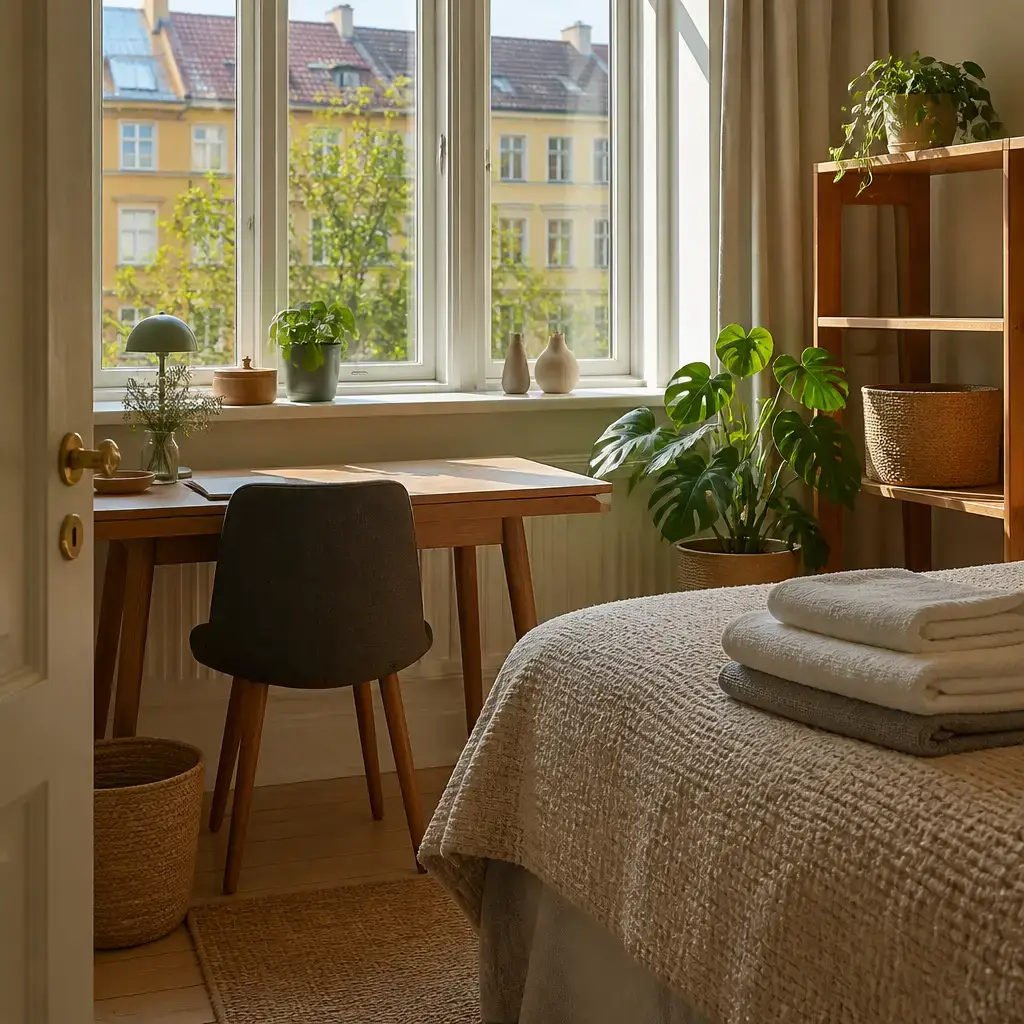
Meine
“Meine” means “my” in “Meine Cousine” and identifies the speaker’s cousin. It is the form used before “Cousine” here; the citation form is “mein”.
Cousine
“Cousine” means “female cousin” in this dialogue. It names the relative who is coming to stay, and it is used as the subject in “Meine Cousine kommt”.
kommt
“Kommt” means “is coming” here. It is the form of “kommen” used with “Meine Cousine” and can describe someone’s arrival or movement toward a place.
für
“Für” means “for” in “für einen kurzen Besuch” and introduces the purpose or duration of the stay. It is commonly followed by a noun phrase such as “für einen Besuch”.
einen
“Einen” is the indefinite article meaning “a” in “für einen kurzen Besuch.” It is the form used in this phrase after “für” before the masculine noun “Besuch”.
kurzen
“Kurzen” means “short” in “einen kurzen Besuch.” Its ending matches the form required in this noun phrase; the citation form is “kurz”.
Besuch
“Besuch” means “visit” in “für einen kurzen Besuch.” It refers to the cousin’s short stay and is useful in phrases describing a visit, such as “ein Besuch” or “für einen Besuch”.
zu
“Zu” means “to” in “zu uns,” referring to movement to the speakers’ place. The pattern “zu” plus a person or place is used for destinations such as someone’s home.
uns
“Uns” means “us” in “zu uns,” referring to the people who will host the cousin. The pattern “zu uns” means “to our place” in this context.
Wir
“Wir” means “we” and is the subject of “Wir sollten das Gästezimmer gemütlicher machen.” It is used when the speaker includes themselves and at least one other person.
sollten
“Sollten” expresses a suggestion or recommendation in “Wir sollten das Gästezimmer gemütlicher machen.” The reusable pattern is “Wir sollten” followed by an action.
das
“Das” means “the” in “das Gästezimmer.” It identifies the particular guest room being prepared and is used directly before the noun here.
Gästezimmer
“Gästezimmer” means “guest room.” It names the spare room that will be made more comfortable, and it is a compound noun formed from “Gäste” and “Zimmer”.
gemütlicher
“Gemütlicher” means “more comfortable” or “cozier” in “das Gästezimmer gemütlicher machen.” It describes a change in the room’s atmosphere; the citation form is “gemütlich.”
machen
“Machen” means “make” in the expression “gemütlicher machen,” meaning to cause the room to become more comfortable. It follows “sollten” in “Wir sollten das Gästezimmer gemütlicher machen.”
bevor
“Bevor” means “before” and introduces the time clause “bevor sie ankommt.” It is used to connect an action with something that has not happened yet.
sie
“Sie” means “she” in “bevor sie ankommt,” referring to the cousin. Here it is the subject of the clause, while in “wo sie sie leicht finden kann” the same spelling has a different role.
ankommt
“Ankommt” means “arrives” in “bevor sie ankommt.” It is the form of the separable verb “ankommen” placed at the end of the clause after “bevor.”
Lass
“Lass” means “let” in “Lass mich den Schreibtisch freimachen,” but “leave” in “Lass die Anweisungen ... dort liegen.” It is the imperative form of “lassen” and can introduce a request or instruction.
mich
“Mich” means “me” in “Lass mich den Schreibtisch freimachen.” It identifies the person who will perform the action, and the pattern “Lass mich” is used to offer to do something.
den
“Den” means “the” in “den Schreibtisch.” It identifies the specific desk that should be cleared and is the form used before this noun in the phrase.
Schreibtisch
“Schreibtisch” means “desk.” It names the surface that should be cleared so the cousin can use it for her laptop, and it is a compound noun containing “Schreib” and “Tisch”.
freimachen
“Freimachen” means “clear” or “free up” in “den Schreibtisch freimachen.” It describes removing things from the desk to create usable space, and it follows “Lass mich” as the action being offered.
damit
“Damit” means “so that” in “damit sie Platz für ihren Laptop hat.” It introduces the purpose of clearing the desk and places the finite verb at the end of the clause.
Platz
“Platz” means “space” in “Platz für ihren Laptop.” It refers to room available for the laptop, and the pattern “Platz für” introduces the thing that needs space.
ihren
“Ihren” means “her” in “ihren Laptop,” showing that the laptop belongs to the cousin. It is the possessive form used directly before “Laptop” in this phrase.
Laptop
“Laptop” means “laptop.” It is the object that needs space on the desk, as shown in “Platz für ihren Laptop,” and the same word is commonly used for a portable computer.
hat
“Hat” means “has” in “damit sie Platz für ihren Laptop hat.” It is the form of “haben” used with “sie” and appears at the end of the purpose clause.
die
“Die” means “the” in “die Anweisungen.” It identifies the specific instructions for the internet access and is placed directly before the plural noun here.
Anweisungen
“Anweisungen” means “instructions.” In “die Anweisungen für den Internetzugang,” it refers to information the guest can use, and the pattern “Anweisungen für” introduces their subject or purpose.
Internetzugang
“Internetzugang” means “internet access.” It specifies what the instructions are about in “Anweisungen für den Internetzugang,” and it is a compound noun.
dort
“Dort” means “there” in “dort liegen,” pointing to a place where the instructions should be left. It is commonly used to identify a location already understood from the situation.
liegen
“Liegen” means “lie” or “be left” in “dort liegen.” Here it describes the instructions remaining in a place where the cousin can find them, rather than the action of putting them there.
wo
“Wo” means “where” in “wo sie sie leicht finden kann.” It introduces the clause that describes the location and is useful for specifying where something can be found.
leicht
“Leicht” means “easily” in “leicht finden,” describing how easily the cousin can find the instructions. It can describe an action’s difficulty or ease.
finden
“Finden” means “find” in “sie sie leicht finden kann.” It is the action the cousin can perform, and it follows the modal verb “kann” in the subordinate clause.
kann
“Kann” means “can” in “sie sie leicht finden kann,” expressing ability. It is the form of “können” used with “sie” and appears at the end of the clause.
Sollen
“Sollen” asks whether the speakers should put the towels in the room or show the cupboard. It introduces a suggestion question, and “Sollen wir ...?” is a reusable way to ask what action is advisable.
zusätzliche
“Zusätzliche” means “extra” or “additional” in “zusätzliche Handtücher.” It indicates that these towels are in addition to what is already provided; the citation form is “zusätzlich.”
Handtücher
“Handtücher” means “towels.” They are the extra items being placed in the room, and the word is the plural form of “Handtuch.”
ins
“Ins” means “into the” in “ins Zimmer.” It is the contraction of “in das” and is used here for movement toward the inside of the room.
Zimmer
“Zimmer” means “room” in “ins Zimmer.” It identifies the destination for the towels, and it also appears as part of “Gästezimmer.”
legen
“Legen” means “put” or “place” in “ins Zimmer legen.” It describes placing the towels somewhere, and the pattern “etwas ins Zimmer legen” keeps the item and destination clear.
oder
“Oder” means “or” and connects the two alternatives “ins Zimmer legen” and “ihr den Schrank zeigen.” It is used to present a choice between actions.
ihr
“Ihr” means “her” in “ihr den Schrank zeigen,” identifying the person who will be shown the cupboard. It is used with “zeigen” for the recipient of the information or demonstration.
Schrank
“Schrank” means “cupboard” or “cabinet.” It is the place where the towels could be stored, and it is the object of “zeigen” in “ihr den Schrank zeigen.”
zeigen
“Zeigen” means “show” in “ihr den Schrank zeigen.” The pattern “jemandem etwas zeigen” expresses showing something to someone, as in showing the cupboard to the guest.
Leg
“Leg” means “put” or “place” in the instruction “Leg sie ins Zimmer.” It is the imperative form of “legen” used to give a direct instruction.
So
“So” means “in this way” or “that way” in “So haben Gäste mehr Privatsphäre.” It refers back to putting the towels in the room and presents that action as the reason for the result.
haben
“Haben” means “have” in “So haben Gäste mehr Privatsphäre.” It describes the guests’ resulting situation, and the pattern “haben mehr” expresses having a greater amount of something.
Gäste
“Gäste” means “guests.” Here it refers to people staying in the room, and it is the plural form of “Gast.”
mehr
“Mehr” means “more” in “mehr Privatsphäre.” It indicates a greater amount of privacy and is placed directly before the noun it quantifies.
Privatsphäre
“Privatsphäre” means “privacy.” In this dialogue, putting towels in the room gives guests more personal space and independence.
Ich
“Ich” means “I” and identifies the speaker in “Ich möchte ein entspannter Gastgeber sein.” It is used as the subject when expressing the speaker’s own intention or preference.
möchte
“Möchte” expresses what the speaker would like or wants in “Ich möchte ein entspannter Gastgeber sein.” The pattern “Ich möchte” is commonly followed by an infinitive or a description of the desired role.
ein
“Ein” means “a” in “ein entspannter Gastgeber.” It introduces the role the speaker wants to have and is placed directly before “Gastgeber”.
entspannter
“Entspannter” means “relaxed” in “ein entspannter Gastgeber.” It describes the host’s manner and is the form used before “Gastgeber” in this phrase; the citation form is “entspannt.”
Gastgeber
“Gastgeber” means “host,” specifically the person welcoming and caring for guests. Here it names the role the speaker wants to have during the visit.
sein
“Sein” means “be” in “ein entspannter Gastgeber sein.” It is the infinitive used after “möchte” to describe the desired identity or role.
nicht
“Nicht” means “not” and negates the alternative “jemand, der jedes Detail erklärt.” It sets up the contrast between being a relaxed host and explaining everything.
jemand
“Jemand” means “someone” in “nicht jemand, der jedes Detail erklärt.” It refers generally to a person and is commonly followed by a relative clause introduced by “der.”
der
“Der” means “who” in “jemand, der jedes Detail erklärt.” It introduces a relative clause describing that person, rather than functioning as the article in this phrase.
jedes
“Jedes” means “every” or “each” in “jedes Detail.” It emphasizes that the host would explain all individual details, and it is placed before the singular noun “Detail.”
Detail
“Detail” means “detail.” In “jedes Detail erklärt,” it refers to each individual piece of information the host might explain.
erklärt
“Erklärt” means “explains” in “der jedes Detail erklärt.” It describes the person’s repeated action of explaining each detail; the citation form is “erklären.”
kurzer
“Kurzer” means “short” in “Ein kurzer Zettel.” It describes the note’s length and is the form used before “Zettel” in this phrase; the citation form is “kurz.”
Zettel
“Zettel” means “note” or “slip of paper.” Here it refers to a short written message containing information about keys, lights, and breakfast.
reicht
“Reicht” means “is enough” or “suffices” in “Ein kurzer Zettel reicht.” It says that no longer explanation is necessary, and it can be used to state that an amount or action is sufficient.
besonders
“Besonders” means “especially” and highlights the information about keys, lights, and breakfast. It is used to give particular importance to selected items in a list.
Schlüssel
“Schlüssel” refers to “keys” in the list “Schlüssel, Licht und Frühstück.” The same form can also refer to a single key, so the surrounding context identifies the intended number here.
Licht
“Licht” means “light” and refers here to information about the lights in the guest room. It is one of the practical topics that can be included on “Ein kurzer Zettel.”
und
“Und” means “and” and links the items “Schlüssel, Licht und Frühstück.” It is used to join the final item in a list.
Frühstück
“Frühstück” means “breakfast.” Here it is one of the practical details that the short note should explain to the guest.
Wenn
“Wenn” means “if” in “Wenn wir das vorher vorbereiten,” introducing a condition. It is used when one action is presented as the condition for a later result.
vorher
“Vorher” means “beforehand” or “ahead of time.” In “das vorher vorbereiten,” it says that the preparation should happen before the later situation begins.
vorbereiten
“Vorbereiten” means “prepare” in “das vorher vorbereiten.” It refers to getting the room and its information ready in advance, and it appears at the end of the “Wenn” clause.
müssen
“Müssen” means “must” or “have to” in “müssen wir später nicht hetzen.” With “nicht,” the sentence says that rushing later will not be necessary.
später
“Später” means “later” in “später nicht hetzen.” It refers to a later time, after the guest has arrived or the visit is underway.
hetzen
“Hetzen” means “rush” in “nicht hetzen.” It describes moving or acting under time pressure, and it follows “müssen” as the action that will not be necessary.
Dadurch
“Dadurch” means “as a result” or “by doing that” in “Dadurch wird sie sich willkommen fühlen.” It connects the earlier preparation with the guest’s resulting feeling.
wird
“Wird” marks the expected result in “wird sie sich willkommen fühlen,” meaning that she will feel welcome. It is the form of “werden” used with the infinitive “fühlen.”
sich
“Sich” refers back to “sie” in “sich willkommen fühlen.” It is part of the reusable reflexive pattern “sich ... fühlen,” describing how someone experiences a feeling.
willkommen
“Willkommen” means “welcome” in “sich willkommen fühlen.” It describes the feeling the guest is expected to have when the room has been prepared thoughtfully.
fühlen
“Fühlen” means “feel” in “sich willkommen fühlen.” Together with “sich” and “willkommen,” it expresses experiencing oneself as welcome, and it follows “wird” here.
ohne
“Ohne” means “without” in the construction “ohne dass der Besuch zu förmlich wirkt.” It introduces a situation that should not occur alongside the welcoming feeling.
dass
“Dass” means “that” and introduces the subordinate clause “dass der Besuch zu förmlich wirkt.” In “ohne dass,” it connects the unwanted result to the main clause.
förmlich
“Förmlich” means “formal” in “zu förmlich.” It describes the visit’s atmosphere and indicates that the preparation should not make the visit feel overly formal.
wirkt
“Wirkt” means “seems” or “appears” in “der Besuch zu förmlich wirkt.” It describes how the visit comes across to people, rather than stating that it objectively is formal.