Unsere
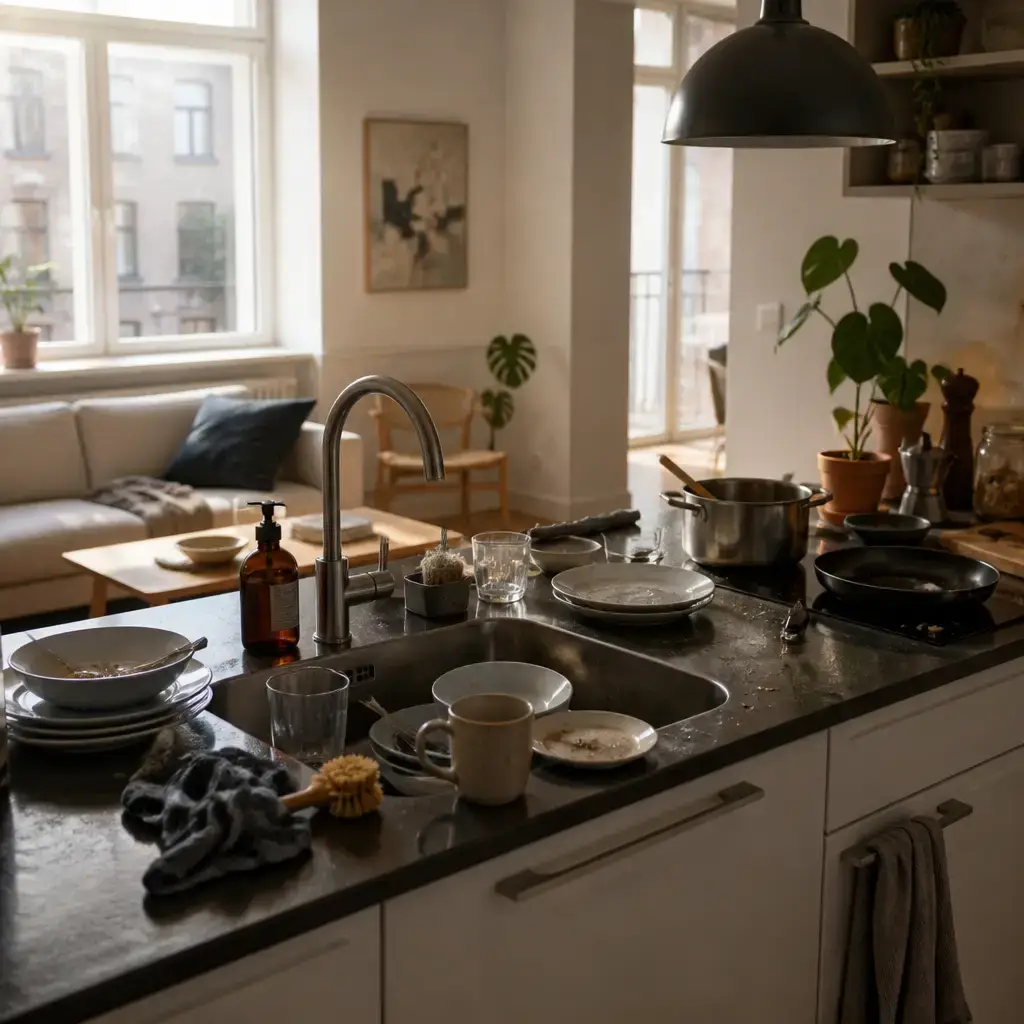
“Unsere” means “our” here and refers to something shared by the speakers in “Unsere Putzroutine”. It comes before the noun it describes; a reusable pattern is “unsere + noun” for something belonging to or involving us.
Putzroutine
“Putzroutine” means cleaning routine: the regular way the housemates organize cleaning. It is a compound noun built from cleaning and routine; it can be used for a repeated cleaning plan at home.
funktioniert
“Funktioniert” means “works” in “Unsere Putzroutine funktioniert nicht”: the routine is not producing the desired result. A common pattern is “etwas funktioniert” for saying that a plan, system, or device works.
nicht
“Nicht” negates “funktioniert”, so “funktioniert nicht” means “does not work”. It is commonly placed directly with the expression or part of the sentence being negated.
und
“Und” connects the two problems in the sentence: the routine does not work, and the kitchen gets messy. It is used to join words, phrases, or complete clauses.
die
“Die” means “the” before “Küche” in “die Küche”. It introduces a specific kitchen known in the shared-home situation.
Küche
“Küche” means kitchen, the room that keeps becoming messy. A common reuse pattern is “in der Küche” when describing something happening in the kitchen.
wird
“Wird” means “becomes” in “die Küche wird ... unordentlich”, describing a change into a messy state. It commonly appears with an adjective when something is getting a new condition.
immer
“Immer” contributes the idea of repeated or continuing occurrence in “immer wieder unordentlich”. It is often used before another time expression or adjective to describe something happening consistently or repeatedly.
wieder
“Wieder” means “again” in “immer wieder”: the kitchen becomes messy repeatedly. A common pattern is “wieder + verb” for something happening another time.
unordentlich
“Unordentlich” means messy or untidy, describing the condition of the kitchen. It can be used after “werden” to describe something becoming messy, as in “etwas wird unordentlich”.
Ich
“Ich” means “I” and is the speaker referring to their own opinion in “Ich glaube nicht”. It is used as the subject when the speaker states what they think or feel.
glaube
“Glaube” means “think” or “believe” in “Ich glaube nicht, dass ...”. It introduces the speaker’s judgment, commonly followed by “dass” and the statement being considered.
dass
“Dass” introduces the statement that the speaker does not believe: “dass einer von uns das absichtlich macht”. In a clause introduced by “dass”, the conjugated verb normally appears at the end.
einer
“Einer” means “one” in “einer von uns”, referring to one person from the group of housemates. The reusable pattern is “einer von + group” for “one of a group”.
von
“Von” means “of” in “einer von uns”, identifying the group from which one person is being selected. The pattern “einer von uns” means “one of us”.
uns
“Uns” means “us” in “einer von uns”, referring to the speakers together. After “von”, it identifies the group that someone belongs to or comes from.
das
The lowercase “das” means “it” in “das absichtlich macht”, referring to the cleaning behavior under discussion. It is the object of “macht” and can refer back to an action or situation.
absichtlich
“Absichtlich” means intentionally or on purpose in “das absichtlich macht”. It describes an action as deliberate; a common pattern is “etwas absichtlich machen” for doing something deliberately.
macht
“Macht” means “does” in “das absichtlich macht”, referring to carrying out the behavior intentionally. The reusable pattern is “etwas machen” for doing or making something, depending on context.
Vielleicht
“Vielleicht” means “maybe” and softens the suggestion “Vielleicht brauchen wir ...”. It is useful when proposing an idea without presenting it as certain.
brauchen
“Brauchen” means “need” in “wir brauchen klarere Regeln”. It commonly takes a noun as its object, as in “etwas brauchen” for needing something.
wir
“Wir” means “we” and refers to both housemates in “wir brauchen”. It is used as the subject when the speakers describe a shared need or action.
klarere
“Klarere” means clearer in “klarere Regeln”, suggesting that the current standard should be more understandable or specific. It comes directly before the plural noun it describes.
Regeln
“Regeln” means rules in “klarere Regeln”, referring to agreed standards for cleaning. A common pattern is “Regeln für + noun” when specifying what the rules concern.
besonders
“Besonders” means especially and highlights the dishes and stove as areas needing clearer rules. It can introduce the part of a situation that deserves particular attention.
für
“Für” means “for” in “für das Geschirr und den Herd”, specifying what the rules apply to. It commonly introduces the person, thing, or area that something is intended for or concerns.
Geschirr
“Geschirr” means dishes or tableware, referring to the items that need to be covered by the cleaning rules. It is used here with “für” to identify an area of responsibility.
den
“Den” means “the” before “Herd” in “für den Herd”. It introduces the specific stove in the shared kitchen.
Herd
“Herd” means stove, another kitchen area covered by the proposed rules. A common reuse pattern is “den Herd putzen” for cleaning the stove.
könnten
“Könnten” means “could” in “Wir könnten die Aufgaben wechseln”, presenting a possible suggestion. It is useful for making a proposal in a cooperative or less forceful way, followed here by an infinitive.
Aufgaben
“Aufgaben” means tasks, referring to the different cleaning jobs. A common pattern is “Aufgaben wechseln” or “Aufgaben verteilen” when organizing responsibilities.
wöchentlich
“Wöchentlich” means weekly, specifying that the tasks should change every week. It can describe a schedule or activity that happens once each week.
wechseln
“Wechseln” means change or rotate in “die Aufgaben wechseln”, where responsibilities move from one housemate to the other. A reusable pattern is “etwas wechseln” when changing an item, role, or arrangement.
damit
“Damit” means “so that” and introduces the intended result: the same person should not always mop. It introduces a subordinate clause, with the conjugated verb at the end.
dieselbe
“Dieselbe” means “the same” in “dieselbe Person”, emphasizing that one unchanged person should not always do the task. It comes before the noun it describes.
Person
“Person” means person, referring to one of the housemates responsible for a task. It is used here in the phrase “dieselbe Person” for the same individual.
wischt
“Wischt” means mops or wipes in “dieselbe Person wischt”, referring to cleaning the floor or a surface. A common pattern is “etwas wischen” for wiping or mopping something.
klingt
“Klingt” means sounds in “Das klingt fair”, expressing an evaluation of an idea rather than an actual noise. A common pattern is “Das klingt + adjective” when reacting to a proposal or description.
fair
“Fair” means fair in “Das klingt fair”, indicating that the proposed rotation seems balanced. It can describe an arrangement, decision, or treatment of people.
obwohl
“Obwohl” means although and introduces a qualification to the statement that the arrangement sounds fair. The clause after “obwohl” is subordinate, so its conjugated verb appears at the end.
lieber
“Lieber” means rather or preferably in “ich lieber den Müll hinausbringe, als das Bad zu putzen”. The reusable pattern “lieber A als B” expresses a preference for A over B.
Müll
“Müll” means trash or garbage in “den Müll hinausbringe”. It commonly appears with “den Müll hinausbringen” when talking about taking household waste out.
hinausbringe
“Hinausbringe” means take out or carry out in “den Müll hinausbringe”. The separable verb “hinausbringen” is used here with “den Müll” as its object.
als
“Als” means “than” in the preference pattern “lieber den Müll hinausbringe, als das Bad zu putzen”. It introduces the less-preferred alternative after “lieber”.
Bad
“Bad” means bathroom in “das Bad zu putzen”. It refers to the room that the speaker prefers not to clean.
zu
“Zu” marks the infinitive in “zu putzen”, which follows the preference comparison. The pattern “lieber A, als zu + verb” compares a preferred action with another action.
putzen
“Putzen” means clean in “das Bad zu putzen”, referring to cleaning the bathroom. A common pattern is “etwas putzen” for cleaning a room or object.
Vorlieben
“Vorlieben” means preferences, referring to the housemates’ preferred cleaning tasks. It is used here as the subject of a general statement about personal choices.
sind
“Sind” means “are” in “Vorlieben sind in Ordnung”. It links the subject “Vorlieben” with the evaluation that follows.
in Ordnung
“In Ordnung” means fine or acceptable in “Vorlieben sind in Ordnung”, so personal preferences are accepted. The whole expression is used to say that something is okay; “in” and “Ordnung” work together here and should not be interpreted separately.
aber
“Aber” means “but” and contrasts accepting preferences with the need to share unpleasant tasks. It connects two statements with opposing or limiting ideas.
unangenehmen
“Unangenehmen” means unpleasant in “die unangenehmen Aufgaben”, describing jobs that are not enjoyable to do. It comes before the noun and identifies which tasks are meant.
müssen
“Müssen” means must or need to in “die Aufgaben müssen ... geteilt werden”. It expresses that sharing the unpleasant jobs is necessary, and it is followed by the required action.
trotzdem
“Trotzdem” means still or nevertheless, showing that the tasks must be shared despite personal preferences. It is useful for marking a result that remains valid after a contrasting point.
geteilt
“Geteilt” means shared or divided in “die Aufgaben müssen trotzdem geteilt werden”. Together with “werden”, it describes the tasks as being distributed among the housemates.
werden
“Werden” completes “geteilt werden”, expressing that the tasks are to be shared. It follows the participle in this construction and appears at the end of the clause.
Wenn
“Wenn” means “if” in “Wenn wir es aufschreiben”, introducing a condition for the result that follows. It begins a subordinate clause, with the conjugated verb at the end.
es
“Es” means “it” in “wir es aufschreiben”, referring to the cleaning arrangement or rules being written down. It functions as the object of “aufschreiben”.
aufschreiben
“Aufschreiben” means write down in “wir es aufschreiben”, meaning to record the arrangement in writing. A common pattern is “etwas aufschreiben” for putting information into written form.
kann
“Kann” means can in “kann sich später kein Frust anstauen”, expressing the possibility of preventing frustration from accumulating. It is followed by the reflexive construction “sich anstauen”.
sich
“Sich” is the reflexive element in “sich anstauen”, showing that the frustration accumulates by itself. It belongs with the verb rather than expressing a separate object here.
später
“Später” means later, referring to a time after the cleaning arrangement has been in use. It can be placed with an action or result that will occur at a later point.
kein
“Kein” means no or not any in “kein Frust”, negating the noun “Frust”. It is used before a noun when saying that none of something is present or occurs.
Frust
“Frust” means frustration or resentment in “kein Frust”, referring to negative feelings that could accumulate over time. A common pattern is “Frust entsteht” or “Frust staut sich an” when frustration builds up.
anstauen
“Anstauen” means build up or accumulate in “sich anstauen”, describing frustration collecting over time. The reusable pattern “sich anstauen” can describe a feeling or problem that gradually accumulates.
Lass
“Lass” means “let’s” in “Lass uns einen einfachen Plan machen”, inviting the other person to act together. The pattern “Lass uns + infinitive” is a common way to make a joint suggestion.
einen
“Einen” means “a” or “an” before “einfachen Plan”, introducing one non-specific plan. It comes before the noun phrase that is the object of “machen”.
einfachen
“Einfachen” means simple in “einen einfachen Plan”, describing a plan that is not complicated. It appears directly before the noun it describes.
Plan
“Plan” means plan or chart in “einen einfachen Plan”, referring to the written cleaning schedule. A common pattern is “einen Plan machen” for creating an arrangement or schedule.
machen
“Machen” means make in “Lass uns einen einfachen Plan machen”, meaning create the cleaning plan. The pattern “einen Plan machen” is used for forming a plan or schedule.
ihn
“Ihn” means “it” in “ihn überprüfen” and refers back to “einen einfachen Plan”. It is used as the object when the previously mentioned masculine noun is checked or reviewed.
überprüfen
“Überprüfen” means review or check in “ihn überprüfen”, referring to examining the plan after trying it. A common pattern is “etwas überprüfen” for checking whether something works or is still suitable.
nachdem
“Nachdem” means “after” and introduces the action that must happen before the plan is reviewed. It introduces a subordinate clause, with the conjugated verb at the end.
eine
“Eine” means “a” or “an” before “Weile”, introducing a non-specific period of time. The phrase “eine Weile” means for a while.
Weile
“Weile” means a while or period of time in “eine Weile”. The common expression “eine Weile” refers to an unspecified but noticeable amount of time.
ausprobiert
“Ausprobiert” means tried out in “ihn ... ausprobiert haben”, referring to using the plan to see how it works. A common pattern is “etwas ausprobieren” for testing an idea or method in practice.
haben
“Haben” completes “ausprobiert haben”, meaning “have tried out” in the subordinate clause. It helps form the completed action before the plan is reviewed.
streng
“Streng” means strict in “zu streng”, describing a plan that may impose too many rigid rules. It can be used with a rule, requirement, or system that allows little flexibility.
anfühlt
“Anfühlt” means feels in “es sich zu streng anfühlt”, describing how the plan seems to the housemates. The pattern “sich anfühlen” is used to describe a person’s impression of a situation or thing.
können
“Können” means can in “können wir es anpassen”, expressing the possibility of changing the plan. It is followed by the infinitive “anpassen”.
anpassen
“Anpassen” means adjust in “es anpassen”, referring to changing the plan so it suits the housemates better. A common pattern is “etwas anpassen” when modifying an arrangement, rule, or setting.
statt
“Statt” means instead of in “statt zu streiten”, contrasting adjustment with arguing. The pattern “statt zu + infinitive” presents one action as an alternative to another.
streiten
“Streiten” means argue in “statt zu streiten”, referring to an unproductive disagreement between the housemates. It is used here after “zu” in the pattern “statt zu streiten”.
Ziel
“Ziel” means goal in “Das Ziel ist ...”, identifying the result the housemates want to achieve. A common pattern is “Das Ziel ist + noun or adjective phrase” when stating an aim.
ist
“Ist” means “is” in “Das Ziel ist ein saubereres Zuhause”. It links the goal with the result being described.
ein
“Ein” means “a” or “an” before “saubereres Zuhause”, introducing the desired kind of home. It forms the noun phrase that describes the goal.
saubereres
“Saubereres” means cleaner in “ein saubereres Zuhause”, describing a home that is cleaner than before. It comes before the noun and expresses a comparison with the current state.
Zuhause
“Zuhause” means home in “ein saubereres Zuhause”, referring to the shared living space. It is used here as the result the housemates want their cleaning routine to achieve.
perfektes
“Perfektes” means perfect in “kein perfektes System”, describing a system with no faults or limitations. It appears before the noun and contrasts the ideal of perfection with the practical goal of a cleaner home.
System
“System” means system in “kein perfektes System”, referring to the cleaning arrangement as an organized method. A common pattern is “ein System für + noun” when describing what a system is designed to organize.