Das
“Das” means “the” in “Das Wetter” and points to the weather being discussed. A common reuse pattern is “das” before a neuter noun, as in “das Wetter”.
Wetter
“Wetter” means “weather” in “Das Wetter ändert sich diese Woche ständig.” Use it for general weather conditions, commonly with “das,” as in “das Wetter”.
ändert
“Ändert” means “changes” in “ändert sich.” Here it describes the weather becoming different repeatedly; the reusable pattern is “etwas ändert sich” for something changing.
sich
“Sich” is part of “ändert sich,” showing that the weather changes itself or changes over time. Reuse it with reflexive expressions such as “etwas ändert sich” when the subject undergoes the change.
diese
“Diese” means “this” in “diese Woche,” referring to the current week. Use it directly before a time expression such as “diese Woche” to identify the week being discussed.
Woche
“Woche” means “week” in “diese Woche.” A common time expression is “diese Woche” for the current week.
ständig
“Ständig” means “constantly” in “ändert sich diese Woche ständig.” It emphasizes that the weather changes again and again; it can be placed after the verb phrase to describe repeated activity.
Zieh
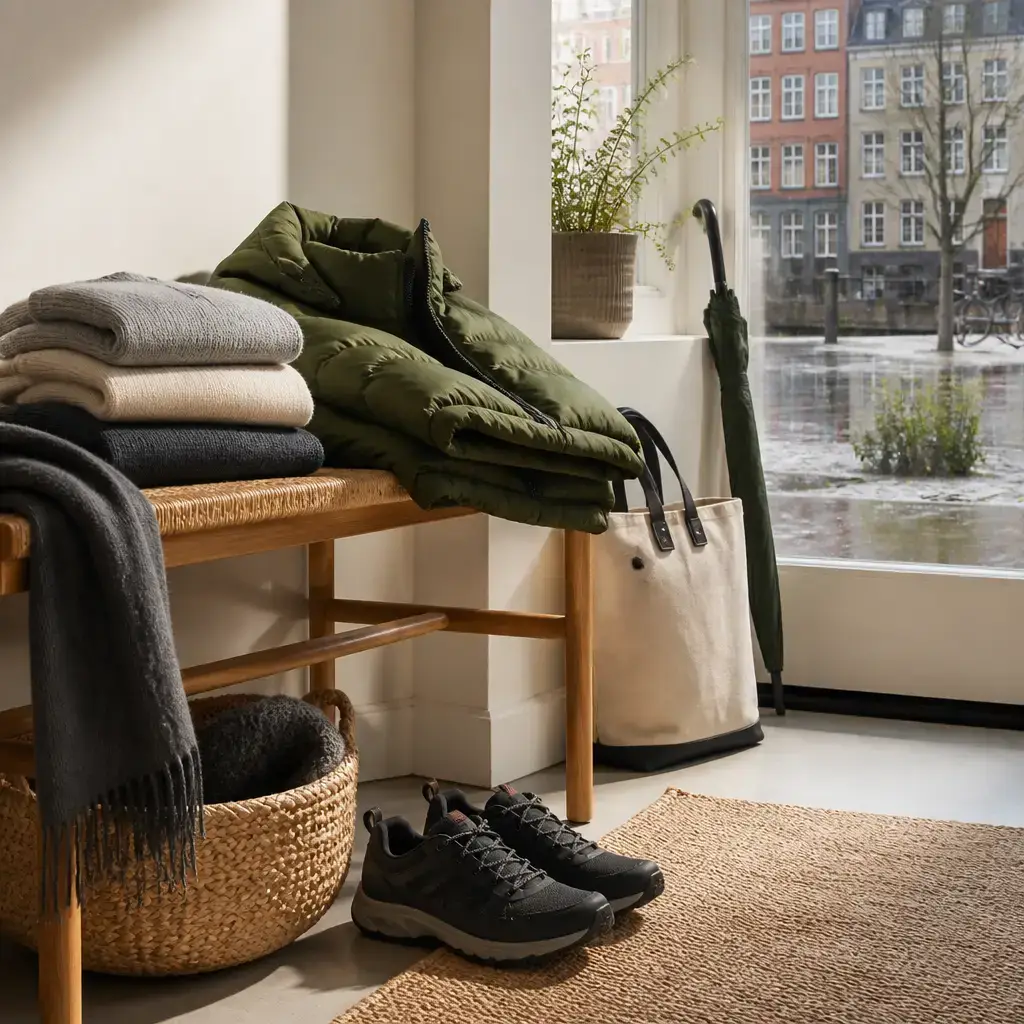
“Zieh” means “put on” in the instruction “Zieh mehrere Schichten an.” It is used when telling one person to put on clothing, with the clothing between “Zieh” and “an” in this expression.
mehrere
“Mehrere” means “several” in “mehrere Schichten,” indicating more than one layer. Use it before a plural noun when recommending or describing a number of items without giving an exact number.
Schichten
“Schichten” means “layers” in “mehrere Schichten.” Here it refers to layers of clothing; a useful pattern is “mehrere Schichten anziehen” for dressing in layers.
an
“An” completes “Zieh mehrere Schichten an” and contributes the meaning of putting clothing on. With clothing, keep this part of the expression together with the verb form “Zieh”.
damit
“Damit” means “so that” in “damit du sie im Laufe des Tages anpassen kannst,” introducing the purpose of wearing layers. It commonly begins a clause that explains the intended result of an action.
du
“Du” means “you” in “damit du sie … anpassen kannst,” referring to the person who can adjust the layers. Use it when speaking directly to one person in an informal context.
sie
“Sie” means “them” in “sie … anpassen,” referring back to “mehrere Schichten.” It is used here to avoid repeating the clothing layers; a similar reuse pattern is a pronoun referring to a previously mentioned plural item.
im
“Im” means “in the” in “im Laufe des Tages.” It is part of the fixed time expression describing the course of the day.
Laufe
“Laufe” contributes the meaning “course” in “im Laufe des Tages,” meaning during the progression of the day. Use the full pattern “im Laufe des Tages” to describe something happening as the day progresses.
des
“Des” means “of the” in “des Tages,” linking the day to the course being described. In the reusable expression “im Laufe des Tages,” it connects “Laufe” with “Tages”.
Tages
“Tages” means “day” in “im Laufe des Tages.” The full expression is used for something that happens during the course of the day.
anpassen
“Anpassen” means “adjust” in “sie im Laufe des Tages anpassen,” referring to changing the layers to suit the weather. A useful pattern is “etwas anpassen” when making something fit changing conditions.
kannst
“Kannst” means “can” in “du … anpassen kannst,” expressing that the person has the ability or option to adjust the layers. Use it with an infinitive, as in “du kannst etwas anpassen”.
Soll
“Soll” means “should” in “Soll ich auch eine warme Jacke mitnehmen?” and turns the sentence into a question about what the speaker ought to do. A common question pattern is “Soll ich …?” when asking for advice or permission.
ich
“Ich” means “I” in “Soll ich auch eine warme Jacke mitnehmen?” and identifies the speaker as the person who may bring the jacket. Use it as the subject when talking about your own action.
auch
“Auch” means “also” or “too” in “auch eine warme Jacke,” adding the jacket to the other clothing being considered. It commonly appears before the additional item or action.
eine
“Eine” means “a” in “eine warme Jacke,” introducing one jacket. Use it before a singular feminine noun such as “Jacke” when referring to one unspecified item.
warme
“Warme” means “warm” in “eine warme Jacke,” describing the jacket as suitable for colder weather. It is placed directly before the clothing noun it describes.
Jacke
“Jacke” means “jacket” in “eine warme Jacke.” A useful pattern is “eine Jacke mitnehmen” when taking a jacket along.
mitnehmen
“Mitnehmen” means “take along” or “bring” in “eine warme Jacke mitnehmen.” Use it for taking an item with you, commonly in the pattern “etwas mitnehmen”.
Nimm
“Nimm” means “take” or “bring” in the instruction “Nimm eine warme Jacke … mit.” It addresses one person and works together with the separated element “mit” when telling someone to take something along.
für
“Für” means “for” in “für den Morgen,” identifying the time for which the jacket is needed. Use it before a person, purpose, or time period, as in “etwas für den Morgen”.
den
“Den” means “the” in “den Morgen,” referring to the morning as the relevant time. Here it appears directly before “Morgen” in the time expression “für den Morgen”.
Morgen
“Morgen” means “morning” in “für den Morgen.” Use it with a time expression such as “für den Morgen” when something is intended for the morning.
mit
“Mit” completes “Nimm eine warme Jacke … mit” and adds the meaning of taking the jacket along. With “Nimm,” it forms the separable expression “Nimm etwas mit”.
Dann
“Dann” means “then” in “Dann kannst du die Jacke später tragen,” linking this advice to the earlier instruction to bring the jacket. Use it at the start of a sentence to introduce the next step or consequence.
die
“Die” means “the” in “die Jacke,” referring to the jacket already mentioned. It is used here before the known clothing item rather than introducing a new one.
später
“Später” means “later” in “die Jacke später tragen,” referring to a time after the morning. It can be placed before the infinitive or other action information to specify when something happens.
tragen
“Tragen” means “carry” in “die Jacke später tragen,” referring to having the jacket with you later. It can also describe wearing clothing, but here the context is carrying the jacket after the weather becomes warmer.
wenn
“Wenn” means “when” or “if” in “wenn es wärmer wird,” introducing the condition or time at which the weather gets warmer. Use it to connect an action with a possible or recurring condition.
es
“Es” means “it” in “es wärmer wird,” referring impersonally to the weather or conditions. A common weather pattern is “es wird …” followed by a description of changing conditions.
wärmer
“Wärmer” means “warmer” in “es wärmer wird,” describing an increase in temperature. Use it with “werden” to express that conditions become warmer.
wird
“Wird” means “becomes” or “gets” in “es wärmer wird.” It combines with “wärmer” to describe a change in the weather; a reusable pattern is “es wird wärmer”.
brauche
“Brauche” means “need” in “Ich brauche auch Schuhe,” expressing that the speaker requires another item. Use it with the needed object, as in “Ich brauche etwas”.
Schuhe
“Schuhe” means “shoes” in “Ich brauche auch Schuhe.” It refers to footwear as a plural item; a common pattern is “Schuhe brauchen” when discussing what footwear is needed.
denen
“Denen” means “which” or “that” in “Schuhe, in denen man gut laufen kann,” referring back to the shoes. It introduces the clause describing what it is like to walk in those shoes; keep it with “in” in the expression “in denen …”.
man
“Man” means “one” or “you in general” in “in denen man gut laufen kann.” It describes what people generally can do, rather than referring to one specific person.
gut
“Gut” means “well” in “gut laufen kann,” describing shoes in which walking is comfortable or easy. Use it before the verb in a pattern such as “gut laufen können”.
laufen
“Laufen” means “walk” in “in denen man gut laufen kann.” It is the action that the shoes make comfortable; a useful pattern is “in etwas gut laufen können” when describing footwear.
kann
“Kann” means “can” in “man gut laufen kann,” expressing ability or suitability for walking. It is followed here by the infinitive “laufen,” as in “man kann gut laufen”.
Wähle
“Wähle” means “choose” in the instruction “Wähle ein leichtes Paar.” It addresses one person and is followed by the item being selected.
ein
“Ein” means “a” in “ein leichtes Paar,” introducing one pair of shoes. Use it before a singular neuter noun such as “Paar” when referring to one unspecified item.
leichtes
“Leichtes” means “light” in “ein leichtes Paar,” describing the pair as not heavy. It is placed before “Paar” to specify the desired property of the shoes.
Paar
“Paar” means “pair” in “ein leichtes Paar,” referring to one pair of shoes. A common pattern is “ein Paar Schuhe” when naming two matching items used together.
gutem
“Gutem” contributes the meaning “good” in “mit gutem Halt,” describing the grip provided by the shoes. The reusable pattern is “mit gutem …” when describing an item with a useful quality.
Halt
“Halt” means “grip” or “hold” in “mit gutem Halt,” referring to how securely the shoes hold the ground. Use it in this pattern when discussing footwear that provides stability, especially on wet paths.
falls
“Falls” means “in case” or “if” in “falls die Wege nass sind,” introducing a possible condition. It is useful when choosing something as a precaution for a situation that may occur.
Wege
“Wege” means “paths” in “die Wege nass sind,” referring to the routes people may walk on. Use it with weather descriptions when talking about outdoor walking conditions.
nass
“Nass” means “wet” in “die Wege nass sind,” describing the condition of the paths. It can be used after “sein” to state that something is wet, as in “die Wege sind nass”.
sind
“Sind” means “are” in “die Wege nass sind,” linking the paths with their condition. Here it appears with a plural subject and the adjective “nass”.
sollte
“Sollte” means “should” in “Das sollte passen,” expressing an expectation that the choice will be suitable. A common pattern is “Das sollte passen” when offering a cautious assessment.
passen
“Passen” means “work” or “be suitable” in “Das sollte passen,” referring to the clothing and shoes being suitable for the changing weather. Use it with “Das” to say that a proposed solution should be acceptable.
am
“Am” means “in the” in “am Nachmittag,” identifying the afternoon as the time when the weather may become warmer. It is part of the common time expression “am Nachmittag”.
Nachmittag
“Nachmittag” means “afternoon” in “am Nachmittag.” Use it with “am” to specify that something happens during the afternoon.
ohne
“Ohne” means “without” in “ohne dass sie sich schwer anfühlt,” introducing an absence of an unwanted result. Here it connects carrying the jacket with not experiencing it as heavy.
schwer
“Schwer” means “heavy” in “sich schwer anfühlt,” describing how the jacket feels while it is being carried. Use it after “sich anfühlen” to describe the perceived weight or character of something.
anfühlt
“Anfühlt” means “feels” in “sie sich schwer anfühlt,” describing the jacket’s perceived heaviness. The reusable pattern is “etwas fühlt sich … an” or, in this clause, “dass es sich … anfühlt” to describe how something feels.