Entschuldigen
“Entschuldigen Sie” means “Excuse me” here and politely gets the staff member’s attention. A reusable pattern is “Entschuldigen Sie, …” when beginning a polite request or explanation.
Sie
“Sie” means “you” in the formal address used with the staff member. It appears in polite questions and requests such as “Was haben Sie bestellt?” and “Bitte warten Sie.”
ich
“ich” and sentence-initial “Ich” mean “I”; the speaker uses them to refer to themselves. A reusable pattern is “Ich habe …” when describing something the speaker did or received.
glaube
“glaube” means “think” or “believe” in “ich glaube”; here it makes the statement about the order less absolute. A reusable pattern is “Ich glaube, …” when giving a belief or impression.
habe
“habe” means “have” in “ich habe die falsche Bestellung bekommen” and “Ich habe Suppe bestellt.” Here it helps express completed actions involving receiving and ordering. These patterns can be reused with an object before the final action word.
die
“die” means “the” in “die falsche Bestellung” and introduces the specific order the speaker received. It is used here before the describing word and noun as one noun phrase.
falsche
“falsche” means “wrong” in “die falsche Bestellung”; it describes the order as not the one the speaker wanted. The pattern “die falsche + noun” can identify an incorrect item.
Bestellung
“Bestellung” means “order,” specifically the food order in this conversation. A reusable pattern is “eine Bestellung” when referring to an order placed with a service or restaurant.
bekommen
“bekommen” means “receive” or “get” in “ich habe die falsche Bestellung bekommen.” It describes what the speaker received, and it can be reused with an object such as “etwas bekommen.”
schaue
“schaue” contributes the meaning “look” or “check” in “Ich schaue nach.” Together with “nach,” it says that the staff member will check the situation. “Ich schaue nach” is a useful expression when checking something for someone.
nach
“nach” completes “Ich schaue nach,” which means “I’ll check that” in this dialogue. With “schaue,” it forms the expression used when looking into a situation or checking something.
Was
“Was” means “what” in the question “Was haben Sie bestellt?” and asks for the food the customer ordered. A reusable question pattern is “Was haben Sie …?” when asking a formal person about a completed action.
haben
“haben” means “have” in “Was haben Sie bestellt?” and helps ask about the customer’s completed order. In this question pattern, it comes before the formal subject “Sie” and the action word at the end.
bestellt
“bestellt” means “ordered” in “Was haben Sie bestellt?” It identifies the completed action being asked about, and it can be reused in “Ich habe … bestellt” with the ordered item in the middle.
Suppe
“Suppe” means “soup,” the food that the customer says they ordered. A reusable pattern is “Suppe bestellen” when ordering soup.
aber
“aber” means “but” and introduces the contrast between ordering soup and finding a salad on the tray. It is useful for connecting an expected situation with a different fact.
auf
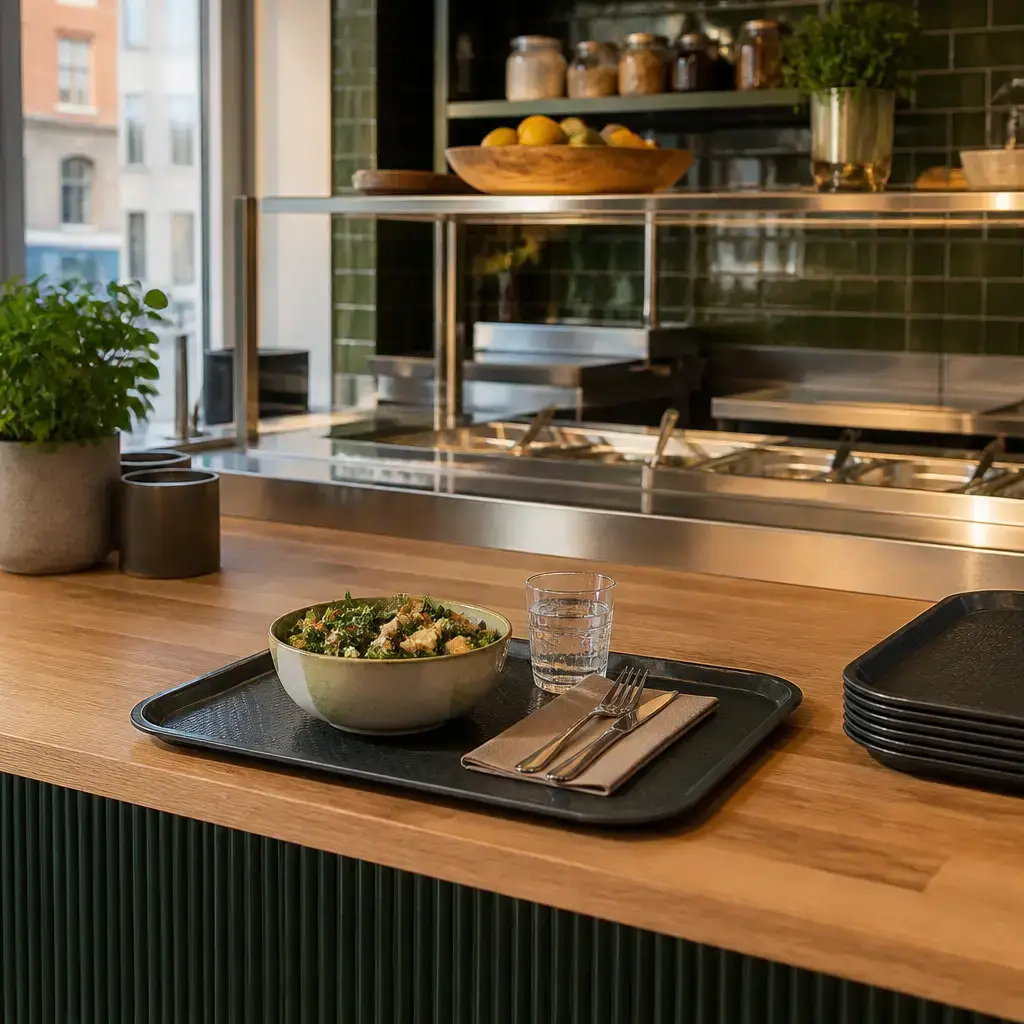
“auf” means “on” in “auf diesem Tablett” and shows where the salad is located. A reusable location pattern is “auf + a surface or object” when something is on it.
diesem
“diesem” means “this” in “auf diesem Tablett” and points to the particular tray being discussed. It is used directly before “Tablett” in this location phrase.
Tablett
“Tablett” means “tray,” the object on which the salad is located. It can be reused when describing food or drinks placed on a tray.
ist
“ist” means “is” in “auf diesem Tablett ist ein Salat.” Here it states that a salad is present on the tray. A reusable pattern is “Auf … ist …” when locating something.
ein
“ein” means “a” in “ein Salat” and introduces one salad as the item on the tray. It appears directly before the noun being identified.
Salat
“Salat” means “salad,” the food that is unexpectedly on the tray. It can be reused when naming salad as a food item in an order or meal.
kann
“kann” means “can” in “Ich kann das sofort austauschen” and expresses the staff member’s ability or willingness to replace the item. A reusable pattern is “Ich kann …” followed by an action.
das
“das” means “it” or “that” in “Ich kann das sofort austauschen” and refers to the incorrect food item or order being discussed. It functions as the object of “austauschen” in this sentence.
sofort
“sofort” means “right away” and says that the replacement can happen without delay. It can be placed with an action to emphasize immediate performance.
austauschen
“austauschen” means “replace” or “swap out” in “Ich kann das sofort austauschen.” It names the action the staff member offers to perform, with “das” as the item being replaced. A reusable pattern is “etwas austauschen.”
Soll
“Soll” means “should” in “Soll ich hier warten?” and asks whether waiting is the right action for the speaker. The pattern “Soll ich …?” is useful when asking what one should do.
hier
“hier” means “here” and identifies the speaker’s current location in “Soll ich hier warten?” It can be combined with an action to say that something happens at the current place.
warten
“warten” means “wait” in “Soll ich hier warten?” and “Bitte warten Sie am Tresen.” It can be reused with a place, as in waiting at a counter, or with a person or thing when waiting for them.
während
“während” means “while” and introduces the action happening at the same time as the waiting in “während Sie das holen.” It is useful for connecting two simultaneous actions in one sentence.
holen
“holen” means “get” or “fetch” in “während Sie das holen,” referring here to getting the replacement food. It can be reused with an object in the pattern “etwas holen.”
Bitte
“Bitte” means “please” in “Bitte warten Sie am Tresen” and makes the instruction polite. It is commonly placed at the beginning of a polite request.
am
“am” means “at the” in “am Tresen” and identifies the place where the customer should wait. It is a common location form used before a place or object.
Tresen
“Tresen” means “counter,” specifically the service counter where the customer should wait. It can be reused when directing someone to wait or go to a counter.
gehe
“gehe” means “go” or “move” in “Ich gehe jetzt dorthin”; here the speaker says they will move to the indicated place. A reusable pattern is “Ich gehe …” when stating where the speaker is going.
jetzt
“jetzt” means “now” and places the movement at the present moment in “Ich gehe jetzt dorthin.” It can be added to an action to emphasize that it is happening immediately.
dorthin
“dorthin” means “over there” with a direction toward the indicated place. In “Ich gehe jetzt dorthin,” it identifies the destination of the speaker’s movement. A reusable pattern is “dorthin gehen” when the destination has already been indicated.
Ihre
“Ihre” means “your” in the formal address in “Ihre Suppe.” It shows that the soup belongs to or was ordered by the person being addressed. A reusable pattern is “Ihre + noun” in polite conversation.
sollte
“sollte” expresses an expectation in “Ihre Suppe sollte bald fertig sein”: the soup is expected to be ready soon. The pattern “sollte … sein” can describe an expected state.
bald
“bald” means “soon” and says that the soup is expected to be ready after a short time. It can be used with an expected future event or state.
fertig
“fertig” means “ready” in “fertig sein,” describing the expected state of the soup. It can be reused with “sein” to say that something is ready.
sein
“sein” means “be” in “fertig sein” and connects the soup with the expected state of being ready. It appears at the end after “sollte,” and the pattern “fertig sein” means “be ready.”