Dieser
Dieser means “this” here and identifies the specific market in Dieser Markt. It is used before a singular noun to point out something nearby or already relevant.
Markt
Markt means “market” here, the crowded place where the speakers are walking. It names a place where people buy and sell things, including in a conversation about being auf einem Markt.
ist
ist means “is” and links the market with its description in ist voller. A common reuse pattern is a subject followed by ist and a description.
voller
voller means “more crowded” or “fuller” here, describing the market in comparison with what the speaker expected. The comparison is completed by als.
als
als means “than” in the comparison voller, als ich erwartet habe. It introduces the second part of a comparison after a comparative description.
ich
ich means “I” and refers to the speaker who had an expectation. In ich erwartet habe, it is the person whose expectation is being described.
erwartet
erwartet means “expected” in the speaker’s statement about the market. It is the participle related to erwarten and appears with habe in the subordinate clause.
habe
habe means “have” as the auxiliary in ich erwartet habe. Together with erwartet, it describes what the speaker had expected; this pattern is used for a completed personal experience or expectation.
Bewahre
Bewahre means “keep” or “store” in this instruction to one person. Together with the separate particle auf, it tells the listener to keep the valuables somewhere; the reusable pattern places the item and its location between Bewahre and auf.
deine
deine means “your” and identifies the valuables as belonging to the person being addressed. It is used before Wertsachen to show whose items they are.
Wertsachen
Wertsachen means “valuables,” the important personal items that should be kept safe. Here it is the thing being stored in the front pocket, and it can refer to valuable belongings in a safety instruction.
in
in means “in” and shows the location of the valuables in der vorderen Tasche. It is commonly used to connect an item with the place where it is located.
der
der means “the” and introduces the specific pocket in der vorderen Tasche. It belongs with the following description and noun to identify one particular place.
vorderen
vorderen means “front” or “at the front” and distinguishes this pocket from other pockets. It appears before Tasche to specify which pocket should be used.
Tasche
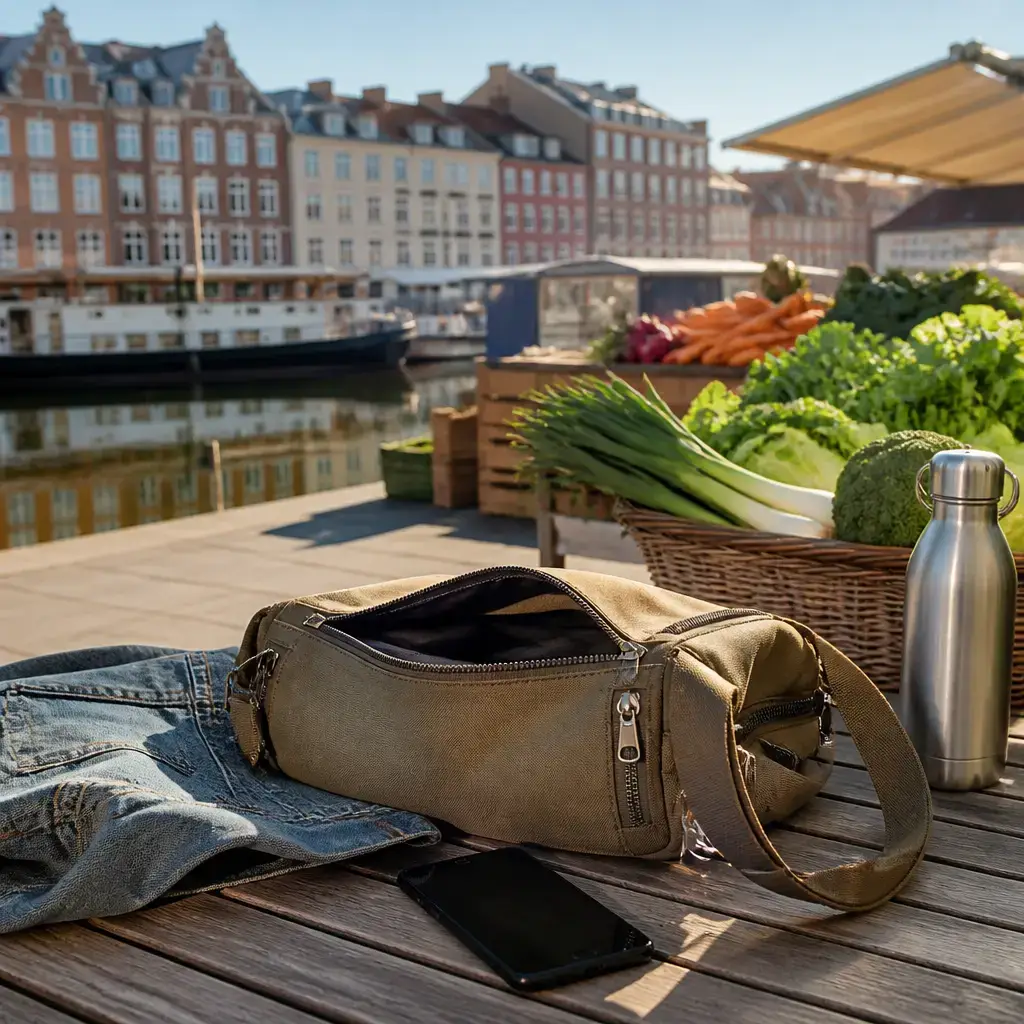
Tasche means “pocket” in der vorderen Tasche and “bag” in meine Tasche. The surrounding words determine whether it refers to a compartment for carrying items or the whole bag.
auf
auf is the separable particle that completes the keep-or-store meaning of Bewahre. In this sentence it appears at the end, after the location, and the full construction is used for storing something in a place.
Soll
Soll means “should” in Soll ich meine Tasche ganz schließen? The question asks whether the speaker ought to close the bag, and Soll ich is a useful way to ask for advice or permission.
meine
meine means “my” and identifies the bag as belonging to the speaker in meine Tasche. It is placed before the noun whose owner is the speaker.
ganz
ganz means “completely” or “all the way” in ganz schließen and in den Reißverschluss ganz. It emphasizes that the closing action should be complete rather than partial.
schließen
schließen means “close” or “zip” here, referring to closing the bag. It follows Soll ich and is used with the thing being closed, such as a bag or zipper.
Schließe
Schließe means “close” or “zip” in this direct instruction to one person. It is the instruction form related to schließen and is followed by the object den Reißverschluss.
den
den means “the” and identifies the specific zipper in den Reißverschluss. It introduces the object of the instruction to close it.
Reißverschluss
Reißverschluss means “zipper,” the part of the bag that should be closed fully. It is used as the object of the instruction Schließe den Reißverschluss.
und
und means “and” and connects the two instructions to close the zipper and hold the bag in front. It joins actions that should be carried out together.
halte
halte means “hold” in the instruction halte die Tasche vor dir. It is the direct-address form related to halten and is used with the object being held and its position.
vor
vor means “in front of” in vor dir and describes where the bag should be held. It is useful for locating one object in relation to a person or another object.
dir
dir refers to “you,” the person being addressed, in vor dir. The phrase vor dir means that the bag is positioned in front of the listener.
Mein
Mein means “my” and identifies the phone as belonging to the speaker in Mein Handy. It is placed before the noun for the thing owned.
Handy
Handy means “mobile phone” here, the valuable item located in the inside pocket. It is a common German word for a personal mobile phone.
Innentasche
Innentasche means “inside pocket,” the pocket located within the bag. In der Innentasche states where the phone is kept, so it is useful when describing the location of an item inside a bag.
Das
Das means “that” and points back to the preceding choice or situation of keeping the phone in the inside pocket. In Das ist sicherer, it introduces a comment about something already mentioned.
sicherer
sicherer means “safer” and compares the inside pocket with the outside pocket. The reusable comparison pattern is sicherer als, followed by the less safe option.
die
die means “the” and introduces the specific outside pocket in die Außentasche. It helps identify the pocket being used as the comparison point.
Außentasche
Außentasche means “outside pocket,” the pocket on the exterior of the bag. It is useful when distinguishing an external compartment from an inside pocket.
werde
werde means “will” as the future auxiliary in Ich werde vorsichtig sein. With an infinitive later in the sentence, it expresses the speaker’s future intention or plan.
vorsichtig
vorsichtig means “careful” or “cautious” in vorsichtig sein. It describes how the speaker intends to behave while walking through the crowded market.
sein
sein means “be” in vorsichtig sein and completes the future expression with werde. The pattern describes a future state or behavior, here being careful.
während
während means “while” and links being careful with the time when the speakers walk. It introduces an activity or clause that happens at the same time.
wir
wir means “we” and refers to the speaker and the other person together. In wir gehen, it identifies the people who are walking.
gehen
gehen means “walk” or “go” here, referring to the two people moving through the market. It is used to describe movement or travel with a subject such as wir.
Bleib
Bleib means “stay” in the direct instruction Bleib in meiner Nähe. It is the instruction form related to bleiben and is used to ask one person not to move away.
Nähe
Nähe means “proximity” or “nearby area” in in meiner Nähe. The phrase tells someone to remain close to the speaker, and the same pattern can describe a person or thing being close to someone.
damit
damit means “so that” and introduces the purpose of staying close: avoiding separation. It is commonly followed by a clause explaining the intended result of an action.
uns
uns refers to “us” or, in this context, “each other” in wir uns nicht verlieren. It identifies the same two people as the ones who might become separated.
nicht
nicht means “not” and makes the clause negative in uns nicht verlieren. It prevents the meaning from being that the two people will lose each other.
verlieren
verlieren means “lose” here, with uns verlieren meaning that the two people become separated or lose track of each other. It is useful when someone or something is no longer kept with or found by you.