Könnten
Könnten in Könnten Sie mir sagen introduces a polite request: could you tell me. It is related to können and is useful when asking a receptionist or another person formally for help.
Sie
Sie means you in the formal request Könnten Sie mir sagen. Use Sie when addressing a receptionist or another person formally.
mir
mir means to me in mir sagen, so the speaker asks someone to tell the information to them. The reusable pattern is jemandem etwas sagen, with mir as the person receiving the information.
sagen
sagen means tell or say in Könnten Sie mir sagen, where the speaker asks for information. Use it in requests such as asking someone to say or tell you something.
wo
wo means where in wo der Konferenzraum ist and introduces the place being asked about. A useful pattern is wo ... ist when asking where something is.
der
der means the in der Konferenzraum and Der Raum. It identifies the conference room or room being discussed, and its capitalization in Der Raum also reflects its position at the start of the sentence.
Konferenzraum
Konferenzraum means conference room in der Konferenzraum. It names the room the visitor is trying to find; wo der Konferenzraum ist is useful when asking for its location.
ist
ist means is in wo der Konferenzraum ist and Der Raum ist ... markiert. It links the room with its location or description, and is related to sein.
Gehen
Gehen means go or walk in Gehen Sie an der Lobby vorbei. Here it gives a formal direction to a visitor; use Gehen Sie when telling someone how to proceed.
an
an contributes to the location phrases an der Lobby vorbei and An der Rezeption. With vorbei it forms a route past the lobby, while An der Rezeption locates something at the reception desk.
Lobby
Lobby means lobby in an der Lobby vorbei. It names the area the visitor should pass, so the full route expression is an der Lobby vorbei.
vorbei
vorbei means past or by in an der Lobby vorbei. Together with an der Lobby, it tells the visitor to go past the lobby; an ... vorbei is a useful route pattern.
Raum
Raum means room in Der Raum ist in der Nähe der Aufzüge. Here it refers back to the conference room, and the phrase Der Raum ist ... gives information about its location.
in
in helps form the location expression in der Nähe der Aufzüge, meaning near the elevators. A useful pattern is in der Nähe followed by the place or thing that is nearby.
Nähe
Nähe means vicinity or proximity in in der Nähe der Aufzüge. The expression in der Nähe places the room close to the elevators and is useful for describing nearby locations.
Aufzüge
Aufzüge means elevators in der Nähe der Aufzüge. This is the plural form referring to the elevators near the room; the singular Aufzug also appears elsewhere in the dialogue.
Soll
Soll in Soll ich von hier den Aufzug nehmen? asks whether taking the elevator is the appropriate next action. It is related to sollen and is useful when asking what one is expected or advised to do.
ich
ich means I in Soll ich von hier den Aufzug nehmen? and Ich bin zum ersten Mal in diesem Gebäude. It identifies the visitor as the person asking or describing their own experience.
von
von means from in von hier and marks the starting point of the route. Use von with a place when describing where an action or journey begins.
hier
hier means here in von hier, referring to the visitor’s current position. The pattern von hier is useful when asking about the route from the place where you are standing.
den
den means the in den Aufzug nehmen and identifies the elevator as the thing being taken. The reusable phrase is den Aufzug nehmen, meaning to take the elevator.
Aufzug
Aufzug means elevator in den Aufzug nehmen. It names the means of transport the visitor is considering; den Aufzug nehmen is useful when choosing or using an elevator.
nehmen
nehmen means take in den Aufzug nehmen. With an elevator, it means to use or take that elevator; the same pattern is useful when describing the chosen transport.
Fahren
Fahren means ride or go in Fahren Sie damit einen Stock höher. Here it gives a formal instruction to ride the elevator upward, and it is related to fahren.
damit
damit means with it in Fahren Sie damit. It refers back to the elevator instead of repeating Aufzug; use damit when the thing being used has already been mentioned.
einen
einen means one or a in einen Stock höher and introduces the one floor to travel upward. The phrase einen Stock höher is useful for giving directions inside a building.
Stock
Stock means floor or storey in einen Stock höher. It describes the vertical distance in the elevator instruction, so einen Stock höher means one floor up.
höher
höher means higher or up in einen Stock höher. It shows that the destination is above the current floor; the full phrase is useful when directing someone upward in a building.
Dann
Dann means then in Dann biegen Sie links in den Flur ab. It marks the next step after taking the elevator, and it is useful at the beginning of a sequence of directions.
biegen
biegen supplies the turning action in biegen Sie links in den Flur ab. Together with links and ab, it tells the visitor to turn left into the hallway; this is useful in spoken route instructions.
links
links means left in biegen Sie links in den Flur ab. It specifies the direction of the turn, while biegen ... ab expresses the turning action.
Flur
Flur means hallway in in den Flur. It names the place the visitor should turn into, and biegen Sie ... in den Flur ab is a useful direction pattern.
ab
ab is the directional particle completing biegen ... ab in biegen Sie links in den Flur ab. It helps express turning off or away into the hallway; keep it with biegen when reusing this construction.
Gibt
Gibt in Gibt es eine Karte? forms an existence question asking whether a map is available. In An der Rezeption gibt es eine, the same expression states that one exists; it is related to geben.
es
es is the structural element in Gibt es that helps form a question or statement about existence. It does not refer to the map itself here; the object is supplied by eine Karte or eine.
eine
eine means a or one in eine Karte and in An der Rezeption gibt es eine. Before Karte it introduces a map, while in the second sentence it refers back to one map without repeating Karte.
Karte
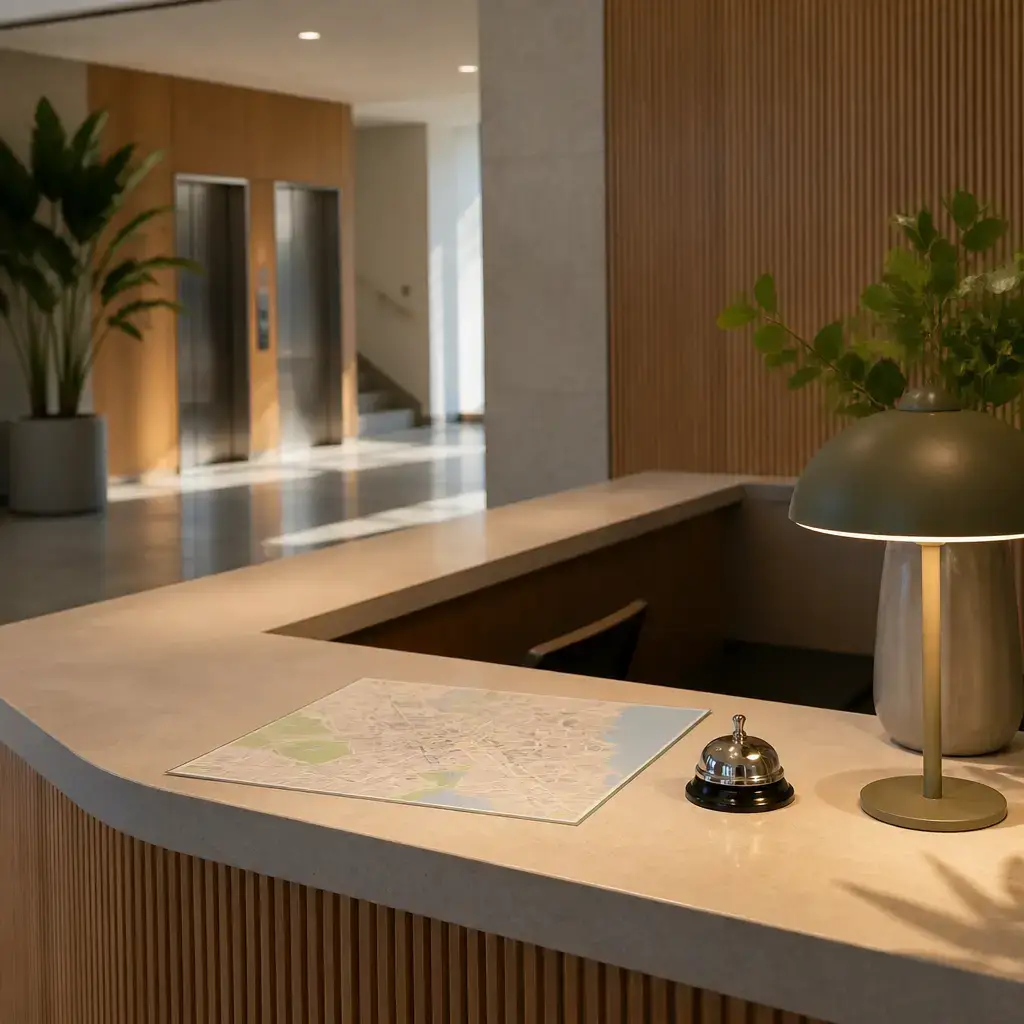
Karte means map in eine Karte, referring to a map the visitor can use for directions. Eine Karte benutzen is a useful pattern when asking about or using a map.
die
die means that or which in die ich benutzen kann. It introduces information describing the map, namely that the speaker can use it.
benutzen
benutzen means use in die ich benutzen kann. It describes what the visitor wants to do with the map; the pattern etwas benutzen is useful for talking about using a tool or resource.
kann
kann means can in die ich benutzen kann and expresses the visitor’s ability to use the map. It is related to können and appears at the end of the clause describing the map.
Rezeption
Rezeption means reception or reception desk in An der Rezeption. It identifies where the map can be found, and An der Rezeption is useful for locating something at a reception area.
Das
Das means that or it in Das hilft and points back to the map or directions just provided. It allows the speaker to refer to the previous help without repeating it.
hilft
hilft means helps or is useful in Das hilft. The speaker uses it to say that the information or map is useful, and it is related to helfen.
bin
bin means am in Ich bin zum ersten Mal in diesem Gebäude. It links the speaker with their current situation, while the full phrase explains that this is their first visit; bin is related to sein.
zum
zum is the contracted form of zu dem in zum ersten Mal. In this expression it helps say for the first time, so it is useful when describing a first experience or visit.
ersten
ersten means first in zum ersten Mal and identifies this occasion as the first one. The full expression zum ersten Mal is used when someone experiences or does something for the first time.
Mal
Mal means time or occasion in zum ersten Mal. Together with zum ersten, it describes the first occasion of being in the building; zum ... Mal is a reusable pattern for counting occasions.
diesem
diesem means this in in diesem Gebäude and points to the particular building where the speaker is now. The phrase in diesem Gebäude is useful when identifying the building being visited.
Gebäude
Gebäude means building in in diesem Gebäude. It names the place the speaker is visiting for the first time, and in diesem Gebäude locates the speaker inside it.
nahe
nahe means near in nahe am Ende des Flurs. It places the room close to the end of the hallway; nahe am Ende is useful for describing a position near an endpoint.
am
am is the contracted form of an dem in am Ende des Flurs. It helps locate the room at the end of the hallway, and am Ende is a common location expression.
Ende
Ende means end in am Ende des Flurs. It identifies the endpoint of the hallway where the room is marked; the phrase am Ende des Flurs gives the complete location.
des
des means of the in des Flurs. It connects the end with the hallway, giving the meaning the end of the hall.
Flurs
Flurs means of the hallway in des Flurs. It is the form of Flur used in this phrase to identify which end is meant: the end of the hallway.
markiert
markiert means marked in Der Raum ist nahe am Ende des Flurs markiert. It says that the room is indicated near the end of the hall, and it is related to markieren.