Kann
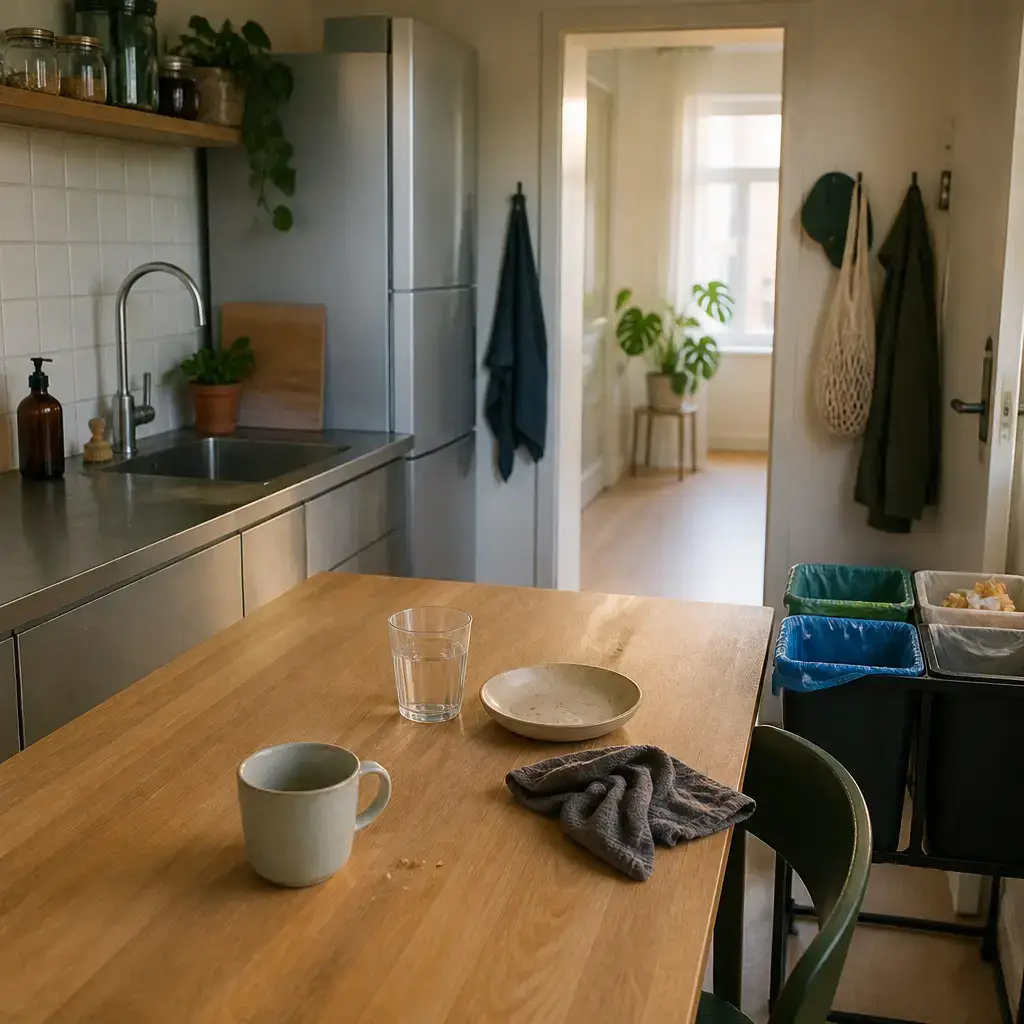
In "Kann ich meine Tasse hier abwaschen?", "Kann" asks whether the speaker is allowed to do something. It is the form used with "ich" in a permission question, and it can be reused in "Kann ich ...?" questions.
ich
"ich" means "I" and identifies the speaker in "Kann ich meine Tasse hier abwaschen?" and "Ich möchte den Raum sauber halten." It is used as the subject before the verb in these sentences.
meine
"meine" means "my" and identifies the cup as belonging to the speaker in "meine Tasse". It is placed directly before the thing that belongs to the speaker, such as a personal object.
Tasse
"Tasse" means "cup" in "meine Tasse". It names the object being washed and can be used after a possessive word such as "meine".
hier
"hier" means "here" and points to the place where the washing would happen in "Kann ich meine Tasse hier abwaschen?". It can be used to identify the current place or location.
abwaschen
"abwaschen" means to wash, especially a cup or other dish, in "meine Tasse hier abwaschen". It can be reused with the item being washed as its object.
Benutze
"Benutze" means "use" in the instruction "Benutze das Waschbecken links." It is addressed to one person informally and can introduce a direct instruction about using something.
das
"das" means "the" before "Waschbecken" in "Benutze das Waschbecken links." It identifies one specific sink, and it is placed directly before the noun.
Waschbecken
"Waschbecken" means "sink" in "das Waschbecken links." It names the place where the cup should be washed and can be specified by a location such as "links".
links
"links" means "on the left" in "das Waschbecken links." It gives the sink's location and can be used after a noun to identify which one is meant.
möchte
"möchte" expresses what the speaker would like or wants to do in "Ich möchte den Raum sauber halten." It introduces a desired action, with the other verb at the end of the sentence.
den
"den" means "the" before "Raum" in "den Raum sauber halten." It identifies the specific space being kept clean and appears directly before the noun.
Raum
"Raum" means "space" or "room" in "den Raum sauber halten." It is the space whose condition the speaker wants to maintain and can follow a definite article such as "den".
sauber
"sauber" means "clean" in "den Raum sauber halten." It describes the condition that the space should remain in and can be used in the pattern of keeping something clean.
halten
"halten" means "keep" in "den Raum sauber halten", where it means maintaining the room in a clean condition. It follows "möchte" at the end of the sentence in this desired-action pattern.
Bitte
"Bitte" means "please" and makes the instruction polite in "Bitte wisch den Tisch ab, wenn du fertig bist." It is commonly placed at the beginning of a polite request.
wisch
"wisch" means "wipe" in "Bitte wisch den Tisch ab, wenn du fertig bist." It is an informal instruction to one person and is used with the thing to be wiped.
Tisch
"Tisch" means "table" in "wisch den Tisch ab." It names the surface being wiped and follows "den" in this instruction.
ab
In "wisch den Tisch ab", "ab" is the separated part that completes the meaning of wiping the table off. The object comes between the verb and this particle, so the particle appears at the end of the clause.
wenn
"wenn" means "when" in "wenn du fertig bist" and introduces the condition or time for wiping the table. It can introduce a clause describing when an action should happen.
du
"du" means informal singular "you" in "wenn du fertig bist." It identifies the person who finishes and is used as the subject of the clause.
fertig
"fertig" means "finished" or "done" in "du fertig bist." It describes the person's state after completing the task and can be used with a form of "sein".
bist
"bist" means "are" with "du" in "du fertig bist." Together with "fertig", it states that the person is finished, and it appears at the end of this subordinate clause.
Kommt
In "Kommt der Müll in diesen Mülleimer?", "Kommt" asks whether the trash goes into the specified bin. It is placed first because this is a question about where something should go.
der
"der" means "the" before "Müll" in "der Müll". It identifies the specific trash being discussed and appears directly before the noun.
Müll
"Müll" means "trash" or "rubbish" in "der Müll". It is the thing whose correct bin is being asked about and can be followed by a destination introduced with "in".
in
"in" means "into" in "in diesen Mülleimer" and marks the bin as the destination for the trash. It can be used before the name of a container when something is put inside it.
diesen
"diesen" means "this" in "diesen Mülleimer" and points to one particular bin. It is placed directly before the noun it identifies.
Mülleimer
"Mülleimer" means "bin" or "trash can" in "diesen Mülleimer." It names the container that may receive the trash and can follow a word such as "diesen".
Tu
"Tu" means "put" in the instruction "Tu ihn in den Mülleimer an der Tür." It tells one person informally what to do and is followed by the thing being put.
ihn
"ihn" means "it" here and refers back to "der Müll" in "Tu ihn in den Mülleimer an der Tür." It is placed after "Tu" as the object of the instruction.
an
"an" means "by" or "at" in "an der Tür" and identifies the location of the bin. It can be used before a place that serves as a nearby reference point.
Tür
"Tür" means "door" in "an der Tür." It names the reference point used to locate the bin and follows "der" in this phrase.
kümmere
In "Ich kümmere mich jetzt darum", "kümmere" contributes the meaning "take care" or "deal with". It is used with "mich" and "darum" to say that the speaker will handle the matter.
mich
"mich" means "myself" or "me" in "Ich kümmere mich jetzt darum." It is used with "kümmere" in this expression for taking care of something.
jetzt
"jetzt" means "now" in "Ich kümmere mich jetzt darum." It shows that the speaker will handle the matter at the present time and can be used to specify when an action happens.
darum
"darum" means "about it" or "concerning it" in "Ich kümmere mich jetzt darum." It refers back to the matter just discussed, namely dealing with the kitchen task.
So
"So" means "that way" or "so" in "So können alle die Küche benutzen." It connects the previous cleaning actions with the result and can introduce the way a result is achieved.
können
"können" means "can" or "be able to" in "So können alle die Küche benutzen." It expresses ability or possibility and is followed by the infinitive "benutzen" at the end.
alle
"alle" means "everyone" or "all" in "alle die Küche benutzen." It refers to all the people sharing the kitchen and functions as the subject of the action.
die
"die" means "the" before "Küche" in "die Küche benutzen." It identifies the specific kitchen being shared and is placed directly before the noun.
Küche
"Küche" means "kitchen" in "die Küche benutzen." It names the place that everyone can use and follows the definite article "die".
benutzen
"benutzen" means "use" in "die Küche benutzen." It remains in the infinitive after "können" and can be reused after a modal verb to describe what someone can use.