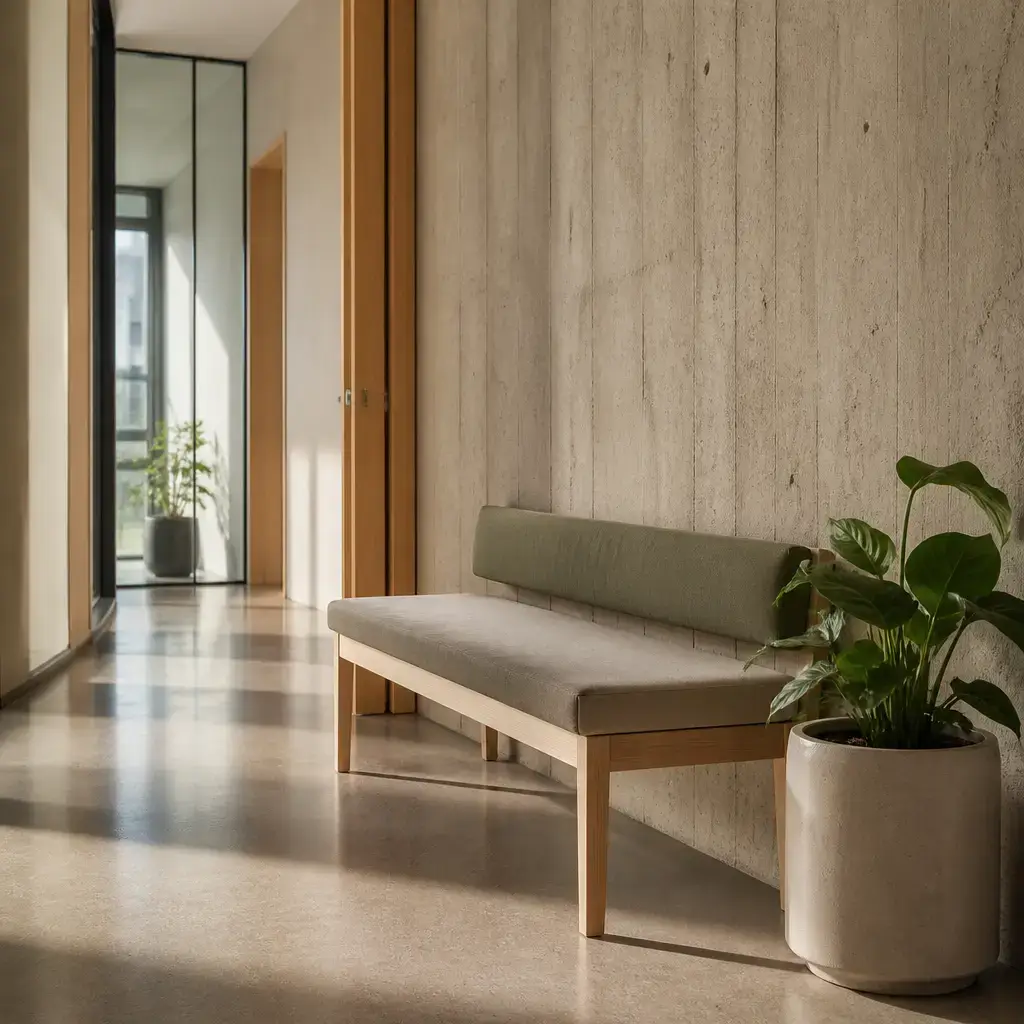
About This Lesson
Use Choosing a quiet break spot to practice German conversation, pronunciation, vocabulary, grammar, and quizzes.
Dialogue
A
Wo können wir eine Pause machen?
voh KUR-nən veer EYE-nə POW-zə MAKH-ən? Where can we take a break?
B
Im Flur gibt es einen ruhigen Platz.
im FLOOR geept ess EYE-nən ROO-ee-gən PLAHTS. There's a quiet spot in the hall.
A
Gibt es dort eine Bank?
geept ess dort EYE-nə bahngk? Is there a bench there?
B
An der Wand steht eine Bank.
ahn dair vahnt shtayt EYE-nə bahngk. There is one by the wall.
A
Ich möchte sitzen und mich ausruhen.
ikh MURKH-tə ZIT-sən oont mikh OWS-roo-ən. I want to sit and rest.
B
Setzen wir uns dort zusammen.
ZET-sən veer oons dort tsoo-ZAH-mən. Let's sit there together.
A
Hier ist es ruhig.
heer ist ess ROO-ikh. This spot feels quiet.
B
Das ist ein guter Ort für eine kurze Pause.
dahs ist EYE-n GOO-tər ohrt fyoor EYE-nə KURT-sə POW-zə. This is a good place for a short break.Word by Word
Wo
“Wo” asks for a location: here it means “where” in “Wo können wir eine Pause machen?”. It is used at the beginning of a question about where something is or happens.
können
“können” expresses possibility or ability; here it asks whether and where the speakers can take a break. It is used with the infinitive “machen” in “Wo können wir eine Pause machen?”. Use this pattern when asking what is possible.
wir
“wir” means “we” and refers to the speaker together with at least one other person. In “Wo können wir eine Pause machen?”, it is the group taking the break. Use it as the subject when describing a shared action.
eine
“eine” is the indefinite article in “eine Pause”, meaning “a” or “one”. It introduces the break as one nonspecific break. Keep it together with the noun in the reusable phrase “eine Pause machen”.
Pause
“Pause” means “break” in “eine Pause machen”. The whole expression “eine Pause machen” means to take a break, while “Pause” names the break itself. Use it when talking about stopping briefly from an activity.
machen
In “eine Pause machen”, “machen” is the verb used with “Pause” to express taking a break. Here it is an infinitive after “können”. This phrase is useful when asking or saying that someone will take a break.
Im
“Im” means “in the” in “Im Flur gibt es einen ruhigen Platz”. It is the contracted form of “in dem”. Use it before a location such as “Flur” when saying that something is inside that place.
Flur
“Flur” means “hall” or “hallway” in “Im Flur”. It identifies the indoor area where the quiet spot is located. Use it when referring to a hallway in a building.
gibt
“gibt” means “there is” in the existence expression “gibt es”. The same form appears as “Gibt” at the beginning of “Gibt es dort eine Bank?”. It comes from “geben” and is useful for saying that something exists or is available.
es
In “gibt es”, “es” is the pronoun used in the German expression for “there is” or “there are”. It does not name the spot or bench itself. Keep it with “gibt” when stating or asking whether something exists in a place.
einen
“einen” is the indefinite article in “einen ruhigen Platz”, meaning “a” or “one”. It introduces one specific but previously unspecified spot. Keep it before the adjective and noun in this noun phrase.
ruhigen
“ruhigen” means “quiet” in “einen ruhigen Platz” and describes the spot as peaceful rather than noisy. Its ending belongs to this noun phrase with “einen” and “Platz”. Use the complete phrase when identifying a quiet place.
Platz
“Platz” means “spot” or “place” in “einen ruhigen Platz”. Here it refers to a suitable location for the break. Use it when pointing out a place where someone can stay or sit.
dort
“dort” means “there” and points to the location being discussed. In “Gibt es dort eine Bank?”, it asks about a bench at that place; in “Setzen wir uns dort zusammen.”, it points to the place where they should sit. Use it when referring to a location away from the immediate speaker position.
Bank
“Bank” means “bench” in “eine Bank”. It is the seat the speakers look for and find by the wall. Use it when referring to a bench as a place to sit.
An
“An” means “at” or “by” in the location phrase “An der Wand”. It places the bench next to the wall. Use this phrase when describing something positioned by a wall.
der
“der” means “the” in “An der Wand”. It is the definite article accompanying “Wand” in this location phrase. Keep it together with “Wand” when saying that something is by the wall.
Wand
“Wand” means “wall” in “An der Wand”. It identifies the surface next to which the bench is standing. Use it when describing the position of an object beside a wall.
steht
“steht” means “stands” or “is located” in “An der Wand steht eine Bank”. It describes the bench as being positioned by the wall. This is a form of “stehen”, used for locating a stationary object.
Ich
“Ich” means “I” and identifies the speaker in “Ich möchte sitzen und mich ausruhen.”. It is the person expressing the wish to sit and rest. Use it as the subject when talking about yourself.
möchte
“möchte” expresses a polite wish or desire; here the speaker would like to sit and rest. It is followed by the infinitives “sitzen” and “ausruhen” in “Ich möchte sitzen und mich ausruhen.”. Use it to state what you would like to do.
sitzen
“sitzen” means “sit” in “Ich möchte sitzen”. It is an infinitive after “möchte” and names the desired action. Use it after a verb such as “möchte” when saying that you want to sit.
und
“und” means “and” and joins the two desired actions in “sitzen und mich ausruhen”. It shows that the speaker wants to do both actions. Use it to connect actions or ideas that belong together.
mich
“mich” refers back to “Ich” in the reflexive expression “mich ausruhen”. It marks the person who is resting, while the whole expression means “rest”. Keep the reflexive pronoun with the verb when describing your own rest.
ausruhen
“ausruhen” means “rest” in “mich ausruhen”. Here it is used with the reflexive pronoun “mich” after “möchte”. Use the pattern “mich ausruhen” when saying that you want to rest yourself.
Setzen
“Setzen” begins the suggestion “Setzen wir uns dort zusammen.” and proposes that the group sit down together. It is used with “uns” and “dort” to describe the shared action and location. Use this sentence pattern when suggesting an action for the group.
uns
“uns” refers to the speakers as a group in “Setzen wir uns dort zusammen.”. Together with “Setzen” it forms the reflexive expression for the group sitting down. Use it when the people performing the action are the same people affected by it.
zusammen
“zusammen” means “together” in “Setzen wir uns dort zusammen.”. It emphasizes that the speakers will sit as a group. Use it with a shared action when several people do something jointly.
Hier
“Hier” means “here” and points to the speakers’ current location in “Hier ist es ruhig.”. It presents the place where they are as quiet. Use it when referring to the place where you are now.
ist
“ist” means “is” in “Hier ist es ruhig.” and states the condition of the place. It is a form of “sein”. Use it to connect a place or subject with a description such as “ruhig”.
ruhig
“ruhig” means “quiet” or “calm” in “Hier ist es ruhig.”. It describes the surroundings as suitable for a peaceful break. Use it when commenting on a place with little noise or activity.
Das
“Das” means “this” or “that” in “Das ist ein guter Ort für eine kurze Pause.”. It refers to the place currently being discussed and introduces an evaluation of it. Use “Das ist” when identifying or assessing something.
ein
“ein” is the indefinite article in “ein guter Ort”, meaning “a”. It introduces the place as one good option. Keep it before the adjective and noun in this phrase.
guter
“guter” means “good” in “ein guter Ort”. It gives a positive description of the place. Its ending belongs to the noun phrase with “ein” and “Ort”; use the phrase when evaluating a place positively.
Ort
“Ort” means “place” in “ein guter Ort für eine kurze Pause”. It refers to a location suitable for a particular purpose. The pattern “ein guter Ort für ...” can describe a place that is suitable for an activity.
für
“für” means “for” in “für eine kurze Pause”. It connects the place with its intended purpose. Use the pattern “ein guter Ort für ...” when explaining what a place is suitable for.
kurze
“kurze” means “short” in “eine kurze Pause”. It describes the break as brief in duration. Its ending belongs to the noun phrase with “eine” and “Pause”.
Grammar Points
Wo + Verb + Subjekt
Wo machen wir Pause?
voh MAKH-ən veer POW-zə?Where are we taking a break?
In German questions with Wo, the verb comes before the subject: Wo machen wir …?
German Vocabulary
Bank
noun
bahngk
bench
dort
adv
DORT
there
Flur
noun
FLOOR
hallway
machen
verb
MAKH-ən
make; take
Pause
noun
POW-zə
break
Platz
noun
PLAHTS
spot; place
ruhig
adj
ROO-ikh
quiet
ruhigen
sitzen
verb
ZIT-sən
sit
stehen
verb
SHTAY-ən
stand; be located
steht
Wand
noun
VAHNT
wall
wir
pron
veer
we
Wo
adv
voh
where
Quiz
Word Order
Arrange the words in the correct order.
Where can we take a break?
Show Answer
Wo können wir eine Pause machen?Is there a bench there?
Show Answer
Gibt es dort eine Bank?There is one by the wall.
Show Answer
An der Wand steht eine Bank.Spelling
Tap the letters to spell the word.
spot; place
Show Answer
Platzthere
Show Answer
dorthallway
Show Answer
Flurquiet