Ich
“Ich” means “I” and is the speaker in “Ich fühle mich an meinem Schreibtisch müde.” It is used as the subject when talking about yourself, as in the new example “Ich brauche Wasser.”
fühle
“fühle” means “feel” in “Ich fühle mich an meinem Schreibtisch müde.” It is the first-person form used with “Ich”; the reusable pattern is “Ich fühle mich …” when describing how you feel.
mich
“mich” means “myself” here and is the reflexive part of “Ich fühle mich …,” meaning that the speaker feels a certain way. Use it with “Ich fühle mich” to describe your own state, for example in the new example “Ich fühle mich gut.”
an
“an” means “at” or “by” in “an meinem Schreibtisch,” locating the speaker at the desk. With a place, it can be reused in patterns such as “an meinem Tisch” in a new example.
meinem
“meinem” means “my” in “an meinem Schreibtisch,” referring to the speaker’s desk. It appears after the location expression “an” in this phrase; the same form is used in a new example such as “an meinem Fenster.”
Schreibtisch
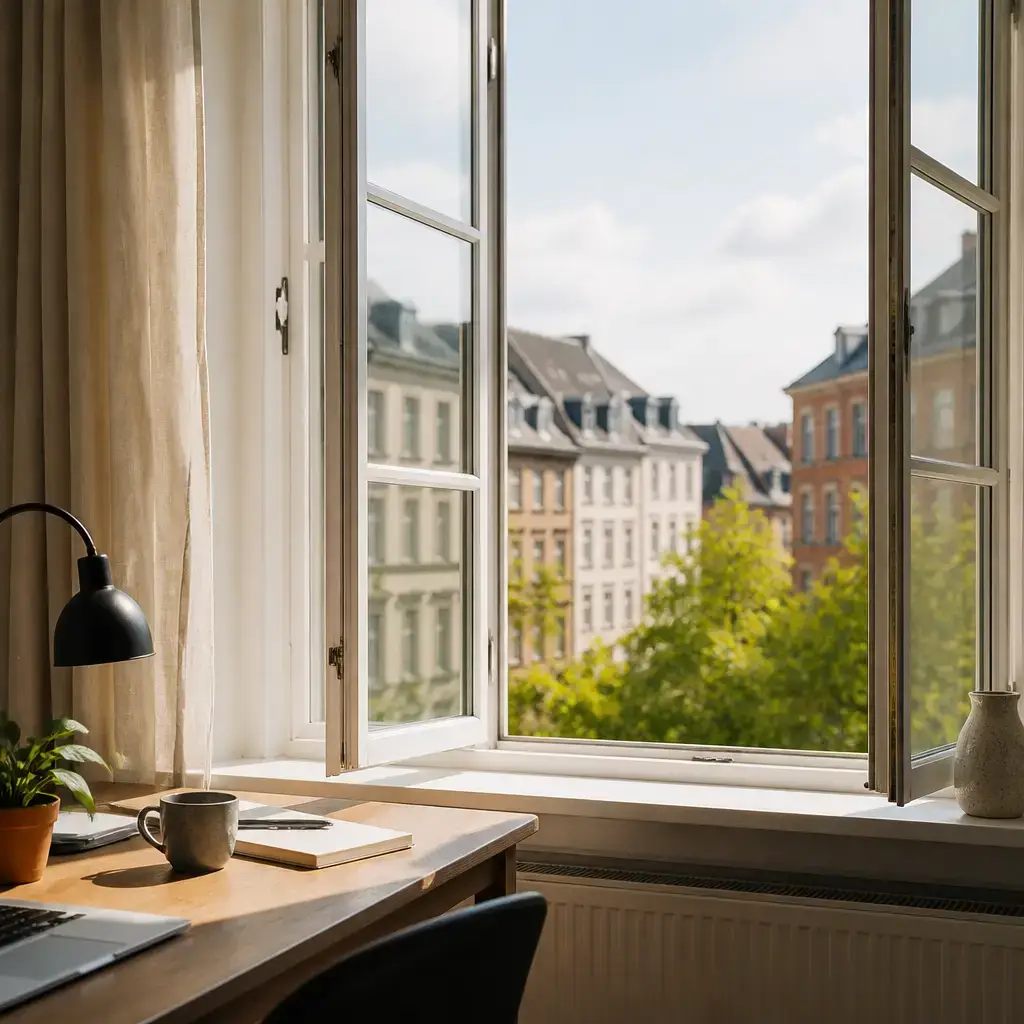
“Schreibtisch” means “desk” in “an meinem Schreibtisch.” It is a noun for the work surface where the speaker is sitting, and it can be reused with “am Schreibtisch” in a new example.
müde
“müde” means “tired” in “Ich fühle mich an meinem Schreibtisch müde.” It describes the speaker’s condition and can be reused after “Ich bin,” as in the new example “Ich bin müde.”
Lass
“Lass” introduces a suggestion in “Lass uns für einen Moment das Fenster öffnen,” meaning “Let’s open the window.” Use “Lass uns” before an infinitive to suggest doing something together, as in the new example “Lass uns warten.”
uns
“uns” means “us” in “Lass uns für einen Moment das Fenster öffnen.” Together, “Lass uns” addresses the other person and suggests a shared action; the reusable pattern is “Lass uns + infinitive.”
für
“für” means “for” in “für einen Moment,” referring to the length of the short action. It is used before the time expression “einen Moment,” and the pattern “für + a period of time” can be reused in a new example.
einen
“einen” means “a” or “one” in “für einen Moment.” Here it introduces the masculine noun “Moment” after “für”; the phrase “für einen Moment” is a reusable way to say “for a moment.”
Moment
“Moment” means “moment” in “für einen Moment,” a short amount of time. Use it after “für einen” when describing an action that lasts briefly, as in the new example “Warte für einen Moment.”
das
“das” means “the” in “das Fenster,” identifying the specific window to be opened. It is used directly before the noun “Fenster” in this expression.
Fenster
“Fenster” means “window” in “das Fenster öffnen.” It is the object that the speakers want to open, and it can be reused with location phrases such as “am Fenster.”
öffnen
“öffnen” means “open” in “das Fenster öffnen.” It is the action suggested after “Lass uns”; the reusable pattern is “Lass uns + infinitive,” such as the new example “Lass uns die Tür öffnen.”
brauche
“brauche” means “need” in “Ich brauche frische Luft.” It is used with “Ich” to express a personal need, and the pattern “Ich brauche + noun” can be reused in a new example.
frische
“frische” means “fresh” in “frische Luft,” describing the air the speaker wants. It comes directly before the noun “Luft”; the reusable expression is “frische Luft,” for example when opening a window.
Luft
“Luft” means “air” in “Ich brauche frische Luft.” It is used with “frische” in this common expression, which is useful when talking about ventilation or being outdoors.
Die
“Die” means “the” in “Die Luft draußen,” identifying the air being discussed. It comes before the noun “Luft” at the start of the sentence.
draußen
“draußen” means “outside” in “Die Luft draußen,” specifying which air is meant. It can be used after a noun to add the location, as in the new example “Die Kinder draußen.”
fühlt
“fühlt” is the “feels” part of “fühlt sich kühl an” in “Die Luft draußen fühlt sich kühl an.” The whole expression describes how something seems by touch; “fühlt” is used with “sich” and the ending “an” here.
sich
“sich” is the reflexive part of “fühlt sich kühl an,” referring back to “Die Luft.” It belongs to the whole expression “fühlt sich … an,” which is used to describe how something feels, as in the new example “Der Stoff fühlt sich weich an.”
kühl
“kühl” means “cool” in “fühlt sich kühl an,” describing the temperature of the air. It comes after “sich” and before “an” in this expression, and it can describe another object in a new example.
Können
“Können” means “can” or “be able to” in the question “Können wir uns am Fenster ausruhen?” It appears at the beginning of the yes-or-no question and is followed by “wir” and an infinitive at the end.
wir
“wir” means “we” in “Können wir uns am Fenster ausruhen?” It names the people who may rest together, and it can be reused as the subject before a shared action.
am
“am” means “at the” or “by the” in “am Fenster.” It is the contracted form of “an dem” and introduces the location; “am Fenster” is a reusable phrase for being by the window.
ausruhen
“ausruhen” means “rest” in “uns am Fenster ausruhen.” It is the infinitive used after “Können” and appears with the reflexive pronoun “uns” when the speakers rest themselves.
hier
“hier” means “here” in “Wir können hier eine kurze Pause machen,” referring to the current place by the window. It can be used to point out the place where an action happens, as in the new example “Wir warten hier.”
eine
“eine” means “a” or “one” in “eine kurze Pause.” It introduces the feminine noun “Pause,” and the phrase “eine kurze Pause” can be reused when describing a brief rest.
kurze
“kurze” means “short” in “eine kurze Pause,” describing the limited length of the break. It comes before “Pause” and can be reused before a feminine noun in a new example such as “eine kurze Reise.”
Pause
“Pause” means “break” in “eine kurze Pause machen.” It names a period of rest from work, and the reusable expression is “eine Pause machen,” meaning to take a break.
machen
“machen” means “make” in the expression “eine kurze Pause machen,” which means “take a short break.” It follows the object “eine kurze Pause”; the full pattern is “eine Pause machen,” not just “machen” alone.
bin
“bin” means “am” in “Ich bin jetzt weniger müde,” describing the speaker’s current state. It is the first-person form of “sein” used with “Ich,” as in the new example “Ich bin müde.”
jetzt
“jetzt” means “now” in “Ich bin jetzt weniger müde,” marking the speaker’s condition at the present time. It can be placed before the description of a current state, as in the new example “Ich bin jetzt bereit.”
weniger
“weniger” means “less” in “weniger müde,” showing that the speaker is tired to a smaller degree than before. It comes before the adjective “müde” and can be reused with other descriptions when comparing amounts or degrees.
bald
“bald” means “soon” in “Lass uns bald wieder arbeiten gehen,” referring to a near future time. It can be used with an action to say that it will happen shortly, as in the new example “Wir kommen bald.”
wieder
“wieder” means “back” or “again” in “wieder arbeiten gehen,” showing a return to work after the break. It comes before the activity expression “arbeiten gehen”; the full phrase keeps the meaning of returning to that activity.
arbeiten
“arbeiten” means “work” in “arbeiten gehen,” the activity the speakers will return to. Together with “gehen,” it forms the reusable expression “arbeiten gehen,” meaning to go to work.
gehen
“gehen” means “go” in “Lass uns bald wieder arbeiten gehen.” Here it follows the activity “arbeiten” in the expression “arbeiten gehen,” which describes going to work; use that full expression when returning to work.