Ich
“Ich” means “I” and identifies the speaker in “Ich habe das Formular ausgefüllt.” It is the German first-person pronoun used when talking about yourself.
habe
“habe” means “have” here and works with “ausgefüllt” to say that the speaker finished filling out the form. It is the first-person form of haben used as an auxiliary in the perfect construction “Ich habe das Formular ausgefüllt.”
das
“das” means “the” in “das Formular” and introduces the specific form being discussed. It is used before the neuter noun Formular in this expression.
Formular
“Formular” means “form” in “das Formular.” It refers to the document that the speaker has filled out, and it can commonly be used with verbs describing completing or filling in a document.
ausgefüllt
“ausgefüllt” means “filled out” in “Ich habe das Formular ausgefüllt.” It is the form of ausfüllen used with habe to describe a completed action involving a form.
Wann
“Wann” means “when” and asks about the time in “Wann können wir zur Walking-Veranstaltung kommen?” It is used at the beginning of a question about when something can happen.
können
“können” means “can” or “be able to” in “Wann können wir ... kommen?” It expresses possibility or permission and is followed here by the infinitive “kommen.”
wir
“wir” means “we” and refers to the people asking about attending the event. In “Wann können wir ... kommen?”, it is the subject of the question.
zur
“zur” means “to the” in “zur Walking-Veranstaltung.” It is the contracted form of zu der and is used here to show movement toward or attendance at the event.
Walking-Veranstaltung
“Walking-Veranstaltung” means “walking event” and names the event the speakers want to attend. In “zur Walking-Veranstaltung,” it follows zur to specify where they want to go.
kommen
“kommen” means “come” in “können wir zur Walking-Veranstaltung kommen?” It is the infinitive used after können and describes going to the walking event.
Sie
“Sie” means formal “you” in “Sie können an der nächsten Walking-Veranstaltung teilnehmen.” It is used when the event representative addresses one or more people politely.
an
In “an der nächsten Walking-Veranstaltung teilnehmen,” “an” is part of the construction for taking part in an event. This expression is used with teilnehmen when identifying the event someone joins.
der
“der” means “the” in “an der nächsten Walking-Veranstaltung.” It is the article used here after an for the feminine noun Walking-Veranstaltung.
nächsten
“nächsten” means “next” in “der nächsten Walking-Veranstaltung.” It specifies that the participants can join the event that follows the current one.
teilnehmen
“teilnehmen” means “take part” or “participate” in “Sie können an der nächsten Walking-Veranstaltung teilnehmen.” It is used with an and the event someone joins.
Sollen
“Sollen” means “should” in the question “Sollen wir etwas mitbringen?” It asks what would be appropriate or expected for the event, with wir as the subject.
etwas
“etwas” means “something” or, in this question, “anything.” In “Sollen wir etwas mitbringen?”, it refers generally to an item without naming it.
mitbringen
“mitbringen” means “bring along” in “Sollen wir etwas mitbringen?” It is used when asking whether to bring an item with you to a place or event.
Bitte
“Bitte” means “please” in “Bitte bringen Sie eine Wasserflasche mit.” It makes the instruction polite and appears at the beginning of this request.
bringen
“bringen” means “bring” in “Bitte bringen Sie eine Wasserflasche mit.” Together with the particle mit, it gives the polite instruction to bring the water bottle along.
eine
“eine” means “a” in “eine Wasserflasche.” It introduces one unspecified water bottle as the item to bring.
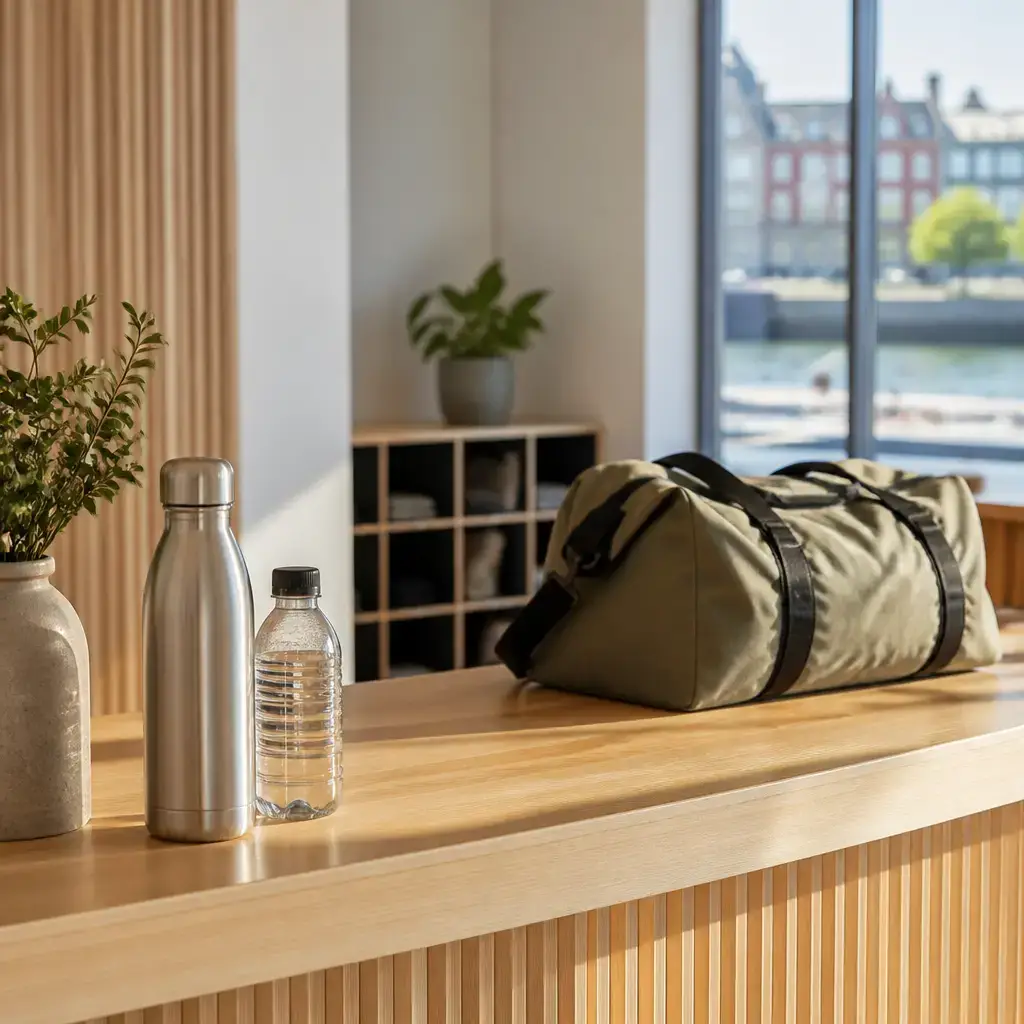
Wasserflasche
“Wasserflasche” means “water bottle” in “Bitte bringen Sie eine Wasserflasche mit.” It names the item requested for the walking event.
mit
“mit” contributes the meaning “along” in “bringen Sie eine Wasserflasche mit.” It is the separable particle of mitbringen and appears at the end of this instruction.
große
“große” means “large” in “eine große Tasche.” It describes the size of the bag that can be left at the desk.
Tasche
“Tasche” means “bag” in “eine große Tasche” and “meine Tasche.” It refers to the personal item that can be handed in or left before the event.
am
“am” means “at the” in “am Schalter.” It is the contracted form of an dem and identifies the location where the bag can be left.
Schalter
“Schalter” means “desk” or “counter” in “am Schalter.” It refers to the event registration or service point where the large bag can be handed in.
abgeben
“abgeben” means “leave” or “hand in” in “eine große Tasche am Schalter abgeben.” It describes giving the bag to the desk so it remains there during the event.
kleine
“kleine” means “small” in “eine kleine Wasserflasche.” It describes the size of the water bottle the speaker already has with them.
dabei
“dabei” means “with me” or “carrying it” in “Ich habe eine kleine Wasserflasche dabei.” It is used to say that an item is currently being carried or is present with the speaker.
lasse
“lasse” means “leave” in “Ich lasse meine Tasche vor dem Start hier.” It expresses the speaker’s intention to let the bag remain in this place before the start.
meine
“meine” means “my” in “meine Tasche.” It shows that the bag belongs to or is associated with the speaker.
vor
“vor” means “before” in “vor dem Start.” It places the action of leaving the bag earlier than the start of the event.
dem
“dem” means “the” in “vor dem Start.” It is the article used here after the temporal preposition vor with Start.
Start
“Start” means “start” in “vor dem Start.” It refers to the beginning of the walking event, before which the speaker will leave the bag.
hier
“hier” means “here” in “Ich lasse meine Tasche vor dem Start hier.” It points to the place where the speaker is currently standing or where the desk is located.
freue
“freue” contributes the meaning “look forward” in “Ich freue mich schon darauf.” It is used with mich and darauf to express positive anticipation of the event.
mich
“mich” means “myself” in the reflexive expression “Ich freue mich schon darauf.” It is the reflexive component required with freue when the speaker says they are looking forward to something.
schon
“schon” adds anticipatory emphasis in “Ich freue mich schon darauf.” It shows that the speaker is already looking forward to the event.
darauf
“darauf” means “to it” in “Ich freue mich schon darauf.” It refers back to the event or activity that the speaker is anticipating and completes the expression with freue mich.