En
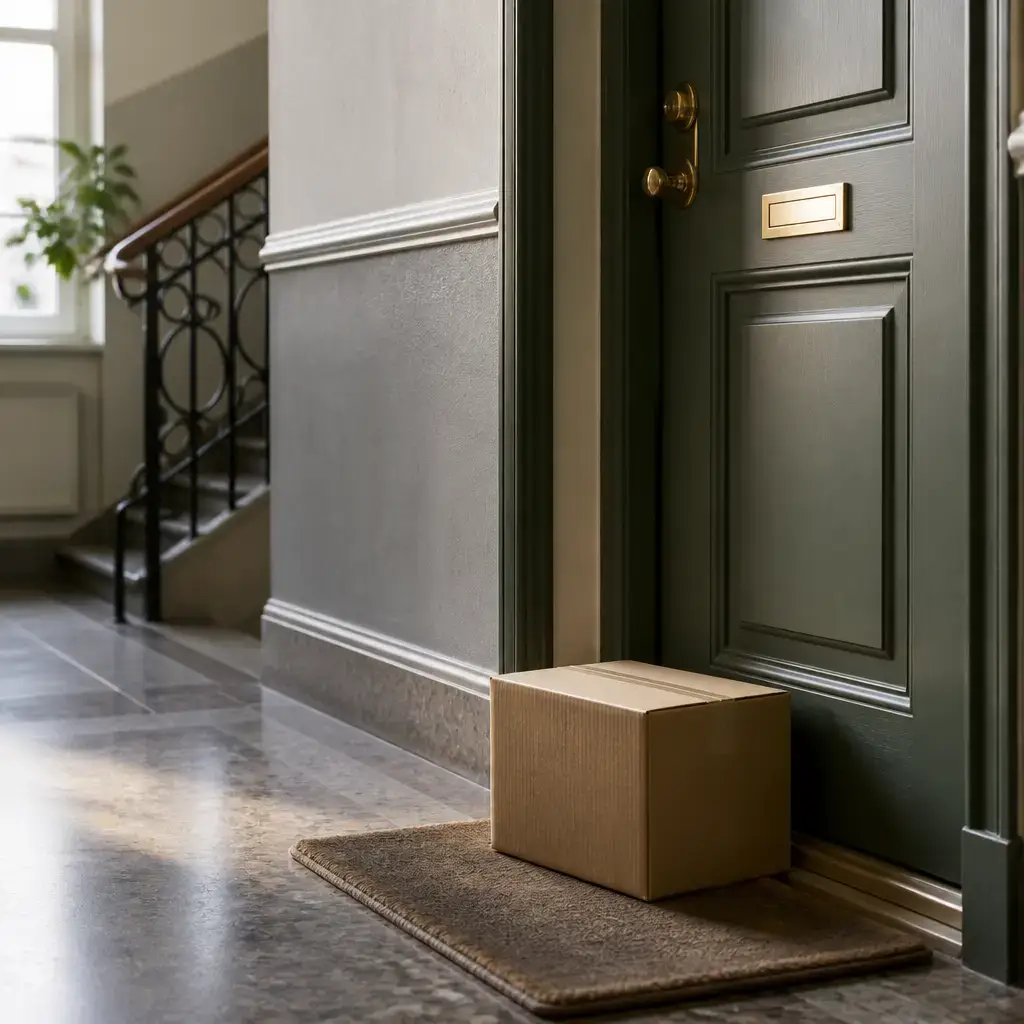
“En” introduces one unspecified package in “En pakke til min lejlighed.” It is reused before a singular noun when mentioning something for the first time, such as an item being delivered.
pakke
“Pakke” means package in “En pakke til min lejlighed.” A useful pattern is to use it with a destination or recipient, as in “til min lejlighed”; use it when discussing a delivery or parcel.
til
In “til min lejlighed,” “til” marks the intended destination or association of the package. It is commonly used before a person or place when saying where something is going or who it is for, such as when discussing a delivery.
min
“Min” means my and identifies the speaker’s apartment in “min lejlighed.” The same possessive pattern appears in “min dør”; use it before a noun when referring to something belonging to or connected with the speaker.
lejlighed
“Lejlighed” means apartment in “min lejlighed.” It can be used after a possessive to identify someone’s home, especially when explaining where a delivery should have gone.
blev
In “blev stillet,” “blev” helps describe the package as having been placed in the past. This form is useful when reporting what happened to an object, such as where a delivery was left.
stillet
“Stillet” means placed or left in “blev stillet uden for din dør.” Together with “blev,” it describes the package being put in a particular location; use this kind of form when reporting where something was left.
uden
In “uden for din dør,” “uden” contributes the meaning outside. The complete location expression is used before a place to say that something is on the exterior side, for example when locating a package.
for
In “uden for din dør,” “for” completes the expression meaning outside of and points to the area beyond the door. This expression is useful when specifying an object’s location relative to a building or room.
din
“Din” means your and identifies the other neighbor’s door in “din dør.” Use this possessive before a noun when referring directly to something belonging to or associated with the person being addressed.
dør
“Dør” means door in “din dør.” The dialogue also uses the definite form in “ved døren”; use this word when identifying the entrance or location where an item has been left.
Jeg
“Jeg” means I and marks the speaker as the subject, as in “Jeg opdagede den.” A common reuse pattern is to begin a statement about your own action with this subject; use it when reporting what you noticed or did.
opdagede
“Opdagede” means noticed or discovered in “Jeg opdagede den.” It reports that the speaker became aware of the package; use it with an object when explaining that you noticed something.
den
“Den” means it here and refers back to the package in “Jeg opdagede den.” It is useful for referring to an already identified item instead of repeating its name when discussing what you noticed, kept, or picked up.
og
“Og” means and and joins the two actions in “Jeg opdagede den og lod den stå.” Use it to connect related actions or pieces of information, such as noticing an item and leaving it in place.
lod
In “lod den stå,” “lod” means let or left something in a particular state. The pattern places the object before the following action; use it when explaining that you allowed or left an item where it was.
stå
“Stå” means stand or remain standing in “lod den stå.” It describes the package remaining in position by the door; use it after a verb meaning let or leave when an object stays in place.
ved
“Ved” means by or at in “ved døren.” It marks the location of the package next to the door; use it before a place when giving a nearby position.
døren
“Døren” means the door in “ved døren til dig.” It is the definite form used for a specific door already relevant in the conversation; use it when identifying that known location.
dig
“Dig” means you in “til dig,” where it identifies the person for whom the package was kept. This form is useful after an expression meaning for someone when offering help or holding something for that person.
håbede
“Håbede” means hoped in “Jeg håbede, at den ikke var blevet væk.” It expresses the speaker’s earlier concern; a reliable pattern is to follow it with a clause explaining what was hoped for.
at
In “Jeg håbede, at den ikke var blevet væk,” “at” introduces the content of the hope. Use it to connect an expression of hoping with the situation or event being hoped for.
ikke
“Ikke” makes the clause negative in “at den ikke var blevet væk.” It is used here before the rest of the verb phrase to say that the package had not disappeared; use it when denying an expected or feared situation.
var
In “var blevet væk,” “var” supplies the was part of the clause describing the package’s condition. It is useful when stating what state or situation something was in, including concern about whether an item was missing.
blevet væk
“Blevet væk” means gone missing or disappeared: “blevet” contributes the change into a state, while “væk” contributes the sense of being gone. Use the complete expression when explaining that an item can no longer be found.
Det
“Det” means it or that in “Det var sandsynligvis bare en forveksling af etiketterne,” referring to the situation just discussed. It is useful as the subject when giving an explanation or assessment of an event.
sandsynligvis
“Sandsynligvis” means probably in “Det var sandsynligvis bare en forveksling af etiketterne.” It signals that the speaker is making a likely explanation rather than stating complete certainty; use it before the explanation being proposed.
bare
“Bare” means just or simply in “Det var sandsynligvis bare en forveksling af etiketterne.” Here it narrows the problem down to a simple mix-up; use it to present an explanation as limited or uncomplicated.
forveksling
“Forveksling” means mix-up or confusion in “en forveksling af etiketterne.” It names the problem that caused the package to go to the wrong door; use it when similar items or labels have been confused.
af
In “en forveksling af etiketterne,” “af” links the mix-up with the labels involved. This pattern is useful when identifying the things that were confused in an error.
etiketterne
“Etiketterne” means the labels in “forveksling af etiketterne.” It refers to the specific labels connected with the package mix-up; use it when explaining which identifying information caused the confusion.
kan
“Kan” means can in “Jeg kan komme forbi” and “Jeg kan komme over med den.” It presents an available ability or option; use it before a verb when offering to do something for another person.
komme
“Komme” means come in “Jeg kan komme forbi.” After “kan,” it describes the proposed movement toward the neighbor; use it when arranging a visit or arrival.
forbi
In “komme forbi,” “forbi” contributes the idea of coming by for a brief visit. This expression is useful when offering to stop at someone’s place, such as to collect an item.
om
In “om et par minutter,” “om” means in when referring to a period from now. Use it before a time period to arrange or estimate when an action will happen.
et
“Et” is part of the quantity expression “et par minutter,” meaning a few minutes. Use this form before “par” when giving a small, approximate amount of time.
par
In “et par minutter,” “par” contributes the meaning a couple or few. The pattern is useful for giving an approximate small quantity, especially when estimating how soon someone will arrive.
minutter
“Minutter” means minutes in “et par minutter.” It names the time period used for the planned visit; use it with a quantity when giving a short time estimate.
hente
“Hente” means pick up or fetch in “komme forbi om et par minutter og hente den.” It describes retrieving the package; use it with an object when arranging to collect something.
over
In “komme over med den,” “over” helps express coming over to the other person while bringing the package. This pattern is useful when offering to take an item to someone nearby.
hvis
“Hvis” means if and introduces the condition in “hvis det er nemmere for dig.” Use it before a clause when making an offer that depends on what is more convenient for another person.
er
“Er” links a subject with a description in “det er nemmere for dig” and “jeg er allerede lige i nærheden.” Use it when describing a situation, such as whether an option is easier or where someone is located.
nemmere
“Nemmere” means easier in “det er nemmere for dig.” It compares the convenience of one option with another; use it when offering an alternative that may suit someone better.
sætter pris på
The expression “sætter pris på” means appreciate or value. “Sætter” provides the verb, “pris” names the value being expressed, and “på” completes the expression; use it to thank someone for help or consideration.
allerede
“Allerede” means already in “jeg er allerede lige i nærheden.” It shows that the speaker is in that situation before the proposed action; use it when explaining that something is true or completed by the relevant time.
lige
In “lige i nærheden,” “lige” strengthens the location to mean right nearby. Use this expression when reassuring someone that you are very close and can reach them easily.
i
In “i nærheden,” “i” means in and forms part of the location phrase for being nearby. Use it before a place or area when describing where someone or something is located.
nærheden
“Nærheden” means the vicinity or nearby area in “i nærheden.” Together with “i,” it tells the other person that the speaker is close; use it when explaining your current location.
stiller
In “Jeg stiller den ved min dør,” “stiller” means place or leave the package. It is used with an object and a location; use this pattern when arranging for an item to remain somewhere for another person.
indtil
“Indtil” means until and introduces the time endpoint in “indtil du kommer.” Use it before a clause to say that an action or arrangement continues up to someone’s arrival or another event.
kommer
“Kommer” means come or arrive in “indtil du kommer.” It identifies the other person’s arrival as the point when the package will no longer need to remain by the door; use it when referring to someone reaching a place.