Jeg
“Jeg” means “I” and is the speaker referring to themself. It is used as the subject in “Jeg ville lige nævne” and “Jeg var ikke klar over”. Use it when describing your own thoughts, actions, or reactions.
ville
In “Jeg ville lige nævne”, “ville” presents what the speaker wanted to mention in a softened, polite way. It comes before the infinitive “nævne”. A neighbor can use this form when raising a sensitive issue calmly.
lige
In “ville lige nævne”, “lige” softens the statement and makes it sound like a brief, considerate remark rather than a strong confrontation. It is placed before the main verb “nævne” in this expression. This is useful when introducing a point politely.
nævne
“Nævne” means “mention” in “ville lige nævne”. It is the infinitive following “ville”. Use “nævne” when bringing a fact or topic to someone’s attention.
at
In “at din musik”, “at” introduces the content of what the speaker wants to mention. In “at tale” and “at få”, it marks an infinitive. It is useful both for introducing a statement and for linking “at” to an action.
din
“Din” means “your” and identifies the music as belonging to or being associated with the person addressed. It appears directly before “musik” in “din musik”. Use “din” before the thing connected with one person you are addressing.
musik
“Musik” means “music” and refers here to the neighbor’s sound travelling through the wall. It appears after the possessive “din” in “din musik”. Use it when discussing music as a sound source or activity.
tydeligt
“Tydeligt” means “clearly” or “noticeably” in “tydeligt kan høres”. It describes how clearly the music can be heard. It can be used before a verb phrase to describe the clarity of an action or perception.
kan
In “kan høres”, “kan” expresses possibility: the music is able to be heard. It is followed here by “høres”. Use “kan” with a following verb form when saying that something is possible or can happen.
høres
“Høres” means “be heard” in “kan høres”. The form presents the music as something that people can hear, rather than focusing on who hears it. Use “kan høres” when describing a sound that is audible.
gennem
“Gennem” means “through” in “gennem væggen”. It describes the path by which the music travels through a physical barrier. Use “gennem” before something that a person, sound, or object passes through.
væggen
“Væggen” means “the wall” and refers to the specific wall between the neighbors. It is the definite form related to “væg”. It appears in the useful expression “gennem væggen” for describing something travelling through a wall.
var
“Var” means “was” in “Jeg var ikke klar over”. It describes the speaker’s earlier state of awareness. It is a form of “være” and is useful when describing a past state or situation.
ikke
“Ikke” means “not” and negates the statement in “var ikke klar over”. It comes before the expression it negates here. Use it to make a statement negative, especially before a verb phrase or description.
klar
In “var ikke klar over”, “klar” contributes the idea of being aware or clear, while “over” completes the expression. Together, “klar over” describes knowing or being aware of something. Use “klar over” before the fact or situation someone is aware of.
over
In “klar over”, “over” is part of the expression meaning “aware of”. It links the person’s awareness to the following clause “at den kunne høres hos dig”. Use “klar over” when stating that someone knows or realizes something.
den
“Den” means “it” here and refers back to “musik”. It is the subject of “kunne høres” in “at den kunne høres hos dig”. Use “den” to refer back to a previously mentioned noun or thing.
kunne
In “den kunne høres”, “kunne” expresses that the music could be heard. It is followed by “høres” and presents the possibility from the situation the speaker had not realized. Use “kunne” with a following verb when describing a possible or possible-to-perceive action.
hos
“Hos” means “at someone’s place” or “on someone’s side” in “hos dig”. It is used with a person rather than naming a physical route. Use “hos” before a person when referring to that person’s place, situation, or side.
dig
“Dig” means “you” in “hos dig”. It is the form used after the preposition “hos” to refer to the person being addressed. Use it when referring to one person as the object of a preposition.
Det
“Det” refers to the situation being discussed in “Det er mest tydeligt” and also appears in “Det ville hjælpe” and “Det er bedre”. It allows the speaker to evaluate a situation without repeating the whole idea. Use “Det er...” to introduce an assessment or description.
er
“Er” means “is” in “Det er mest tydeligt”. It links “Det” with the description “mest tydeligt”. It is useful for describing a current state, quality, or situation.
mest
“Mest” means “mostly” or “most” in “mest tydeligt”. Here it limits the statement, showing that the sound is mainly noticeable at the stated time. Use it before an adjective or adverb when indicating the greatest or main degree.
sent
“Sent” means “late” in “sent om aftenen”. It describes when the music is most noticeable. Use it with a time expression when saying that something happens late.
om
In “om aftenen”, “om” is used for a time period and means “in” or “during”. In “tale om det”, it introduces the topic being discussed and means “about”. Use “om” with time expressions or with “tale” to name a topic.
aftenen
“Aftenen” means “the evening” in “om aftenen”. It is the definite form related to “aften”. Use “om aftenen” when referring to activity during the evening.
når
“Når” means “when” and introduces the time or situation in “når der er stille i bygningen”. It connects the main statement with the condition under which the sound is noticeable. Use it before a clause describing when something happens.
der
In “der er stille”, “der” is an existential marker used to introduce the situation that there is quiet. It does not refer to a specific location in this clause. Use “der er” to state that a condition or thing exists.
stille
“Stille” means “quiet” in “der er stille i bygningen”. It describes the building as having little or no noise. Use it after “være” or in “der er stille” when describing a quiet environment.
i
“I” means “in” in “i bygningen”. It places the quiet situation inside the building. Use “i” before a place or area where something happens or exists.
bygningen
“Bygningen” means “the building” and refers to the shared building where the neighbors live. It is the definite form related to “bygning”. Use it when referring to a specific building already identified in the conversation.
skrue
In “skrue ned for bassen”, “skrue” describes adjusting a control, while “ned” indicates lowering and “for” links the adjustment to the bass. The whole expression means to turn the bass down. Use “skrue ned for” before a sound or setting that should be reduced.
ned
In “skrue ned for bassen”, “ned” indicates a reduction or downward adjustment. It works together with “skrue” and “for” to describe lowering the bass. Use it in “skrue ned for” when reducing a setting or volume.
for
In “skrue ned for bassen”, “for” links the adjustment to the thing being lowered. It is part of the expression “skrue ned for”. Use this preposition with that expression before the sound or setting being adjusted.
bassen
“Bassen” means “the bass” and refers to the low-frequency sound setting in the music. It is the definite form related to “bas”. It appears after “skrue ned for” in the practical suggestion “skrue ned for bassen”.
og
“Og” means “and” and joins the two proposed actions “skrue ned for bassen” and “flytte højttalerne væk fra væggen”. Use it to connect actions, objects, or statements that belong together.
flytte
“Flytte” means “move” in “flytte højttalerne væk fra væggen”. It is coordinated with “skrue” after “kan”. Use it before an object when describing changing that object’s position.
højttalerne
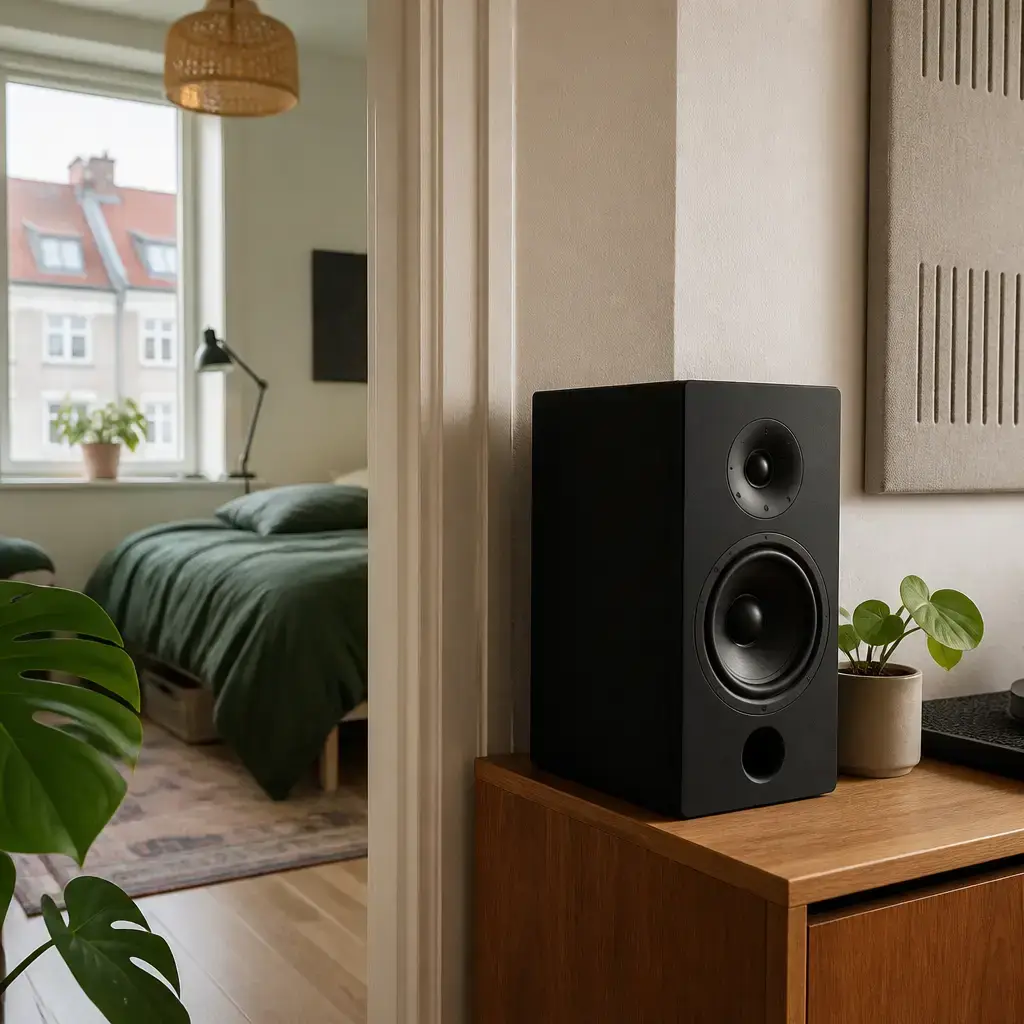
“Højttalerne” means “the speakers” and refers to the speakers producing the music. It is the definite plural form related to “højttaler”. Use it as the object of “flytte” when discussing moving the specific speakers.
væk
In “væk fra væggen”, “væk” means “away” and indicates increasing distance from the wall. It works together with “fra” to describe the direction of movement. Use “væk fra” before the place or object someone or something moves away from.
fra
In “væk fra væggen”, “fra” means “from” and identifies the wall as the point being moved away from. It completes the directional expression “væk fra”. Use “væk fra” before a place or object when describing separation or movement away.
hjælpe
“Hjælpe” means “help” in “Det ville hjælpe”. It is the action that the proposed changes are expected to support. Use it after a modal form such as “ville” when saying that an action or change would improve a situation.
især
“Især” means “especially” in “især på hverdagsaftener”. It gives special emphasis to weekday evenings as the time when the adjustment matters most. Use it before the time, person, or circumstance that deserves extra emphasis.
på
In “på hverdagsaftener”, “på” introduces the time period during which the change would be particularly helpful. It is used here with the plural time expression “hverdagsaftener”. Use “på” with a specified day or type of day or evening.
hverdagsaftener
“Hverdagsaftener” means “weekday evenings” or “work nights”. It identifies evenings when people may need quiet for ordinary weekday routines. Use it after “på” when referring to this type of evening.
Sig
“Sig” means “tell” in the instruction “Sig endelig til”. It is the imperative form of “sige” and asks the other person to communicate something. Use it in a direct but polite request when you want someone to let you know about a change or problem.
endelig
In “Sig endelig til”, “endelig” softens the instruction and means “please do” or “by all means”. It makes the invitation sound open and reassuring. Use it with a request when encouraging someone to speak up.
til
In “Sig endelig til”, “til” is part of the expression meaning “let me know”. In “villig til at tale”, it introduces the activity someone is willing to do. Use these expressions when asking for information or describing willingness to perform an action.
hvis
“Hvis” means “if” and introduces the condition “ændringen ikke er nok”. It shows what should happen if the adjustment does not solve the problem sufficiently. Use it before a conditional clause.
ændringen
“Ændringen” means “the change” and refers to the adjustment to the bass and speaker position. It is the definite form related to “ændring”. Use it when referring back to a specific change already discussed.
nok
“Nok” means “enough” in “ændringen ikke er nok”. It describes whether the change is sufficient to solve the noise problem. Use “er nok” or “ikke er nok” when evaluating whether something is sufficient.
sætter pris på
“Jeg sætter pris på” is a construction meaning “I appreciate” or “I value”. Within it, “sætter” supplies the verb, “pris” expresses value, and “på” links that value to the person or action appreciated. Use “sætter pris på” before a noun or an “at” clause, as in “sætter pris på, at du...”.
du
“Du” means “you” and is the subject of “du er villig til at tale om det”. It identifies the person whose willingness is being appreciated. Use it when addressing one person as the subject of a clause.
villig
“Villig” means “willing” in “du er villig til at tale”. It describes readiness to take part in the discussion. Use “villig til at” before an action someone is prepared to do.
tale
“Tale” means “talk” in “til at tale om det”. It is the infinitive after “at” and names the action of discussing the issue. Use “tale om” before the topic that is being discussed.
bedre
“Bedre” means “better” in “Det er bedre at få det her løst”. It presents resolving the issue as the preferable option. Use “Det er bedre at” before an action that is recommended over leaving the situation unresolved.
få
In “få det her løst”, “få” means “get” in the sense of bringing about a resolved result. The pattern places the object “det her” before the result “løst”. Use “få” with an object and a result when describing having something dealt with or completed.
her
In “det her”, “her” means “this” and points to the current noise issue. It does not indicate a physical location in this expression. Use “det her” when referring to a specific matter currently being discussed.
løst
“Løst” means “resolved” in “få det her løst”. It describes the desired result of dealing with the issue. Use it after an object in the pattern “få ... løst” when saying that a problem should be resolved.
før
“Før” means “before” and introduces the event that should not happen first: “det udvikler sig til spændinger”. It sets a time limit for resolving the issue. Use “før” before a clause describing a later or unwanted development.
udvikler
In “udvikler sig til spændinger”, “udvikler” means “develops” or “turns into”. It describes the noise issue becoming a more serious relational problem. Use “udvikle sig til” before the result or condition something may become.
spændinger
“Spændinger” means “tensions” and names the strained relations that could result if the issue is not resolved. It is the outcome after “udvikler sig til”. Use “udvikle sig til spændinger” when describing a situation becoming relationally tense.