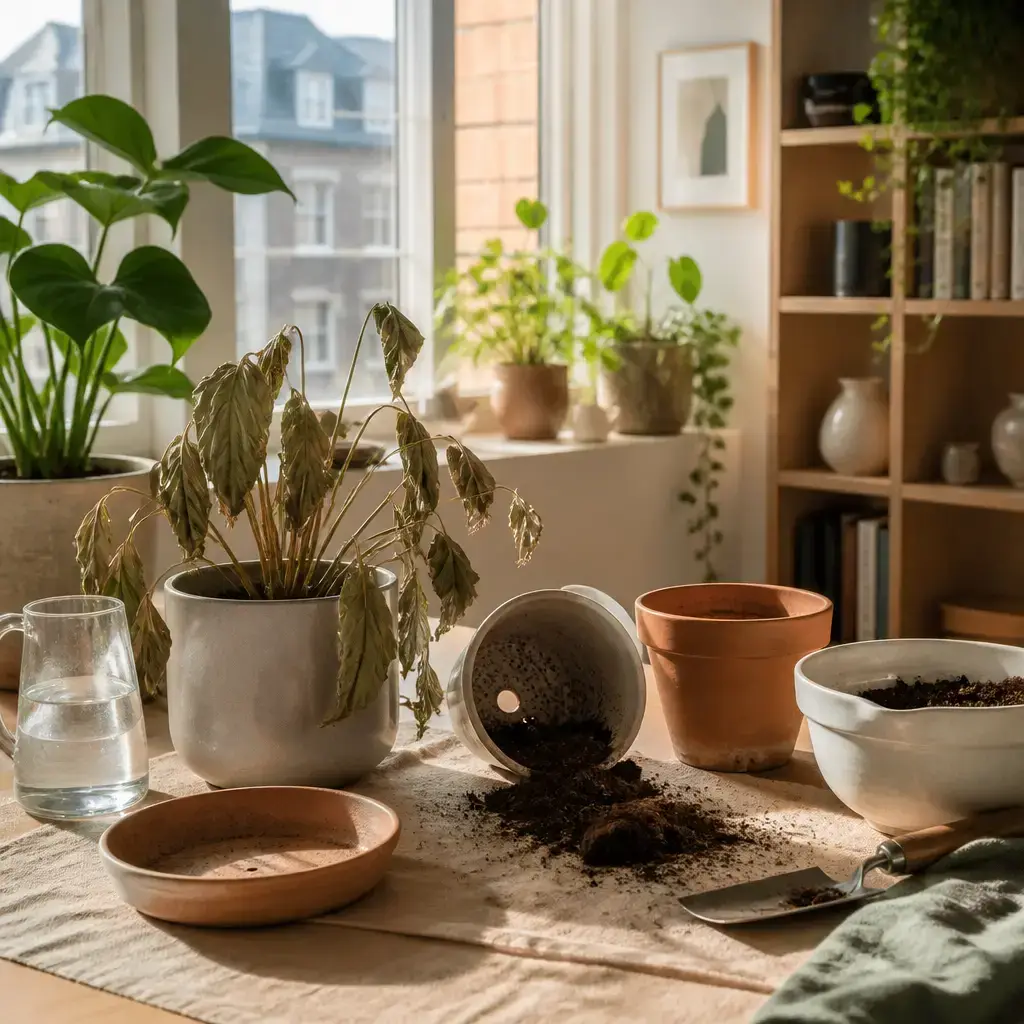
Min
In “Min plante visner,” this means “my” and identifies the plant as belonging to the speaker. Reuse Min before a singular noun when referring to something belonging to you.
plante
In “Min plante visner,” this means “plant,” the living thing being discussed. Reuse plante when naming a plant as the subject or object of a sentence.
visner
In “Min plante visner,” this describes the plant as wilting. Reuse plante visner when describing a plant that is losing its healthy condition.
selv
In “selv om jeg vander den ofte,” this contributes the meaning “even,” while the full expression means “even though.” Reuse selv om before a clause that contrasts with the main situation.
om
In “selv om jeg vander den ofte,” this is part of the expression meaning “even though.” Reuse selv om + a clause to introduce an unexpected or contrasting fact.
jeg
In “jeg vander den ofte,” this means “I” and names the person doing the watering. Reuse jeg as the subject when talking about your own action.
vander
In “jeg vander den ofte,” this means “water” in the context of giving water to the plant. Reuse a pattern such as jeg vander + an object when describing your watering routine.
den
In “vander den ofte,” this means “it” and refers back to the plant. Reuse den for a known object or plant when its identity is already clear.
ofte
In “vander den ofte,” this means “often” and describes repeated watering. Reuse ofte after the action or near the end of a sentence to describe frequency.
har
In “Den har måske fået for meget vand,” this is part of the expression “has gotten” and connects the plant with the water it has received. Reuse har fået + an object when describing something that has received or obtained something.
måske
In “Den har måske fået for meget vand,” this means “maybe” and shows that the speaker is making a possibility rather than a certainty. Reuse måske when giving a tentative explanation or suggestion.
fået
In “har måske fået for meget vand,” this means “gotten” or “received,” referring to the amount of water the plant has received. Reuse fået after har when describing something received or obtained.
for
In “for meget vand,” this means “too” and makes the amount excessive; in “i stedet for,” it is part of the expression meaning “rather than.” Reuse for meget or for lidt for excessive or insufficient amounts, and i stedet for to introduce an alternative.
meget
In “for meget vand,” this means “much” or “a lot” and refers to an excessive amount of water. Reuse for meget before an uncountable amount when saying that there is too much of it.
vand
In “for meget vand,” this means “water,” the substance given to the plant. Reuse vand when talking about watering, drainage, or the amount a plant receives.
i
In “i stedet for lidt,” this is part of the expression “instead of” or “rather than.” Reuse i stedet for before the alternative that replaces or contrasts with something else.
stedet
In “i stedet for,” this is the “place” element of the fixed expression meaning “instead of” or “rather than.” Learn stedet together with i stedet for when comparing two alternatives.
lidt
In “for lidt,” this means “too little,” while in “tørre lidt” it means “a little.” Reuse lidt for a small amount and for lidt when that amount is insufficient.
troede
In “Jeg troede, at mere vand ville hjælpe,” this reports the speaker’s earlier belief that more water would help. Reuse Jeg troede, at + a clause when explaining what you previously believed.
at
In “Jeg troede, at mere vand ville hjælpe,” this introduces the content of the belief; in “at komme sig” and “at observere,” it marks an infinitive. Reuse at after verbs such as troede to introduce a clause, and before an infinitive in the relevant construction.
mere
In “mere vand,” this means “more” and refers to an increased amount of water. Reuse mere before an amount or noun when comparing it with a smaller amount.
ville
In “ville hjælpe den med at komme sig,” this expresses the expected result of the earlier thought: the water would help. Reuse ville + a verb when describing what was expected or intended from a past viewpoint.
hjælpe
In “ville hjælpe den med at komme sig,” this means “help” and describes support for the plant’s recovery. Reuse hjælpe + an object + med at + a verb when saying that something helps someone or something do or achieve something.
med
In “hjælpe den med at komme sig,” this introduces what the help enables: the plant’s recovery. Reuse hjælpe + an object + med at + a verb for help connected with an action or result.
komme
In “komme sig,” this is part of the expression meaning “recover” or “return to a better condition.” Reuse komme sig when describing a person, plant, or other subject recovering.
sig
In “komme sig,” this is the reflexive part of the expression meaning “recover.” Learn sig together with komme in komme sig rather than treating the two words as a separate English-style phrase.
Tjek
In “Tjek dræningen,” this is a direct instruction to check or inspect the drainage. Reuse Tjek + a noun when telling someone to inspect something.
dræningen
In “Tjek dræningen,” this means “the drainage,” specifically the way excess water can leave the pot. Reuse dræningen when discussing whether water can escape from soil or a container.
og
In “Tjek dræningen, og lad jorden tørre lidt,” this means “and” and joins two instructions. Reuse og to connect related actions or instructions.
lad
In “lad jorden tørre lidt,” this means “let” and tells someone to allow the soil to dry. Reuse lad + a noun or pronoun + an infinitive when giving permission or an instruction to allow an action.
jorden
In “lad jorden tørre lidt,” this means “the soil,” the material surrounding the plant’s roots. Reuse jorden when discussing how wet or dry the soil is.
tørre
In “lad jorden tørre lidt,” this means “dry” and describes the change the soil should be allowed to undergo. Reuse lad something tørre when telling someone to let something dry.
Krukken
In “Krukken har ikke noget hul,” this means “the pot,” the container holding the plant. Reuse Krukken when referring to a particular pot already known in the conversation.
ikke
In “har ikke noget hul,” this means “not” and negates the statement that the pot has a hole. Reuse ikke before the relevant part of a sentence when expressing negation.
noget
In “ikke noget hul,” this means “any” within the negative idea “no hole.” Reuse ikke noget before a noun when saying that there is none of something.
hul
In “noget hul i bunden,” this means “hole,” referring to an opening in the bottom of the pot. Reuse hul when describing an opening in a container or other object.
bunden
In “i bunden,” this means “the bottom,” identifying the lower part of the pot. Reuse i bunden when locating something at the bottom of an object.
det
In “det kan være problemet,” this means “it” and refers to the lack of a hole or the situation just described. Reuse det kan være + a noun when identifying a possible cause or explanation.
kan
In “det kan være problemet,” this expresses possibility: the missing hole may be the problem. Reuse kan + an infinitive when saying that something can or may happen or be true.
være
In “kan være problemet,” this means “be” and links the possible cause with the problem. Reuse kan være + a noun or description when identifying a possible state or explanation.
problemet
In “det kan være problemet,” this means “the problem,” referring to the likely cause of the plant’s condition. Reuse problemet when discussing a specific difficulty already being investigated.
Rødder
In “Rødder kan tage skade,” this means “roots,” the parts of the plant affected by excess water. Reuse Rødder when explaining how conditions in the soil affect a plant.
tage
In “tage skade,” this is part of the expression meaning “suffer harm” or “be damaged.” Reuse noget kan tage skade when explaining that a person, plant, or object may be harmed.
skade
In “tage skade,” this means “harm” or “damage,” describing the negative effect on the roots. Learn skade together with tage in the expression tage skade.
når
In “når vandet ikke har nogen steder at løbe ud,” this means “when” and introduces the condition under which the roots can suffer. Reuse når + a clause when describing a time or condition.
vandet
In “vandet ikke har nogen steder at løbe ud,” this means “the water,” referring to the water in or around the plant’s soil. Reuse vandet when referring to a specific amount of water already under discussion.
nogen
In “ikke har nogen steder,” this means “any” within the negative expression “has nowhere.” Reuse ikke ... nogen before a noun when saying that there are no examples or places of something.
steder
In “nogen steder at løbe ud,” this means “places,” referring to possible routes for the water to escape. Reuse steder when talking about locations or possible places for an action to happen.
løbe
In “løbe ud,” this means “flow” in the context of water moving out. Reuse løbe ud for liquid that moves outward from a container or area.
ud
In “løbe ud,” this means “out” and completes the direction of the water’s movement. Reuse ud after a movement verb when something moves from inside to outside.
Skal
In “Skal jeg også flytte den,” this asks whether the speaker should move the plant as well. Reuse Skal jeg + an infinitive when asking whether you should do something.
også
In “Skal jeg også flytte den,” this means “also” or “too” and adds moving the plant as another possible change. Reuse også when adding an action or fact to something already mentioned.
flytte
In “flytte den tættere på vinduet,” this means “move,” referring to changing the plant’s position. Reuse flytte + an object + a location or direction when describing relocation.
tættere
In “tættere på vinduet,” this means “closer” and describes a position nearer to the window. Reuse tættere på + a place or person when comparing positions.
på
In “tættere på vinduet,” this is part of the expression meaning “closer to.” Reuse tættere på before the place or person that something approaches.
vinduet
In “tættere på vinduet,” this means “the window,” the possible new location for the plant. Reuse vinduet when referring to a particular window already known in the situation.
Prøv
In “Prøv at ændre én ting ad gangen,” this is an instruction to try an action. Reuse Prøv at + an infinitive when suggesting that someone test or attempt something.
ændre
In “ændre én ting ad gangen,” this means “change,” referring to making one adjustment to the plant-care routine. Reuse ændre + an object when describing a change to a thing, plan, or method.
ting
In “én ting ad gangen,” this means “thing” and refers to one individual change or factor. Reuse ting when referring generally to an item or factor that can be changed or considered.
ad
In “ad gangen,” this is part of the expression meaning “at a time.” Reuse ad gangen after an amount or item when describing a step-by-step sequence.
gangen
In “ad gangen,” this completes the expression meaning “at a time.” Reuse ad gangen in patterns such as én ad gangen when actions should be done separately.
så
In “så du kan se, hvad der hjælper,” this means “so that” and introduces the purpose of changing one thing at a time; in “Så potter jeg den om,” it means “then.” Reuse så before a result or purpose clause, and at the beginning of a sentence when marking the next step.
du
In “så du kan se,” this means “you” and refers to the person who will identify what helps. Reuse du as the subject when addressing one person directly.
se
In “kan se, hvad der hjælper,” this means “see” in the sense of identifying or telling which change is effective. Reuse kan se, hvad ... when saying that someone can determine or observe a result.
hvad
In “hvad der hjælper,” this means “what” and introduces the thing that needs to be identified. Reuse hvad der + a verb when asking or explaining what performs an action or has an effect.
der
In “hvad der hjælper,” this helps connect “what” with the action “helps.” Reuse the pattern hvad der + a verb when referring to the unknown thing that performs the action.
hjælper
In “hvad der hjælper,” this means “helps” and identifies which change has a beneficial effect. Reuse X hjælper when saying that a person, action, or thing is beneficial.
potter
In “potter jeg den om,” this means “repot” and describes moving the plant into a different or more suitable pot. Reuse potte + an object + om when describing repotting a plant.
mindre
In “vander den mindre,” this means “less” and refers to reducing the watering. Reuse vande ... mindre when saying that a plant should receive less watering than before.
denne
In “denne uge,” this means “this” and points to the week currently being discussed. Reuse denne before a noun when referring to the current or specifically identified period or thing.
uge
In “denne uge,” this means “week,” the period during which the speaker will change the plant care. Reuse uge when specifying a weekly time period.
Plantepleje
In “Plantepleje handler mest om at observere,” this means “plant care,” the general activity of looking after plants. Reuse Plantepleje when discussing watering, light, soil, or other care tasks.
handler
In “Plantepleje handler mest om at observere,” this means “is about” or “concerns.” Reuse noget handler om + a noun or infinitive when explaining the main subject or purpose of something.
mest
In “handler mest om,” this means “mostly” and shows that observation is the main part of plant care. Reuse mest om when describing what something is mainly concerned with.
observere
In “at observere,” this means “observe,” referring to carefully watching the plant and its condition. Reuse at observere when naming observation as an activity or method.
lave
In “lave små justeringer,” this means “make” or “do,” referring to carrying out small changes. Reuse lave + a noun when describing the action of making or carrying out something.
små
In “små justeringer,” this means “small” and describes changes that are limited rather than major. Reuse små before a noun when describing adjustments or objects of limited size or scope.
justeringer
In “lave små justeringer,” this means “adjustments,” referring to minor changes in plant care. Reuse lave justeringer when describing practical changes made to improve a situation.