Min
In "Min paraply", this means “my” and shows that the umbrella belongs to the speaker. The capital letter is used because "Min" starts the sentence; the same word appears as lowercase "min" before a noun elsewhere. Use it before the thing that belongs to someone.
paraply
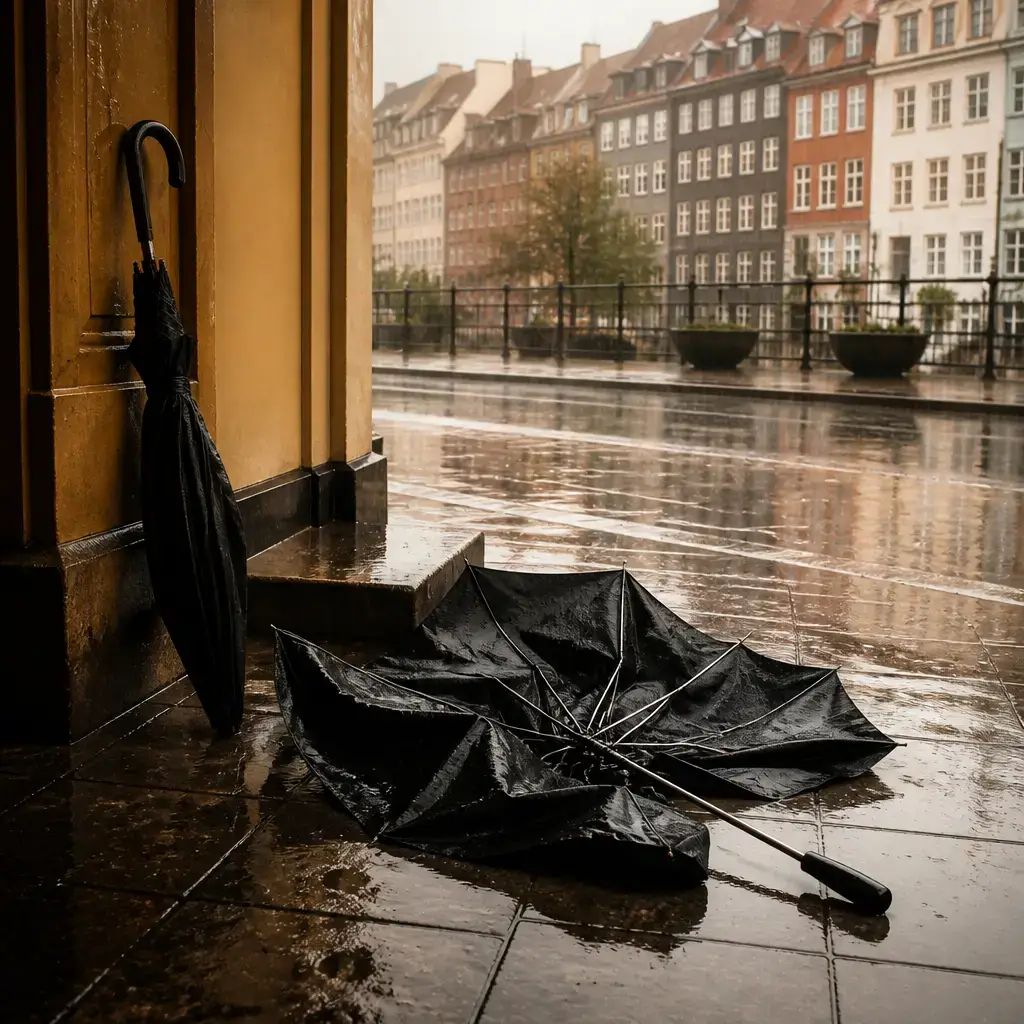
In "Min paraply", this means “umbrella”, the object that broke in the wind. It is the noun being described by "Min". Use it when talking about the item that protects you from rain.
gik i stykker
The whole expression "gik i stykker" means “broke” or “stopped working” here. "gik" supplies the past event, "i" links into the expression, and "stykker" contributes the idea of pieces; together they describe the umbrella becoming unusable. Use this expression for an object that breaks, as in "Min paraply gik i stykker".
den
This form has two functions in the dialogue. In "den stærke vind", it means “the”, while in "den så ud til" it means “it” and refers back to the rain. Identify its function from the noun phrase or clause around it.
stærke
In "den stærke vind", this means “strong” and describes the wind. The -e ending is used in this definite noun phrase after "den". Use the pattern "den" followed by an adjective and a noun when describing a specific thing.
vind
In "den stærke vind", this means “wind”, specifically the strong wind that broke the umbrella. It is the noun after the adjective "stærke". Use it when describing weather conditions outside.
Kom
In "Kom ind i tørvejr", this is an invitation or command meaning “come”. It is the imperative form of "komme" and addresses the person who is standing in the rain. Use it to invite someone to move toward you or into a place.
ind
In "Kom ind i tørvejr", this means “in” or “inside” and indicates movement inward, toward shelter. Together with "Kom", it forms the familiar invitation “come in”. Use "Kom ind" when inviting someone inside.
i
In "i tørvejr", this means “in” the dry shelter or dry conditions; in "i den stærke vind", it refers to being in the strong wind. It is a preposition that links a person or thing to a place or surrounding condition. Use it before a place or weather condition in these patterns.
tørvejr
In "i tørvejr", this means shelter from the rain or dry conditions. The expression tells the listener to move out of the rain rather than remain exposed. Use it when offering someone a dry place during wet weather.
før
In "før du bliver gennemblødt", this means “before” and sets a time limit for the invitation. It introduces the event that should be avoided. Use it before a clause describing what may happen later.
du
This form means “you” and refers to the person being helped in the rain. In "før du bliver gennemblødt", it is the person who may get soaked; the capitalized "Du" at the start of another sentence is the same word. Use it as the subject when speaking directly to one person.
bliver
In "du bliver gennemblødt", this means “becomes” or “gets” and describes a change into a soaked state. It is the present form of "blive" and is followed here by "gennemblødt". Use "bliver" with a description of a new or changing condition.
gennemblødt
In "du bliver gennemblødt", this means “soaked through” and describes the state the person may reach in the rain. It follows "bliver" to show the resulting condition. Use it when someone or something has become completely wet.
Regnen
In "Regnen er kraftigere", this means “the rain” and is the subject being described. The ending in "Regnen" marks the specific rain discussed in the situation. Use it when talking about the rain that is falling or has just been observed.
er
In "Regnen er kraftigere", this means “is” and links the rain to its description. It is the present form used to state the current condition of the rain. Use it to connect a subject with a description.
kraftigere
In "Regnen er kraftigere", this means “heavier” or “more intense”, referring to the rain. The -ere ending marks a comparison with how the rain first appeared. Use the pattern "kraftigere end" when comparing intensity.
end
In the comparison "kraftigere, end den så ud til", this means “than”. It connects the current intensity of the rain with its earlier appearance. Use it after a comparative description to introduce the point of comparison.
så ud til
The whole expression "så ud til" means “looked” or “seemed to” in the dialogue. "så" is the past-looking part, while "ud til" completes the expression of appearance and leads to what seemed to be true. Use it when an observation gives an impression that may differ from the actual situation.
kan
This form means “can” or “be able to”. In the dialogue it appears in "kan låne", "kan klare" and "kan aflevere", followed by an infinitive. Use it to express ability, possibility or permission.
låne
In "Du kan låne min ekstra paraply", this means “borrow”, referring to taking the umbrella for temporary use. The thing being borrowed follows the verb in this sentence. Use "låne" with the item someone may borrow.
ekstra
In "min ekstra paraply", this means “extra” and identifies an additional umbrella that is available. It comes before the noun it describes. Use it before a noun when there is an additional item beyond the one normally needed.
sikker
In "Er du sikker på", this means “sure” or “certain” and asks whether the listener is confident about something. It is commonly used with "på" before the content being checked. Use it when confirming that someone really means or knows something.
på
In "sikker på, at du ikke har brug for den", this is the preposition used after "sikker" to connect certainty with its content. It does not mean literal physical “on” here. Use it in the fixed pattern "sikker på" when asking or stating whether something is certain.
at
In "at du ikke har brug for den", this means “that” and introduces the information being checked. It links the expression "sikker på" to a complete clause. Use it before a clause that states what someone is sure or unsure about.
ikke
In "du ikke har brug for den", this means “not” and makes the statement about needing the umbrella negative. It appears before the verb phrase in this clause. Use it to deny or negate an action or situation.
har brug for
The whole expression "har brug for" means “need”. "har" contributes the idea of having, "brug" contributes use or need, and "for" completes the fixed relation to the needed item. Use "har brug for" followed by the thing that is needed, as in "har brug for den".
Jeg
In "Jeg har en regnfrakke", this means “I” and identifies the person speaking. It is the subject of the sentence. Use it before the verb when speaking about yourself.
har
In "Jeg har en regnfrakke", this means “have” and states that the speaker possesses a raincoat. The same form also appears inside the expression "har brug for". Use it before an item someone possesses or as part of that fixed expression for needing something.
en
In "en regnfrakke", this means “a” and introduces one unspecified raincoat. It comes directly before the noun. Use it before a singular item when introducing it as one of a kind.
regnfrakke
In "en regnfrakke", this means “raincoat”, the clothing that protects the speaker from the rain. It is the item possessed after "har". Use it when talking about waterproof outer clothing for wet weather.
så
In "så jeg kan klare mig", this means “so” or “therefore” and links having a raincoat to being able to manage. The same form also occurs in the expression "så ud til", where it contributes to the meaning “looked” or “seemed to”. Use the standalone connector to introduce a result or consequence.
klare mig
The whole expression "klare mig" means “manage” or “cope”. "klare" expresses managing, while "mig" refers back to the speaker as the person managing; together they mean manage on one’s own or in the situation. Use it after "kan", as in "kan klare mig", when explaining that you can cope.
aflevere
In "kan aflevere den", this means “return” or “hand back”, referring to returning the borrowed umbrella. It follows "kan" as the action the speaker is able to perform. Use it with the item being handed back.
morgen
In the time expression "i morgen", this means “tomorrow”. It identifies when the umbrella can be returned. Use "i morgen" to refer to the day after today.
Bare
In "Bare hold dig tør", this means “just” or “simply” and makes the instruction sound like a straightforward piece of advice. It comes before the command. Use it when giving a simple, reassuring instruction.
hold
In "hold dig tør", this means “keep” or “stay” and tells the listener to remain in a dry condition. It is the imperative form of "holde" and is used with "dig" and "tør" here. Use it in this pattern when telling someone to maintain a condition.
dig
In "hold dig tør", this refers to “yourself” and is the object linked to the listener. Together with "hold" and "tør", it means “stay dry”. Use it after "hold" when the listener is the person who should remain in a condition.
tør
In "hold dig tør", this means “dry” and describes the condition the listener should maintain. It completes the advice about staying protected from the rain. Use it after "hold dig" when telling someone to remain dry.
vej
In "på vej hjem", this means “way” or “route” and refers to the journey toward home. Together with "på" and "hjem", it forms a common expression for being on the way. Use "på vej" when talking about someone’s journey.
hjem
In "på vej hjem", this means “home” and indicates the destination of the listener’s journey. The phrase means “on your way home”. Use it in this expression when someone is travelling back to their home.