Er
Er means “is/are” here and begins the question about whether a quiet area exists. Reuse Er der ...? when asking whether a place or resource is available, such as when speaking to library staff.
der
In Er der et roligt område, der helps present something as existing or being available. Reuse Der er ... to say that something exists or is located somewhere.
et
Et means “a/an” before område in this dialogue. It is used before a neuter singular noun, so reuse et before a neuter noun when introducing one place or object.
roligt
Roligt means “quiet” or “calm” when describing område. This form is used with the neuter noun område; reuse et roligt ... when describing a quiet neuter place or thing.
område
Område means “area” in the question about a place to work. Reuse it after a place description such as et roligt område when asking about a specific area.
hvor
Hvor means “where” in the part that specifies where the speaker can work. Reuse hvor after a place expression to add the location of an action.
jeg
Jeg means “I” and identifies the speaker as the person who can work. Reuse jeg before an action when talking about something you can or will do.
kan
Kan means “can” in kan arbejde, expressing the speaker’s ability or possibility to work there. Reuse jeg kan + an action when saying what you can do.
arbejde
Arbejde means “work” here and follows kan. Reuse kan arbejde when saying that someone can work in a particular place.
borde
Borde means “desks” or “tables” in the library. It is the plural form of bord; reuse borde til ... when referring to several desks or tables intended for an activity.
til
Til means “for” in borde til stille arbejde and til telefonopkald, marking the intended use. Reuse noun + til + activity or purpose when saying what something is for.
stille
Stille means “quiet” in stille arbejde, describing work done without noise. Reuse stille before an activity or noun when describing a quiet form of it.
ovenpå
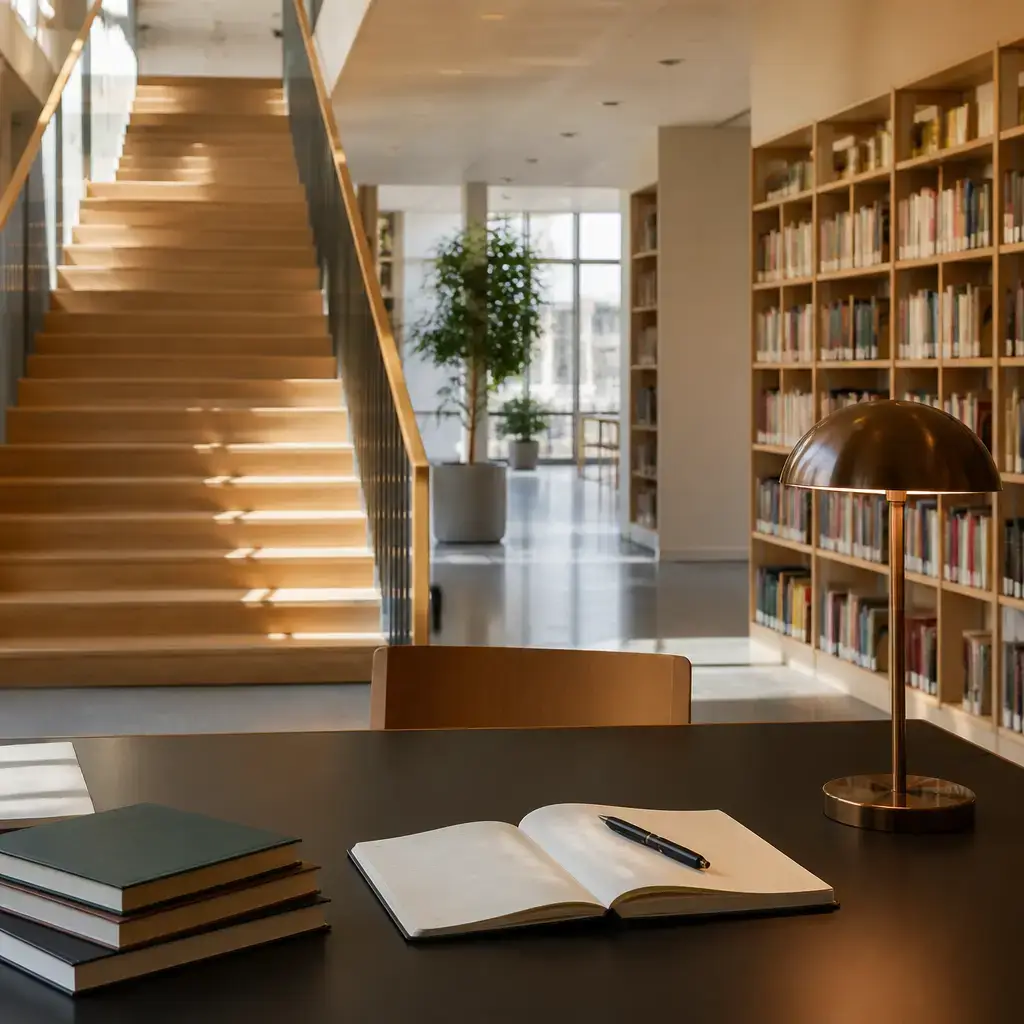
Ovenpå means “upstairs” and gives the location of the desks. Reuse ovenpå when directing someone to a higher floor or area, as in ovenpå til venstre.
venstre
Venstre means “left” in til venstre, giving a direction. Reuse til venstre when telling someone where to go or where something is located.
Må
Må means “may I” or “can I” in this permission question. Reuse Må jeg ...? when politely asking whether you are allowed to do something.
tale
Tale means “talk” or “speak” in tale kort i telefon and follows Må. Reuse Må jeg tale ...? when asking permission to speak in a particular situation.
kort
Kort means “briefly” in tale kort, indicating that the conversation will be short. Reuse tale kort when saying that you want to speak for only a short time.
i
I means “in” as part of i telefon, the expression used for talking on the phone. Reuse i telefon with tale when describing a phone conversation.
telefon
Telefon means “phone” in i telefon. Together, i telefon describes speaking by phone; reuse tale i telefon for talking on the phone.
De
De means “those” and points back to the desks already mentioned. This capitalized form starts the sentence; reuse De before a plural noun when referring to specific items that have already been identified.
kun
Kun means “only” and limits the desks to silent study. Reuse kun til ... to state that something is reserved exclusively for a particular purpose.
at
At introduces the activity studere in til at studere i stilhed. Reuse til at + an action when explaining that something is intended for doing that action.
studere
Studere means “study” in at studere i stilhed. It follows at here and names the activity the desks are intended for; reuse til at studere when describing a place for studying.
stilhed
Stilhed means “silence” in i stilhed, describing studying without noise. Reuse i stilhed when saying that an activity is done silently or in silence.
Så
Så means “then” or “so” at the start of the speaker’s decision. Reuse Så ... to connect new information with a resulting choice or action.
tager
Tager means “take” in tager mine telefonopkald, referring to handling phone calls. The citation form is tage, while tager is the form used here; reuse tager ... when describing what someone takes or handles.
mine
Mine means “my” before the plural noun telefonopkald. Reuse mine before plural nouns for things belonging to or associated with the speaker.
telefonopkald
Telefonopkald means “phone calls” in mine telefonopkald. Reuse it after an expression such as tager mine when talking about handling the speaker’s calls.
andet
Andet means “another” or “different” in et andet sted, referring to a different place from the desks. This form is used with the neuter noun sted; reuse et andet before a different neuter place or thing.
sted
Sted means “place” in et andet sted. Reuse it after a location description when referring to a place where someone can go or do something.
Forhallen
Forhallen means “the lobby” and is the place recommended for calls. The citation form is forhal, while Forhallen is the definite form used here; reuse it as the subject when describing what the lobby is suitable for.
bedre
Bedre means “better” in bedre til telefonopkald, comparing the lobby’s suitability for calls with the desks. Reuse er bedre til ... when saying that one place or option is more suitable for an activity.
bord
Bord means “desk” or “table” in et bord ovenpå. Reuse et bord when referring to one desk or table in a practical location.
passer
Passer means “suits” or “works” in passer fint til mig, saying that the upstairs desk is suitable for the speaker. The citation form is passe, while passer is the form used here; reuse something passer til mig when saying that it suits you.
fint
Fint means “fine” or “well” in passer fint til mig and strengthens the positive assessment. Reuse passer fint til ... when saying that something suits a person well.
mig
Mig means “me” after til in til mig, identifying the person for whom the desk is suitable. Reuse til mig when saying that something is intended for or suits the speaker.
som
Som contributes to the expression som regel, which means “usually” or “as a rule.” Reuse som regel to describe something that normally happens.
regel
Regel means “rule” within som regel, but the whole expression means “usually.” Reuse som regel when describing a normal or typical situation, such as the usual calm in the afternoon.
om
Om means “in” or “during” in om eftermiddagen, marking a time of day. Reuse om before a time expression such as om eftermiddagen when saying when something happens.
eftermiddagen
Eftermiddagen means “the afternoon” in om eftermiddagen. The citation form is eftermiddag, while eftermiddagen is the definite form used here; reuse om eftermiddagen to specify that something happens during the afternoon.