Jeg
“Jeg” means “I” and is the speaker in “Jeg har en reservation på et værelse her.” It is used as the subject before what the speaker has or does.
har
“har” means “have” in “Jeg har en reservation på et værelse her.” It expresses possession here and is followed by the thing possessed, such as “en reservation”.
en
“en” means “a” or “an” before “reservation” in “en reservation.” It introduces one reservation without making it definite.
reservation
“reservation” means “reservation” in “en reservation på et værelse.” It names the booking the guest has at the hotel; a useful pattern is “en reservation på” followed by what has been reserved.
på
“på” links “reservation” to “et værelse” in “en reservation på et værelse,” giving the room connected with the reservation. This expression can be reused when specifying what a reservation is for.
et
“et” means “a” or “an” before “værelse” in “et værelse.” It introduces one room without making it definite.
værelse
“værelse” means “room” in “et værelse.” At a hotel, it identifies the room connected with the guest’s reservation.
her
“her” means “here” in both “Her er det” and “en reservation på et værelse her.” It points to the current place; at the beginning of a sentence it appears as the capitalized form “Her”.
Må
“Må” asks for permission in “Må jeg se dit pas, tak?” Together with “jeg” and “se,” it makes a polite request to be allowed to see something.
se
“se” means “see” in “Må jeg se dit pas, tak?” It follows “Må jeg” in this polite request and takes “dit pas” as the thing to be seen.
dit
“dit” means “your” in “dit pas.” It identifies the passport as belonging to the person being addressed and comes directly before “pas”.
pas
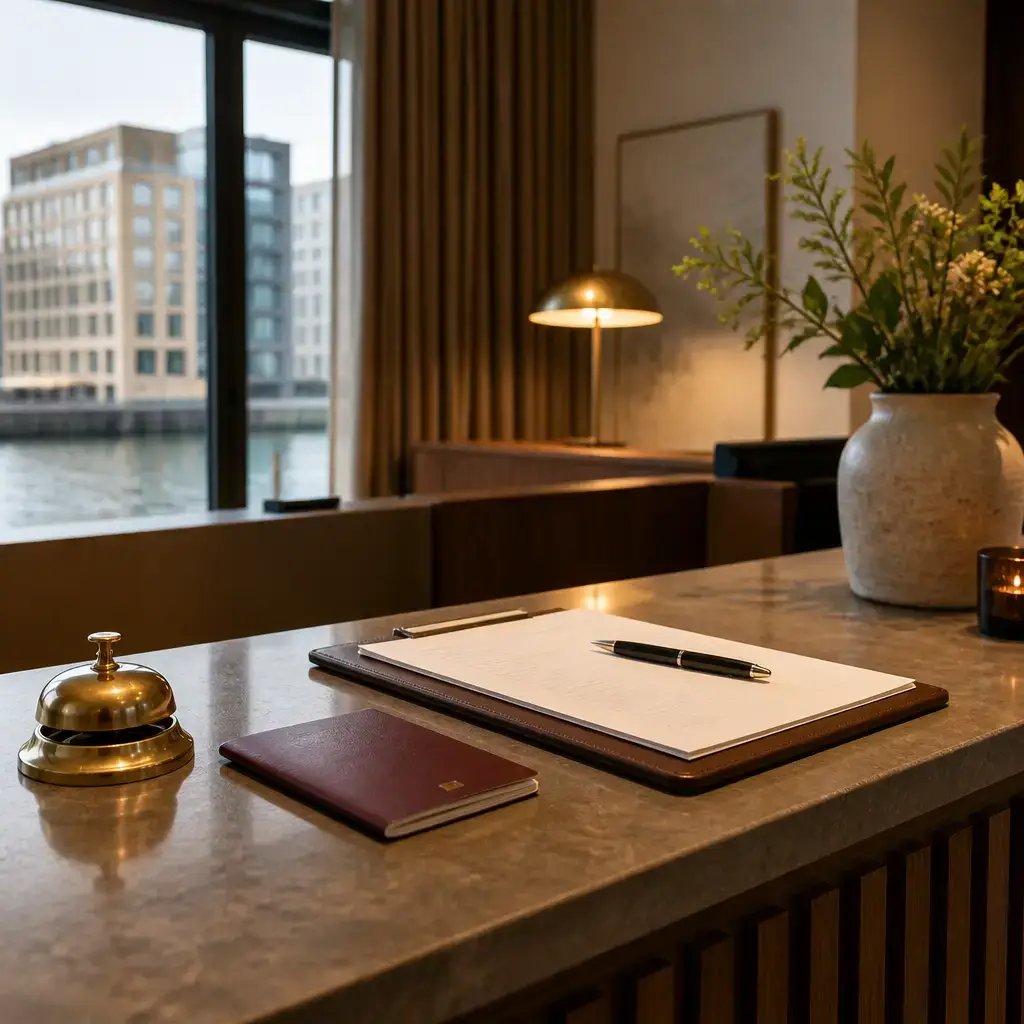
“pas” means “passport” in “dit pas.” It is the identity document the receptionist asks the guest to show.
tak
“tak” means “please” at the end of “Må jeg se dit pas, tak?” Here it softens the request rather than expressing thanks for something already received.
er
“er” means “is” in “Her er det.” It connects the location “Her” with the item “det” being presented.
det
“det” means “it” in “Her er det” and refers to the passport that is being shown. In “Jeg har det klar,” it refers to the same prepared item.
klar
“klar” means “ready” in “Jeg har det klar.” It says that the item is prepared for use or presentation; a reusable pattern is having an item ready for a task.
Kunne
“Kunne” helps make “Kunne du skrive under her?” a polite request, meaning “Could you sign here?” The pattern “Kunne du” is followed by the requested action.
du
“du” means “you” in “Kunne du skrive under her?” It refers to the guest being asked to perform the action.
skrive under
“skrive under” means “sign” in “Kunne du skrive under her?” The whole expression is used for signing a document: “skrive” and “under” work together as one expression, followed here by “her” to show where to sign.
også
“også” means “also” or “too” in “Har du også brug for min underskrift på denne formular?” It adds the idea that the signature is needed in addition to something else.
brug for
“brug for” expresses “need” in “Har du også brug for min underskrift på denne formular?” The two parts work together in the construction “har brug for,” which is followed by the thing that is needed.
min
“min” means “my” in “min underskrift.” It shows that the signature belongs to the speaker and comes before the noun it describes.
underskrift
“underskrift” means “signature” in “min underskrift.” It names the written signature the receptionist may need on the form.
denne
“denne” means “this” in “denne formular.” It points to the particular form being discussed and comes before “formular”.
formular
“formular” means “form” in “denne formular.” It refers to the document the guest may need to sign.
fint
“fint” means “fine” or “okay” in “Det er fint nederst på formularen.” The receptionist uses it to approve the suggested place for the signature.
nederst
“nederst” means “at the bottom” in “nederst på formularen.” It gives the position on the form and is followed by the location phrase “på formularen”.
formularen
“formularen” means “the form” in “på formularen.” It refers to the specific form already being discussed; the ending makes the form definite.
Hvor
“Hvor” means “where” in “Hvor serveres morgenmaden i morgen tidlig?” It asks for the location of the breakfast service.
serveres
“serveres” means “is served” in “Hvor serveres morgenmaden i morgen tidlig?” It describes the serving of breakfast and is used in the question pattern “Hvor serveres” when asking about its location.
morgenmaden
“morgenmaden” means “the breakfast” in “Hvor serveres morgenmaden i morgen tidlig?” It refers to the specific breakfast offered by the hotel; the ending makes “morgenmad” definite.
i
“i” has two location or time uses in this dialogue. In “i morgen tidlig” it forms the time expression “tomorrow morning,” while in “I spisesalen” it means “in” a place; the capital letter in “I” is only because it begins the sentence.
morgen
“morgen” means “tomorrow” in the time expression “i morgen tidlig.” Together with “tidlig,” it specifies that the breakfast service is tomorrow morning.
tidlig
“tidlig” means “early” in “i morgen tidlig.” It adds the time detail that the breakfast is served early tomorrow.
spisesalen
“spisesalen” means “the dining room” in “I spisesalen tæt på receptionen.” It names the place where breakfast is served; “I spisesalen” is a useful location phrase.
tæt på
“tæt på” means “near” or “close to” in “tæt på receptionen.” The parts work together: “tæt” expresses closeness and “på” connects that closeness to the place that follows; the pattern is “tæt på” plus a location.
receptionen
“receptionen” means “the reception” in “tæt på receptionen.” It identifies the hotel reception desk as the place near the dining room; the ending makes “reception” definite.