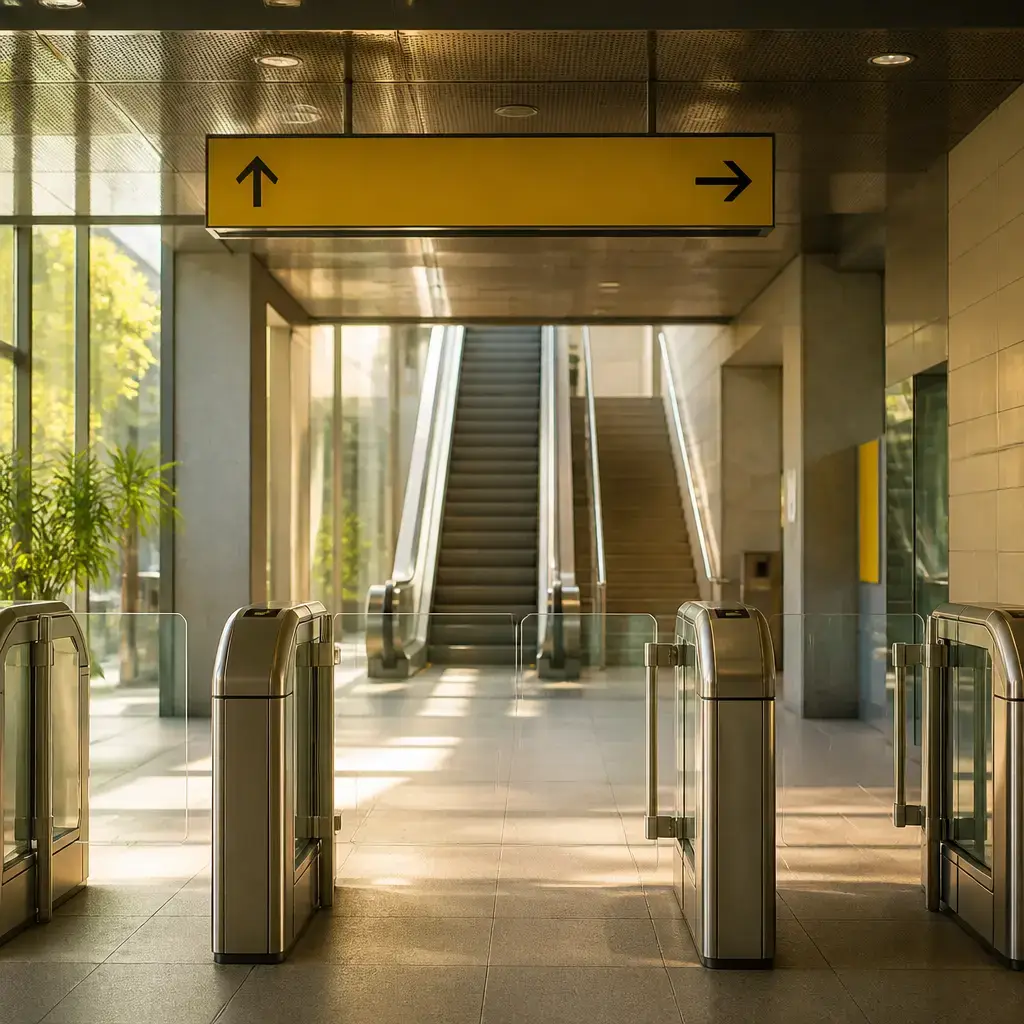
Undskyld
“Undskyld” means “excuse me” here and politely gets another person’s attention. It is useful at the beginning of a question to a stranger, such as when asking for directions in a station.
hvilken
“hvilken” means “which” when choosing one direction in “hvilken vej”. It is used before a noun when asking which specific option is meant. You can reuse the pattern “hvilken + noun” when asking someone to identify one choice.
vej
“vej” means “way” or “route” in “hvilken vej”. Together, “hvilken vej” asks which direction to take. This is useful when asking for directions from a person in a public place.
fører
“fører” means “leads” in “fører til hovedindgangen”. The pattern “fører til + destination” describes where a route goes. Use it when asking or explaining which way reaches a place.
til
“til” means “to” in “fører til hovedindgangen” and marks the destination. It commonly appears after a direction verb before the place being reached. In this dialogue, it connects the route with “hovedindgangen”.
hovedindgangen
“hovedindgangen” means “the main entrance”, the destination being asked about. It is used after “til” in “til hovedindgangen”. This word is useful when identifying the primary entrance to a building or station.
Følg
“Følg” means “follow” as a direct instruction in “Følg de gule skilte”. The pattern “Følg + thing” tells someone which signs, route, or direction to follow. A person giving directions would use it to guide someone through a station.
de
“de” means “the” before the plural expression “de gule skilte”. It helps identify a specific group of signs. The reusable pattern is “de + adjective + plural noun”.
gule
“gule” means “yellow” and describes the signs in “de gule skilte”. It helps the listener recognize the correct signs among others. Use the pattern “de + adjective + plural noun” when identifying visible objects by their description.
skilte
“skilte” means “signs” in “de gule skilte”. It is the thing the listener is told to follow. In a station, this word is useful for referring to signs that show routes or destinations.
mod
“mod” means “toward” in “mod hovedhallen” and marks the direction of travel. The pattern “mod + destination” tells someone which way to move. It is useful when giving directions toward a hall, entrance, or other place.
hovedhallen
“hovedhallen” means “the main hall”, the place toward which the signs point. It appears after “mod” in “mod hovedhallen”. Use it when directing someone toward the central hall of a station or building.
Skal
“Skal” means “should” in the question “Skal jeg tage rulletrappen”. It asks whether taking the escalator is the appropriate action. The reusable question pattern is “Skal jeg + verb” when checking what to do.
jeg
“jeg” means “I” and identifies the person asking what action to take in “Skal jeg tage rulletrappen”. It is the subject of the question. Use it when asking about your own next action.
tage
“tage” means “take” in “tage rulletrappen”. It follows “Skal jeg” and names the action being considered. The pattern “tage + transport option” is useful when asking which transport or route to use.
rulletrappen
“rulletrappen” means “the escalator” in “tage rulletrappen”. It is the specific escalator being discussed inside the station. The same object is referred to in the instruction “Tag rulletrappen op”.
efter
“efter” means “after” in “efter billetslusen” and places the action after passing the ticket gate. The pattern “efter + place or event” helps show when or where something happens next. It is useful when giving a sequence of directions.
billetslusen
“billetslusen” means “the ticket gate”, the point after which the escalator should be taken. It appears after “efter” in “efter billetslusen”. This word is useful when referring to the controlled entry point in a station.
Tag
“Tag” means “take” as a direct instruction in “Tag rulletrappen op”. It tells the listener to use the escalator and go upward. Someone giving step-by-step directions would use this form to state the next action.
op
“op” means “up” or “upstairs” in “Tag rulletrappen op”. It adds the upward direction to the action of taking the escalator. This pattern is useful when telling someone to move upward by a route or means of transport.
og
“og” means “and” and links the two instructions in “Tag rulletrappen op, og drej så til højre”. It presents the turn as the next connected step. Use it to join consecutive actions in directions.
drej
“drej” means “turn” as an instruction in “drej så til højre”. It tells the listener to change direction. The pattern “drej til + direction” is useful when giving route instructions.
så
“så” means “then” in “drej så til højre”. It shows that turning happens after taking the escalator upward. Use it to sequence actions clearly when explaining a route.
højre
“højre” means “right” in the direction expression “til højre”. It tells the listener which side to turn toward. This expression is commonly used when giving walking directions.
Er
“Er” means “is” in the question “Er hovedindgangen langt herfra?”. It asks about the distance from the current location to the main entrance. The question pattern is “Er + place + description?” when checking a place or condition.
langt
“langt” means “far” in “langt herfra”. It describes the distance to the main entrance from the speaker’s current position. This is useful when asking whether a destination requires a long journey.
herfra
“herfra” means “from here” and marks the speaker’s current location in “langt herfra”. It identifies the starting point for the distance question. Use it when asking how far something is from where you are now.
Der
“Der” introduces the existence of something in “Der er en kort gåtur derfra”. It helps present the walk as the distance or route from that place. The reusable pattern is “Der er + noun phrase” when saying that something exists or is available.
en
“en” means “a” in “en kort gåtur” and introduces one unspecified walk. It comes before the adjective and noun in this phrase. The pattern “en + adjective + noun” is useful for describing one item or activity.
kort
“kort” means “short” and describes the walk in “en kort gåtur”. It tells the listener that the distance can be covered in a short walk. Use it before a noun when describing a limited length or duration.
gåtur
“gåtur” means “walk” in “en kort gåtur”. It describes the route or distance that can be covered on foot. In this dialogue, it reassures the traveler that the entrance is not far from there.
derfra
“derfra” means “from there” in “en kort gåtur derfra”. It marks the earlier location as the starting point of the walk. It contrasts with “herfra”, which refers to the speaker’s current location.
Denne
“Denne” means “this” in “Denne station”. It identifies the station the speakers are currently inside. The pattern “Denne + noun” is useful when pointing out a particular nearby place or object.
station
“station” means “station” in “Denne station”. It is the place being described as confusing. This word is useful when talking about the building where trains or other transport services are accessed.
lidt
“lidt” means “a little” in “lidt forvirrende”. It softens the description by saying that the station is somewhat confusing rather than completely confusing. The pattern “lidt + adjective” is useful for expressing a mild degree.
forvirrende
“forvirrende” means “confusing” in “Denne station er lidt forvirrende”. It describes the station as difficult to understand or navigate. You can use it when explaining why a route, layout, or set of instructions is not clear.
Det
“Det” is a placeholder subject in “Det er lettere at følge skiltene ovenpå”. The sentence gives a general assessment that following the signs is easier upstairs, rather than referring to a particular object called “it”. The reusable pattern is “Det er + adjective + at + verb”.
lettere
“lettere” means “easier” in “Det er lettere at følge skiltene ovenpå”. It says that following the signs requires less effort in the upstairs location. The pattern “Det er lettere at + verb” is useful when comparing how easy two actions or routes are.
at
“at” introduces the infinitive in “at følge skiltene”. It connects the assessment “lettere” with the action being assessed. The reusable pattern is “at + verb” after an expression such as “Det er lettere”.
følge
“følge” means “follow” in the infinitive phrase “at følge skiltene”. It names the action that is easier upstairs. The pattern “at følge + object” is useful when describing following signs, directions, or a route.
skiltene
“skiltene” means “the signs” in “følge skiltene”. It refers to the specific signs that guide people through the station. This form is used as the object after “følge” when telling someone to follow those signs.
ovenpå
“ovenpå” means “upstairs” and gives the location where following the signs is easier. It completes the location information in “følge skiltene ovenpå”. Use it when directing someone to a higher floor or level.