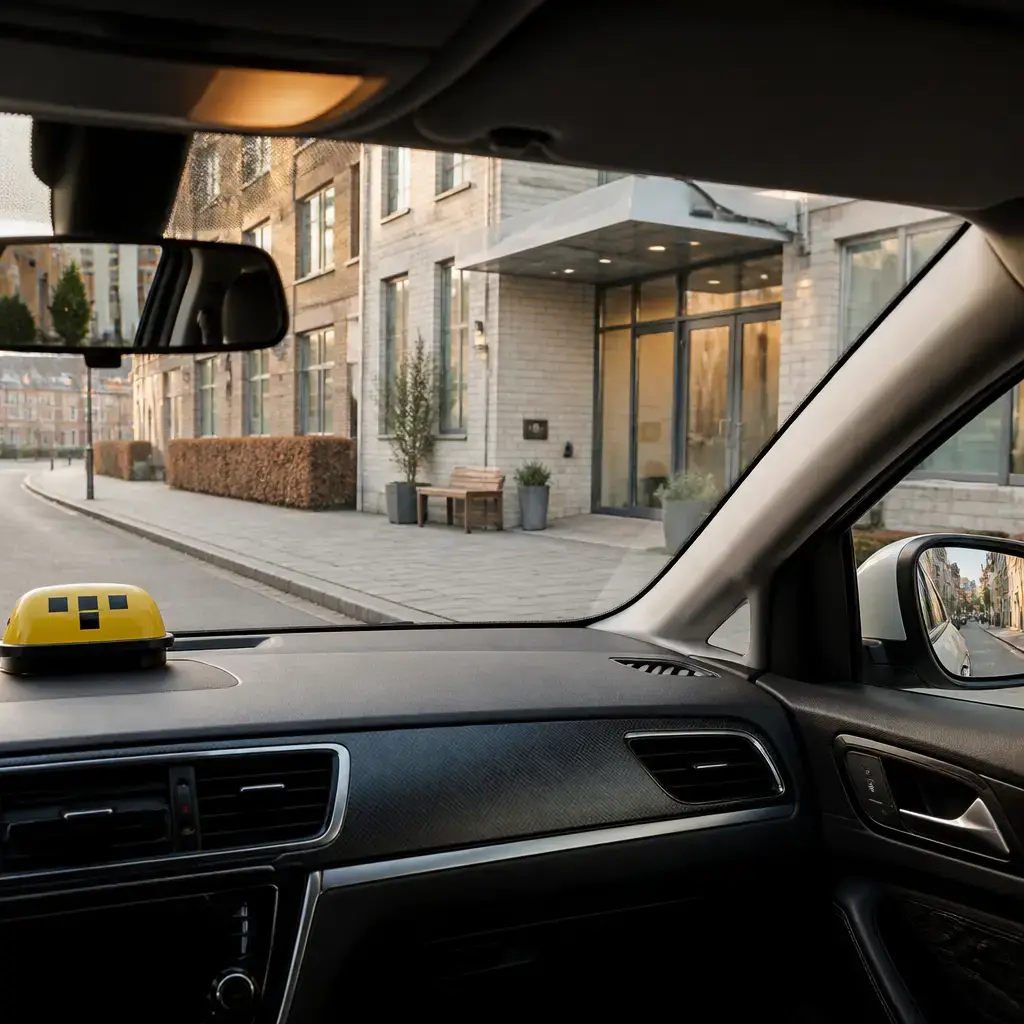
Kan
“Kan” means “can” or polite “could” here, as in the request “Kan du sætte os af”. It comes before the subject and the requested action in this kind of question. Use it when politely asking whether someone can do something.
du
“du” means “you” in “Kan du sætte os af”. It identifies the person being asked to perform the action. A common question pattern is “Kan du” followed by an action.
sætte
“sætte” means “set” or, in “sætte os af”, “drop off”. Together with “os af”, it asks the driver to let the passengers out. Use “sætte” with a person or object when describing placing or setting something, and with “af” for dropping someone off.
os
“os” means “us” in “sætte os af”. It is the group that the driver should drop off. Use it after an action when the action is done to or for “us”.
af
In “sætte os af”, “af” is the particle that completes the meaning “drop off”. It is not the word meaning “near” in this dialogue; “nær” expresses that location. Use “af” as part of the expression for letting passengers out.
nær
“nær” means “near” in “nær klinikkens indgang”. It introduces the location that should be close to the clinic entrance. Use it before a place or landmark when giving a nearby destination.
klinikkens
“klinikkens” means “the clinic’s” in “klinikkens indgang”, showing that the entrance belongs to or is associated with the clinic. The exact form is the possessive form related to “klinik”. Use it before a noun when identifying something connected with the clinic.
indgang
“indgang” means “entrance” in “klinikkens indgang”. It identifies the place near which the taxi should stop. Use it for an entrance to a building or other place.
tak
At the end of “Kan du sætte os af nær klinikkens indgang, tak?”, “tak” makes the request polite and means “please”. It is placed after the request here. The same word can also mean “thanks” in another context.
Er
“Er” means “is” in the question “Er det lige efter det store kryds?”. It asks whether the described location is just past the intersection. Use it at the start of a yes-or-no question when checking what something is or where it is.
det
“det” refers to the place being checked in “Er det lige efter det store kryds?” and corresponds to “that” or “it”. In “det store kryds”, it also appears before the noun phrase meaning “the main intersection”. Use it when referring back to a place or thing already understood.
lige
“lige” means “just” in “lige efter det store kryds” and “lige forbi indgangen”. It makes the distance or position sound immediate: just after or just beyond. Use it before a location expression when indicating a short distance.
efter
“efter” means “after” or “past” in “lige efter det store kryds” and “efter banken”. It marks the point that comes after a landmark. Use it before a place or event when giving directions based on what comes next.
store
“store” means “big” and contributes to the description of the main intersection in “det store kryds”. It describes the size or importance of the intersection in this direction. Use it before a noun when describing a large or prominent place.
kryds
“kryds” means “intersection” or “crossroads” in “det store kryds”. It is the landmark used to confirm the taxi’s position. Use it when giving directions around roads that cross.
Drej
“Drej” means “turn” in the instruction “Drej til venstre efter banken.” It directly tells the driver what action to take. Use this command with a direction such as “til venstre” when giving road directions.
til
In “til venstre”, “til” helps express the direction “to the left”. It connects the turning action with the side to which the driver should turn. Use it in direction expressions such as “til venstre” when indicating a turn.
venstre
“venstre” means “left” in “Drej til venstre”. It identifies the side toward which the driver should turn. Use it after “til” to give a left-hand direction.
banken
“banken” means “the bank” in “efter banken”. It is the landmark after which the driver should turn. Use a place name like this after “efter” when giving a direction based on passing that place.
Følg
“Følg” means “follow” in the instruction “Følg så vejen mod apoteket.” It tells the driver to stay along the road toward the destination. Use it as a direction command before the road, path, or route to follow.
så
“så” means “then” in “Følg så vejen mod apoteket.” It links this next instruction to the previous turn. Use it to order directions or actions in sequence.
vejen
“vejen” means “the road” in “Følg så vejen”. It is the route the driver should follow. Use it after an instruction such as “Følg” when referring to a specific road.
mod
“mod” means “toward” in “mod apoteket”. It shows the direction or destination of travel. Use it before a place when saying that someone is moving in that place’s direction.
apoteket
“apoteket” means “the pharmacy” in “mod apoteket” and “til apoteket”. It is the landmark used to guide the driver and locate the right side of the road. Use it with a direction word when travelling toward or to the pharmacy.
Skal
“Skal” means “should” in “Skal jeg fortsætte ligeud efter svinget?”. It asks whether continuing straight is the correct next action. Use it at the start of a question when checking what action is expected.
jeg
“jeg” means “I” in “Skal jeg fortsætte ligeud efter svinget?” and “Jeg kan holde ind”. It identifies the speaker as the person who may continue or pull over. Use it before an action when stating or asking what you will do.
fortsætte
“fortsætte” means “continue” or “keep going” in “Skal jeg fortsætte ligeud”. It describes continuing along the route rather than turning. Use it with a direction or route to say that movement should carry on.
ligeud
“ligeud” means “straight ahead” in “fortsætte ligeud”. It tells the driver not to turn at that point. Use it after an action such as continuing when giving a straight-ahead direction.
svinget
“svinget” means “the turn” in “efter svinget”. It identifies the turn that has just been passed or referred to. Use it after a direction word such as “efter” when locating the next action relative to a turn.
Fortsæt
“Fortsæt” means “continue” or “keep going” in “Fortsæt, til apoteket er på din højre side.” It is a direct instruction to keep moving until the stated landmark appears on the right. Use it as a direction command when the route should continue.
på
“på” means “on” in “på din højre side”. It describes the pharmacy’s position relative to the driver’s route. Use it with a side or surface when saying where something is located.
din
“din” means “your” in “din højre side”. It identifies the side belonging to or associated with the person being addressed. Use it before the noun that refers to something belonging to “you”.
højre
“højre” means “right” in “din højre side”. It identifies the side on which the pharmacy will appear. Use it before “side” when describing a right-hand position.
side
“side” means “side” in “på din højre side”. The phrase identifies the right-hand side of the route. Use it with a direction word to describe where a landmark is located.
Hvor
“Hvor” means “where” in “Hvor vil du gerne have, at jeg stopper?”. It asks for the desired stopping place. Use it at the beginning of a question about a location.
vil
“vil” contributes “would like” to the polite request “Hvor vil du gerne have, at jeg stopper?”. It introduces the person’s desired arrangement. Use it with “gerne have” when asking what someone would like to happen.
gerne
“gerne” makes “vil du gerne have” a polite way to ask what the passenger would like. Here it helps express a preference about where the driver should stop. Use it with a request or preference when you want the wording to sound willing or polite.
have
In “vil du gerne have, at jeg stopper?”, “have” contributes the meaning “have” or “get” in the sense of wanting an action to take place. The requested action follows in the clause beginning with “at”. Use “have” after an expression of wanting when specifying the result or action desired.
at
“at” introduces the clause “at jeg stopper” that states the requested action. It connects the desired arrangement with what the driver should do. Use it before a clause when reporting or requesting that someone perform an action.
stopper
“stopper” means “stops” in “at jeg stopper”. It describes the driver bringing the taxi to a stop. Use it in a clause after an expression that specifies where or when the stopping should happen.
som
“som” is part of the expression “hvor som helst”, which means “anywhere” in this dialogue. It helps turn “hvor” into an unrestricted location expression rather than identifying one specific place. Learn it together with “hvor som helst” for saying that any location is acceptable.
helst
“helst” completes “hvor som helst”, meaning “anywhere” in “Du kan stoppe hvor som helst”. It shows that no particular stopping place is required. Use the full expression when giving someone freedom to choose the location.
i
“i” means “in” in “i nærheden af hoveddøren”. Together with “nærheden af”, it helps describe a location near the front door. Use it in location expressions that place something within an area or vicinity.
nærheden
“nærheden” means “the vicinity” in “i nærheden af hoveddøren”. The phrase describes a nearby area rather than one exact point. Use “i nærheden af” before a landmark when saying that something is close to it.
hoveddøren
“hoveddøren” means “the front door” in “i nærheden af hoveddøren”. It is the specific landmark near which the passenger accepts being dropped off. Use it when identifying the main entrance door of a building.
holde
In “holde ind”, “holde” contributes to the meaning “pull over” or bring the vehicle to the side. The complete expression describes the driver stopping safely near the entrance. Use “holde” with “ind” when talking about pulling a vehicle over.
ind
In “holde ind”, “ind” is the particle that completes the meaning “pull over”. It indicates moving the vehicle in toward the side rather than continuing along the road. Learn it together with “holde” for this driving action.
forbi
“forbi” means “past” or “beyond” in “lige forbi indgangen”. It places the stopping point just beyond the entrance. Use it after a landmark when saying that someone moves or stops past that point.