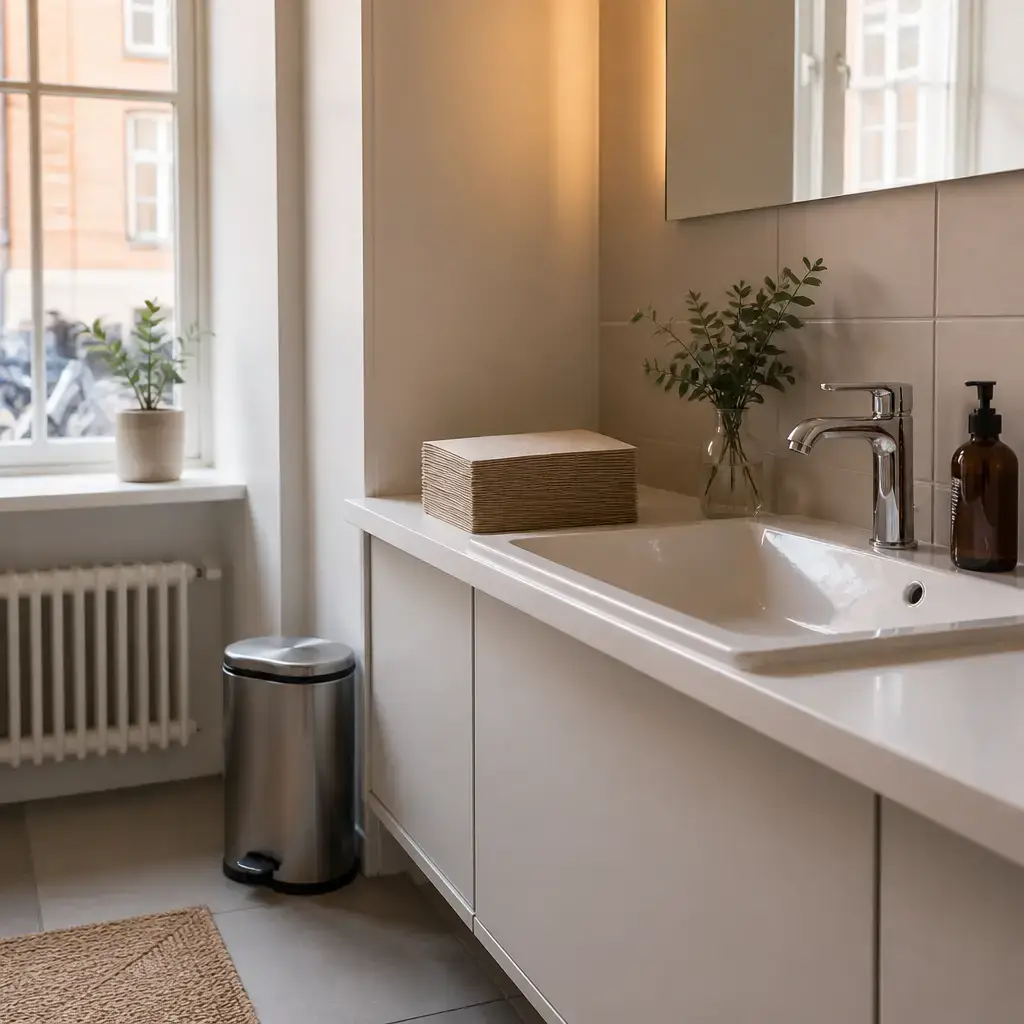
Kan
“Kan” asks for permission in “Kan jeg bruge dette fælles badeværelse?” It is also used in “Det kan du” to say that someone may or can do something; reuse the pattern “Kan jeg + verb?” when asking permission.
jeg
“jeg” means “I” and is the person asking to use the bathroom in “Kan jeg bruge dette fælles badeværelse?” It commonly comes before the verb in a statement or question about your own action.
bruge
“bruge” means “use” in “Kan jeg bruge dette fælles badeværelse?” It follows “kan” here; reuse “bruge + object” when saying that you use something.
dette
“dette” means “this” and points to the bathroom being discussed in “dette fælles badeværelse.” It comes directly before the noun phrase it identifies.
fælles
“fælles” means “shared” in “fælles badeværelse,” describing a bathroom used by more than one person. It can be placed before a noun to describe something shared.
badeværelse
“badeværelse” means “bathroom” in “dette fælles badeværelse.” It is the place being requested in the question and can follow a describing word such as “fælles”.
Det
“Det” refers to the situation or request in “Det kan du,” which means that the person may use the bathroom. Here it is the subject of the response and is written with a capital letter because it begins the sentence.
du
“du” means “you” and refers to the person who wants to use the bathroom in “Det kan du.” It is used for the person being addressed, including in “Kan jeg ...?” replies.
og
“og” means “and” and connects the permission with the request to keep the sink area clean in “Det kan du, og hold venligst området ved vasken rent.” It joins two related parts of a sentence.
hold
“hold” tells the listener to keep something in a particular condition in “hold venligst området ved vasken rent.” It is used as a direct request here; reuse “hold + object + adjective” for a request about maintaining a condition.
venligst
“venligst” means “please” and makes “hold venligst området ved vasken rent” a polite request. It can be placed with a command to soften the request.
området
“området” means “the area,” specifically the area by the sink in “området ved vasken.” It is the definite form of “område” and is the object of the request to keep it clean.
ved
“ved” means “near” or “by” in “ved vasken,” locating the area next to the sink. It commonly introduces the place near which something is located.
vasken
“vasken” means “the sink” in “området ved vasken” and “nogle ved vasken.” It is the definite form of “vask” and identifies the nearby reference point.
rent
“rent” means “clean” and describes the condition requested for “området ved vasken” in “hold venligst området ved vasken rent.” It follows the object here to state the condition that should be maintained.
har brug for
“har brug for” means “need” in “Jeg har brug for et stykke køkkenrulle.” The whole construction expresses need: “har” contributes “has,” “brug” contributes “use,” and “for” links the need to what is required; reuse “Jeg har brug for + object” when saying what you need.
et
“et” means “a” or “an” before “stykke køkkenrulle” in “et stykke køkkenrulle.” It introduces one unspecified item and comes directly before the noun phrase.
stykke
“stykke” means “piece” in “et stykke køkkenrulle,” referring to one piece of paper towel. The reusable pattern “et stykke + material or product” describes one piece of something.
køkkenrulle
“køkkenrulle” means “paper towel” or “kitchen roll” in “et stykke køkkenrulle.” It identifies what kind of piece is needed and follows “et stykke” in this phrase.
Der
“Der” introduces the existence of something in “Der er nogle ved vasken,” meaning that some are by the sink. It commonly begins a statement that tells where something or someone can be found.
er
“er” means “is” or “are” in “Der er nogle ved vasken.” Together with “Der” it states that something exists or is located somewhere.
nogle
“nogle” means “some” in “Der er nogle ved vasken,” referring here to some paper towels. It can be used when the exact number is not specified.
Skal
“Skal” asks whether something should go somewhere in “Skal det her i skraldespanden?” It is useful in the pattern “Skal + item + i + container?” when checking where an item belongs.
her
“her” means “here” in the expression “det her,” which refers to this item in the speaker’s immediate situation. In this dialogue it helps identify the object being held or discussed, rather than naming a separate location.
i
“i” means “in” or “into” in “i skraldespanden,” marking the trash bin as the destination. It commonly comes before a container or place when describing where something should be put.
skraldespanden
“skraldespanden” means “the trash bin” in “i skraldespanden” and “den lille skraldespand.” It is the definite form of “skraldespand” and names the container for the item.
Læg
“Læg” means “put” or “place” in the instruction “Læg det i den lille skraldespand.” It is used for a direct instruction and fits the pattern “Læg + object + i + place.”
den
“den” means “the” in “den lille skraldespand,” introducing the specific bin that should be used. It comes before the describing word and noun in this phrase.
lille
“lille” means “small” and describes the bin in “den lille skraldespand.” It is placed before the noun it describes.
vil
“vil” expresses the speaker’s intention in “Jeg vil også hurtigt tørre vasken af.” It is followed by the infinitive “tørre”; reuse “Jeg vil + verb” to state what you intend to do.
også
“også” means “also” or “too” and shows that wiping the sink is an additional action in “Jeg vil også hurtigt tørre vasken af.” Here it comes after “Jeg vil” and before the rest of the action.
hurtigt
“hurtigt” means “quickly” and describes how the speaker will wipe the sink in “Jeg vil også hurtigt tørre vasken af.” It is an adverb that can describe the manner of an action.
tørre
“tørre” means “wipe” in “tørre vasken af,” where the speaker says they will wipe the sink. After “vil,” it appears in the infinitive and is used with an object before “af” in this expression.
af
“af” is part of “tørre vasken af,” indicating wiping something off or clean. It belongs with “tørre” here; reuse the full pattern “tørre + object + af” rather than using “af” alone for this meaning.
hjælper
“hjælper” means “helps” in “Det hjælper den næste person,” explaining that the cleaning action benefits the next person. It can be used with the person or thing that receives the benefit after the verb.
næste
“næste” means “next” in “den næste person,” identifying the person who will use the shared space afterward. It comes before the noun it describes.
person
“person” means “person” in “den næste person,” the person who benefits from the clean sink area. It is the noun at the end of this specific noun phrase.