Hvad
“Hvad” asks what in the question “Hvad laver du i din fritid?” It is used at the beginning when asking about an activity or thing.
laver
“Laver” means do here in “Hvad laver du i din fritid?” It is used with “du” to ask what someone does.
du
“Du” means you, referring to the person being asked. In this dialogue it appears in “Hvad laver du” and “Du kan bruge min gamle blyant.”
i
“I” means in and places the activity within a time period in “i din fritid.” It commonly comes before a time or place expression.
din
“Din” means your and links “fritid” to the person being addressed in “din fritid.” It is used before the thing that belongs to you.
fritid
“Fritid” means free time in “i din fritid.” The expression “i din fritid” is used when asking or talking about activities outside work or other duties.
kan godt lide
“Kan godt lide” means like or enjoy in “Jeg kan godt lide at tegne derhjemme.” In this construction, “kan” contributes “can,” “godt” is part of the idiomatic expression, and “lide” contributes the idea of liking; together they express that someone likes something. A reusable pattern is “Jeg kan godt lide at” followed by an activity.
Jeg
“Jeg” means I and identifies the speaker in “Jeg kan godt lide at tegne derhjemme.” It is used as the subject when the speaker describes their own activity or preference.
at
“At” marks the following verb as an infinitive in “at tegne.” The pattern “kan godt lide at” is used before an activity that someone enjoys.
tegne
“Tegne” means draw in “at tegne derhjemme.” It is used after “at” and can name the activity someone enjoys.
derhjemme
“Derhjemme” means at home in “tegne derhjemme.” It gives the place where the drawing happens and does not need a separate preposition here.
Det
“Det” means that in “Det lyder som en afslappende hobby,” referring to the drawing activity just mentioned. It is used as the subject of this comment about how something sounds.
lyder
“Lyder” means sounds in “Det lyder som en afslappende hobby.” It commonly appears with “som” when describing how something seems or sounds.
som
“Som” means like or as in “lyder som en afslappende hobby.” Here it introduces the description that follows “lyder.”
en
“En” means a in “en afslappende hobby.” It comes before the singular noun phrase being introduced.
afslappende
“Afslappende” means relaxing and describes “hobby” in “en afslappende hobby.” It is used before a noun to describe the activity or thing.
hobby
“Hobby” means hobby in “en afslappende hobby.” It names drawing as a leisure activity.
tegner
“Tegner” means draw or sketch in “Jeg tegner normalt små ting i min notesbog.” It is the form used when the speaker says what they usually do.
normalt
“Normalt” means usually or normally in “Jeg tegner normalt små ting i min notesbog.” It indicates that the activity is a usual practice rather than a single event.
små
“Små” means small and describes “ting” in “små ting.” It is used before the noun to specify the size of the things being drawn.
ting
“Ting” means things in “små ting.” It refers here to the objects that the speaker draws in the notebook.
min
“Min” means my and links “notesbog” to the speaker in “min notesbog.” It is used before a thing that belongs to or is associated with the speaker.
notesbog
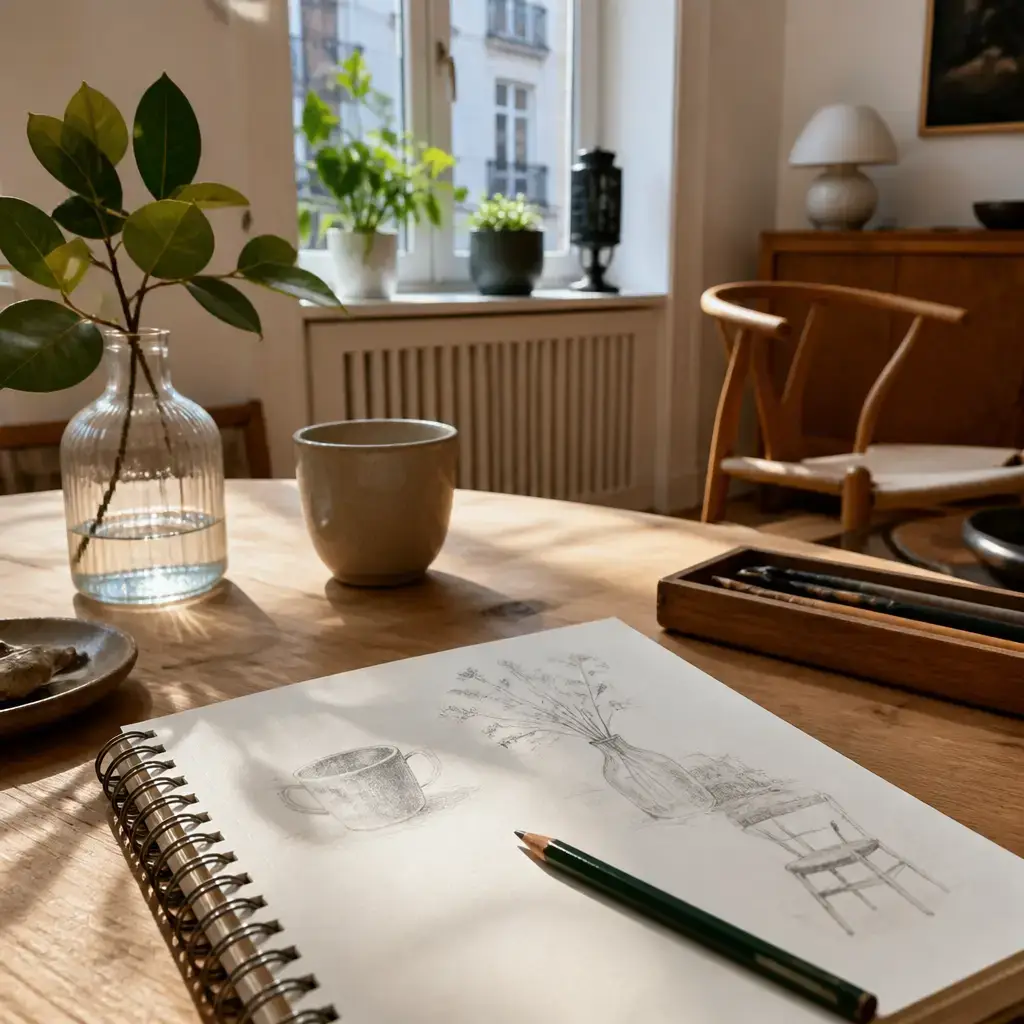
“Notesbog” means notebook in “i min notesbog.” It is the place where the speaker draws small things.
Øver
“Øver” means practice in the question “Øver du dig ofte?” It is used with “dig” when asking whether someone practices an activity.
dig
“Dig” means yourself in “Øver du dig ofte?” Together with “øver,” it shows that the person practices themselves or their skill.
ofte
“Ofte” means often in “Øver du dig ofte?” It asks about how frequently the practice happens.
Lidt
“Lidt” means a little in the short answer “Lidt, mest når jeg har tid.” It gives a small or limited amount without repeating the activity.
mest
“Mest” means mostly in “mest når jeg har tid.” It points to the main situation in which the speaker practices.
når
“Når” means when and introduces the time condition “når jeg har tid.” It is used before a clause that says when something happens.
har
“Har” means have in “jeg har tid.” It is the form used when the speaker says that they have time available.
tid
“Tid” means time in “jeg har tid.” The expression “have time” is used to say that someone is available to do something.
Måske
“Måske” means maybe in “Måske kan jeg også prøve det.” It expresses an uncertain or tentative possibility, often at the beginning of a sentence.
kan
“Kan” means can in “kan jeg også prøve det” and “Du kan bruge min gamle blyant.” It comes before the subject and another verb when expressing ability or possibility.
også
“Også” means also or too in “jeg også prøve det.” It adds that the speaker wants to try the activity in addition to the other person.
prøve
“Prøve” means try in “kan jeg også prøve det.” It follows “kan” and takes “det” as the thing being tried.
bruge
“Bruge” means use in “Du kan bruge min gamle blyant.” It follows “kan” and is followed by the object that can be used.
gamle
“Gamle” means old and describes “blyant” in “min gamle blyant.” It tells the listener which pencil is being offered.
blyant
“Blyant” means pencil in “min gamle blyant.” It is the object that the listener is told they can use.