Jeg
“Jeg” means “I” and is the first-person singular subject in several lines. Use “Jeg” before the verb when talking about yourself.
har
“har” means “have” here and works with “udfyldt” to describe the form as completed. It is the present form related to the citation form have; reuse “har” before a completed-action form.
udfyldt
“udfyldt” means filled out in “Jeg har udfyldt formularen.” It is the completed-action form related to udfylde; use it after “har” when saying that a form has been filled out.
formularen
“formularen” means the form in “Jeg har udfyldt formularen.” It is the definite form related to formular, used when the specific form is known; use it as the object after a verb such as “udfyldt”.
Hvornår
“Hvornår” asks when something can happen, here when they can come. Put it at the beginning of a question about time, as in “Hvornår kan vi komme til gåarrangementet?”.
kan
“kan” means can and expresses possibility in “Hvornår kan vi komme til gåarrangementet?” and “I kan være med til det næste gåarrangement.” It is the present form related to the citation form kunne and comes before the infinitive in patterns such as “kan vi komme” and “kan være med”.
vi
“vi” means “we” and refers to the adults who are asking or starting together. Use it as the subject before a verb, as in “kan vi komme” and “vi starter”.
komme
“komme” means come in the question about attending the event. It is the infinitive related to the citation form komme and follows “kan” in “kan vi komme”; use it after a modal when describing coming.
til
“til” links “komme” to the event in “komme til gåarrangementet,” and it links participation to an event in “være med til det næste gåarrangement.” Use it before a destination or event, or as part of “være med til” for taking part.
gåarrangementet
“gåarrangementet” means the walking event in the question. It is the definite form related to gåarrangement, pointing to the specific event; use it after “til” in “til gåarrangementet” when that event is already identified.
I
“I” means “you” when addressing more than one person, as in “I kan være med til det næste gåarrangement.” It comes before the verb or modal in a statement addressed to the group.
være med til
“være med til” means to join or take part in an activity or event. In this construction, “være” contributes “be,” “med” adds the idea of being along or with others, and “til” connects that participation to the event; use it before an activity or event.
det
“det” means “it” here and refers back to the walking event in “Jeg glæder mig til det.” Use “til det” when referring to a previously mentioned thing without repeating its noun.
næste
“næste” means next and identifies the upcoming walking event in “det næste gåarrangement.” It comes before the event noun; use it to point to the next item in an ordered sequence.
Skal
“Skal” asks whether something should be done in “Skal vi have noget med?” It is related to the citation form skulle and comes before “vi” in this question; use it at the beginning of a similar question about what to do.
have
“have” means to have something with you, so “have noget med” asks whether to bring anything. It is the infinitive related to the citation form have and follows “Skal” in the question; reuse “have noget med” when carrying something along.
noget
“noget” means something or anything in the question “Skal vi have noget med?” It refers to an unspecified item; use it before “med” when asking whether there is something to bring.
med
“med” means along or with in “have noget med” and “en vandflaske med.” It shows that an item is being brought or kept with someone; reuse it after an object in the pattern “have noget med.”
Tag
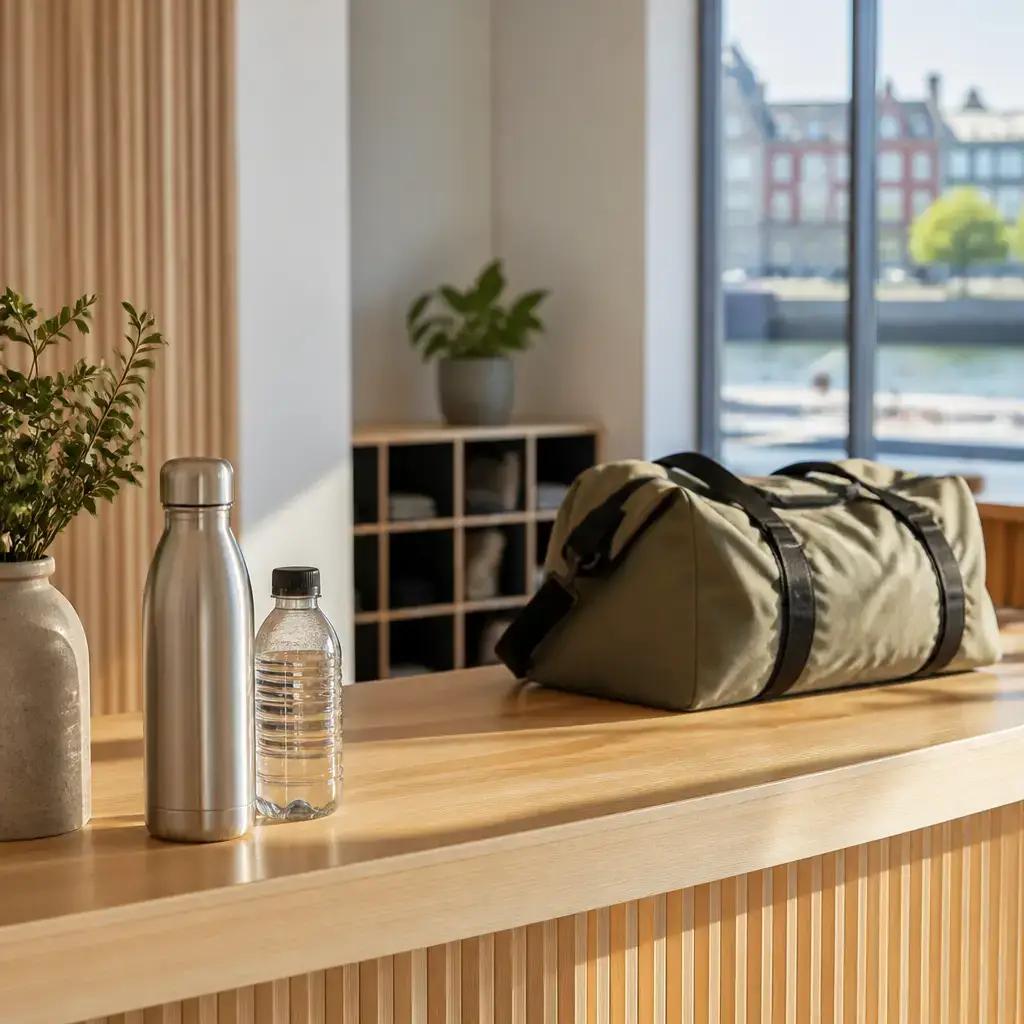
“Tag” means bring or take in the request “Tag venligst en vandflaske med.” It is the imperative form related to the citation form tage; use it at the beginning of a direct request before the item to be brought.
venligst
“venligst” means please and makes “Tag venligst en vandflaske med” a polite request. Place it in a request to soften the instruction, often after the command form.
en
“en” marks one unspecified item in “en vandflaske,” meaning a water bottle. Use it before a singular noun when introducing one item.
vandflaske
“vandflaske” means water bottle in “en vandflaske.” It names the item to bring; use it after an article or another determiner when talking about a water bottle.
lægge
“lægge” means put or leave something in a place in “I kan lægge en stor taske ved skranken” and “Jeg vil lægge min taske her.” It is the infinitive related to the citation form lægge and follows “kan” or “vil”; use it before the object and location.
stor
“stor” means large in “en stor taske.” It describes “taske” and comes before the noun; use it in the same position when describing an item’s size.
taske
“taske” means bag in “en stor taske” and “min taske.” It can follow an article or a possessive such as “min”; use it for the bag being carried or left.
ved
“ved” means at or by in “ved skranken,” locating the bag next to the desk. Use “ved” before a place or reference point when saying where something is located or left.
skranken
“skranken” means the desk or counter in “ved skranken.” It is the definite form related to skranke, referring to the specific registration desk; use it after “ved” when that desk is the location.
lille
“lille” means small in “en lille vandflaske.” It comes before “vandflaske” to describe its size; use it before the noun when identifying a small item.
min
“min” means my in “min taske.” It comes before the noun and shows that the bag belongs to or is associated with the speaker; use it before a noun you identify as yours.
her
“her” means here in “Jeg vil lægge min taske her.” It identifies the place where the speaker is leaving the bag; use it after a verb to point to the current or indicated location.
før
“før” means before and introduces the earlier timing in “før vi starter.” It can introduce a clause or time point; use it when one action must happen earlier than another.
starter
“starter” means start or begin in “før vi starter.” It is the form related to the citation form starte and follows “vi” here; use it when saying that an activity begins.
glæder mig til
“glæder mig til” means look forward to in “Jeg glæder mig til det.” In the construction, “glæder” expresses pleasure, “mig” identifies the speaker as the person feeling it, and “til” introduces the awaited thing; “glæder” is related to the citation form glæde. Use this pattern before an event or activity you anticipate.