Sidder
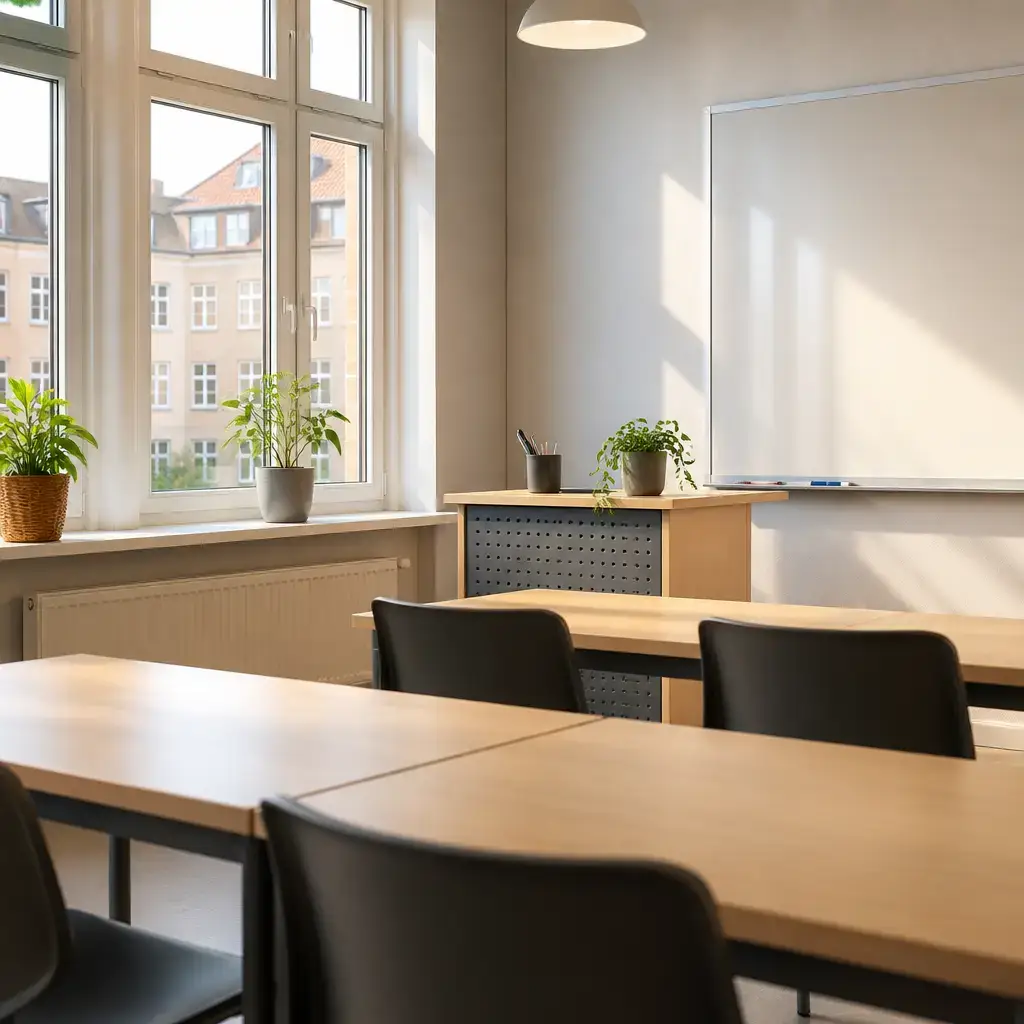
Sidder means “sit” in the question Sidder du altid her? It is the present form related to sidde. A reusable question pattern is Sidder + person + place? when asking where someone usually sits.
du
Du means “you” when addressing one person, as in Sidder du altid her? It is the subject placed after Sidder in this question. Use du when asking one person about an action or habit.
altid
Altid means “always” in Sidder du altid her? It says that the action happens every time or regularly. It commonly comes before the place or time information in a question, as in Sidder du altid her?
her
Her means “here,” referring to the place where the speakers are sitting. In Sidder du altid her? it points to the speaker’s current place. Use her to refer to the place where you or the other person is now.
Jeg
Jeg means “I” in Jeg kan høre læreren godt and Jeg kan godt lide at sidde foran; the lowercase form jeg also appears later in Det vil jeg gerne. Jeg is capitalized at the beginning of a sentence, while jeg is lowercase elsewhere. It is used as the subject when the speaker describes a preference, ability, or response.
kan godt lide
Kan godt lide means “like” in Jeg kan godt lide at sidde foran. Kan, godt, and lide work together as one expression of preference here, so the whole construction—not one component alone—expresses liking. A reusable pattern is Jeg kan godt lide + a noun or at + an action.
at
At is the infinitive marker in at sidde, at stille, At sidde, and at koncentrere mig. It introduces the action that is liked, easy, or helpful in these sentences. A reliable pattern is at + verb when referring to an action in this way.
sidde
Sidde means “sit” in at sidde foran. It is the infinitive form after at and describes the action of remaining seated. Use at sidde with a place expression such as foran when describing where someone sits.
foran
Foran means “at the front” in at sidde foran. It describes the position chosen in the classroom. The reusable pattern sidde foran describes sitting at the front, for example when choosing a seat near the teacher.
kan
Kan means “can” in Jeg kan høre læreren godt and expresses the speaker’s ability to hear. Kan is the present form related to kunne. A reusable pattern is Jeg kan + verb when saying what you are able to do.
høre
Høre means “hear” in Jeg kan høre læreren godt. It follows kan and names the ability being described. Use kan høre with a person or sound as the thing that can be heard.
læreren
Læreren means “the teacher” in Jeg kan høre læreren godt. It is the definite form related to lærer and is the person the speaker can hear. It appears after høre as the person being heard.
godt
Godt means “well” in Jeg kan høre læreren godt and describes how clearly the speaker hears the teacher. In kan godt lide, it is one component of the whole expression meaning “like,” rather than a separate meaning of “well.” It can follow a verb when describing how well an action is performed, as in høre læreren godt.
Det
Det means “it” in Det er nemt and refers back to the proposed activity in Det vil jeg gerne, where it means “that.” In Det er nemt, it introduces the statement that asking questions is easy; in Det vil jeg gerne, it refers to the suggestion to sit together. Use Det er + description for a simple statement about a situation.
er
Er means “is” in Det er nemt. It is the present form related to være and connects Det with the description nemt. A reusable pattern is Det er + description when saying what something is like.
nemt
Nemt means “easy” in Det er nemt at stille spørgsmål her. It describes the activity of asking questions as not difficult. It can follow Det er before an action introduced by at, as in Det er nemt at stille spørgsmål her.
stille
Stille is the verb used for “ask” in stille spørgsmål. Together with spørgsmål, it forms the meaning “ask questions”; the whole construction carries that meaning. Use stille with spørgsmål when describing asking questions, especially in a classroom.
spørgsmål
Spørgsmål means “questions” in stille spørgsmål. It is the thing being asked, while stille supplies the verb in the expression for asking questions. A reusable pattern is stille spørgsmål when asking for information or clarification.
Lad
Lad means “let” in Lad os sidde sammen næste gang and is used to make a suggestion. It is the imperative form related to lade in this expression. A reusable pattern is Lad os + action when proposing that the speaker and listener do something together.
os
Os means “us” in Lad os sidde sammen næste gang. It identifies the speaker and the listener as the people included in the suggestion. It follows Lad in the reusable suggestion pattern Lad os + action.
sammen
Sammen means “together” in Lad os sidde sammen næste gang. It shows that the speakers will sit with each other rather than separately. Use sammen after an action when emphasizing that people do it jointly.
næste
Næste means “next” in næste gang. It points to the following occasion, not the current class. It commonly comes directly before a time or occasion word, as in næste gang.
gang
Gang means “time” or “occasion” in næste gang, which means “next time.” Here it refers to the following class or meeting. Use gang with a time expression when referring to one occasion, especially in næste gang.
vil
Vil contributes the meaning of wanting or being willing in Det vil jeg gerne, which as a whole means “I would like that.” Vil is the present form related to ville, but with gerne it expresses the speaker’s positive response rather than standing alone. A reusable pattern is vil gerne + an action or thing the speaker is willing to do or have.
gerne
Gerne expresses willingness or that the speaker would be happy to do something in Det vil jeg gerne. Together with vil and the rest of the sentence, it makes a positive reply to the suggestion. Use vil gerne when accepting or expressing willingness to do an action.
hjælper
Hjælper means “helps” in At sidde foran hjælper mig med at koncentrere mig. It says that sitting at the front makes focusing easier for the speaker. Hjælper is the present form related to hjælpe. A reusable pattern is a helpful action + hjælper + a person + med at + an action.
mig
Mig means “me” in hjælper mig, where the speaker is the person receiving help. In koncentrere mig, it refers back to the speaker and is part of the expression for focusing oneself. Use mig after a verb when the speaker is affected by the action or is the person carrying it out reflexively.
med
Med means “with” in hjælper mig med at koncentrere mig, where it links the help to the action that becomes easier. It is part of the construction for helping someone do something, rather than describing physical accompaniment. A reusable pattern is hjælper + person + med at + action.
koncentrere
Koncentrere means “focus” or “concentrate” in at koncentrere mig. It follows at and combines with mig to express focusing oneself. Use med at koncentrere mig when explaining that something helps the speaker focus.