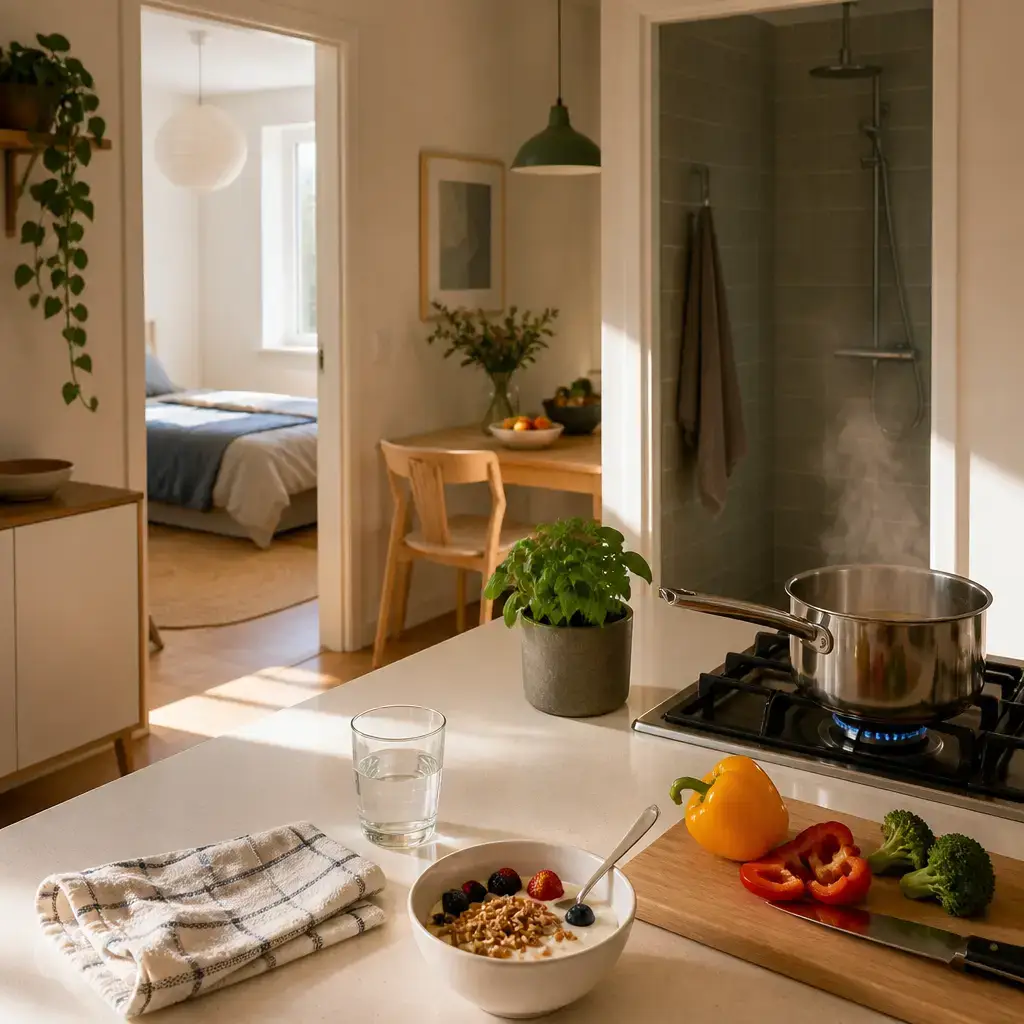
About This Lesson
Use Basic actions happening now to practice Danish conversation, pronunciation, vocabulary, grammar, and quizzes.
Dialogue
A
Hvad laver du?
vay LAIR-er doo? What are you doing?
B
Jeg spiser nu.
yai SPEE-er noo. I am eating now.
A
Jeg drikker vand.
yai DREG-er vahn(d). I am drinking water.
B
Jeg laver aftensmad.
yai LAIR-er AF-dn-smayth. I am making dinner.
A
Jeg gør mit værelse rent.
yai GUHR meet VAIR-luhs REN(d). I am cleaning my room.
B
Jeg tager et brusebad.
yai TAIR-er ay BROO-suh-bayth. I am taking a shower.Word by Word
Hvad
In Hvad laver du?, Hvad asks for information about what the other person is doing. It appears at the beginning of this direct question. Use it when asking for the thing, activity, or information involved.
laver
In Hvad laver du?, laver means doing; in Jeg laver aftensmad., it means making. Its meaning here depends on the surrounding words and situation. A useful reuse pattern is subject + laver + the activity or thing being made.
du
In Hvad laver du?, du means you and refers to the person being addressed. It is the person connected with the action in the question. Use it when speaking directly to one person.
Jeg
Jeg means I and identifies the speaker as the person carrying out the action. It begins the statements Jeg spiser nu., Jeg drikker vand., Jeg laver aftensmad., Jeg gør mit værelse rent., and Jeg tager et brusebad. A useful reuse pattern is Jeg + an action when reporting what you are doing.
spiser
In Jeg spiser nu., spiser means eating. Jeg identifies who is eating, and nu makes the timing explicit. Use this form when telling someone that you are eating, especially with food or a meal as the context.
nu
In Jeg spiser nu., nu means now and shows that the eating is happening at the current time. It comes at the end of this statement. Use it to make the timing of an action clear.
drikker
In Jeg drikker vand., drikker means drinking. The following word, vand, identifies what is being drunk. A useful reuse pattern is subject + drikker + a drink or liquid when telling someone what you are drinking.
vand
In Jeg drikker vand., vand means water and names what the speaker is drinking. It follows drikker in this sentence. Use it when talking about drinking water in an everyday situation.
aftensmad
In Jeg laver aftensmad., aftensmad means dinner and names the meal being made. It follows laver as the thing connected with the making action. Use it when saying that you are preparing the evening meal.
gør
In Jeg gør mit værelse rent., gør contributes to the meaning of making or getting something clean. The full expression means that the speaker cleans the room: gør supplies the action, mit værelse names what is affected, and rent describes the resulting state. A useful pattern is subject + action + object + rent.
mit
In Jeg gør mit værelse rent., mit means my and shows that the room belongs to or is associated with the speaker. It comes directly before værelse. Use mit before a thing you identify as yours when this form fits the following noun.
værelse
In Jeg gør mit værelse rent., værelse means room and is the thing being cleaned. It follows mit and comes before rent in the full expression. Use it when referring to a room in the home or another building.
rent
In Jeg gør mit værelse rent., rent means clean and describes the state of the room that the action produces. It completes the meaning of the cleaning expression with gør. A useful pattern is describing an object as rent after an action that makes it clean.
tager
In Jeg tager et brusebad., tager expresses the action of taking a shower. It works together with et brusebad as the everyday expression for this activity. Use it when telling someone that you are taking a shower.
et
In Jeg tager et brusebad., et introduces brusebad as one non-specific shower. It comes immediately before brusebad. Use it before a singular noun when this indefinite form is required.
brusebad
In Jeg tager et brusebad., brusebad means shower and names the activity taken by the speaker. It follows et in the expression. Use it when talking about showering in an everyday personal-care situation.
Grammar Points
Hvad + verb + du
Hvad laver du?
vath LAIR-er doo?What are you doing?
In Danish questions, the question word comes first, followed by the verb and then the subject.
mit + neuter noun
mit værelse
meet VAIR-luhsmy room
mit is the possessive form used with neuter nouns such as værelse.
Danish Vocabulary
aftensmad
noun
AF-dn-smayth
dinner
drikker
verb
DREG-er
drinking
du
pron
doo
you
gør
verb
GUHR
make; do
Hvad
pron
vath
what
Jeg
pron
yai
I
laver
verb
LAIR-er
doing; making
mit
det
meeth
my
nu
adv
noo
now
spiser
verb
SPEE-er
eating
vand
noun
vahn(d)
water
værelse
noun
VAIR-luhs
room
Quiz
Word Order
Arrange the words in the correct order.
What are you doing?
Show Answer
Hvad laver du?I am eating now.
Show Answer
Jeg spiser nu.I am drinking water.
Show Answer
Jeg drikker vand.Spelling
Tap the letters to spell the word.
what
Show Answer
Hvaddoing; making
Show Answer
lavereating
Show Answer
spiserdinner